 By st20113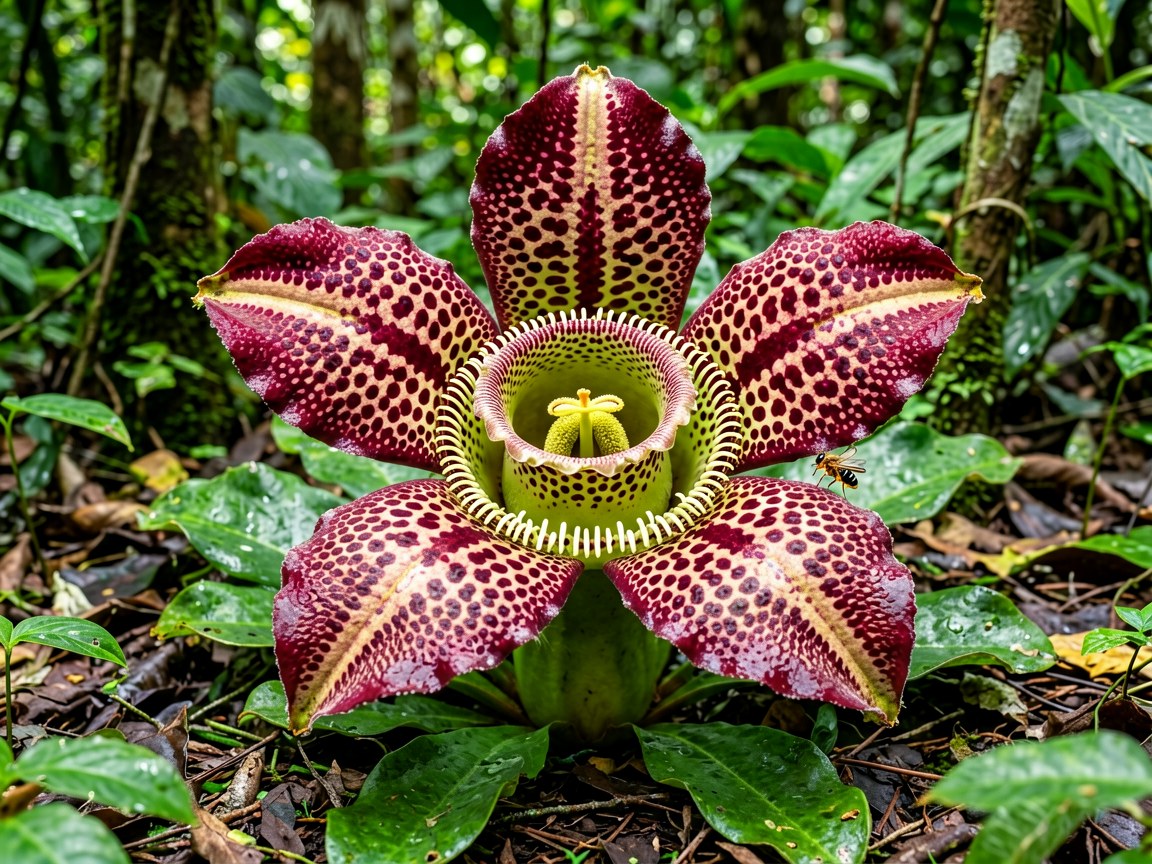
Rafflesia arnoldii | Corpse Lily
Introduction
Rafflesia arnoldii, commonly called the corpse lily or corpse flower, is a parasitic flowering plant native to the rainforests of Sumatra and Borneo. It produces the largest individual flower on Earth, a fleshy, five-lobed bloom that can measure more than one metre across and weigh up to 11 kilograms. The plant is famous for the overpowering odour of rotting flesh it emits to attract carrion flies, which serve as its pollinators. Unlike almost all other plants, R. arnoldii has no leaves, no stems, and no roots of its own; it lives entirely embedded within the tissues of a host vine. Its bizarre life history and enormous bloom have made it one of the most iconic and sought-after botanical wonders of Southeast Asia, and it is the official state flower of Indonesia’s Sabah and Surat Thani in Thailand.
Taxonomy
Rafflesia arnoldii is the type species of the genus Rafflesia, which sits in the family Rafflesiaceae alongside other rootless parasites such as Sapria and Rhizanthes. Despite its flower’s size, it is a true angiosperm and shares the basic floral plan of Rosa canina (Dog Rose) and every other flowering plant, though its evolutionary path has been radically altered by parasitism. Genetic studies place Rafflesiaceae close to the order Malpighiales, surprisingly near the violets. The genus is named after Sir Stamford Raffles, who led the expedition that first collected the plant for Western science, while “arnoldii” honours the botanist Joseph Arnold. More than twenty Rafflesia species are now recognised, but R. arnoldii holds the record for the biggest single flower.
Physical Characteristics
The most striking feature of Rafflesia arnoldii is its flower, a thick, leathery structure with five broad lobes surrounding a central cup-like chamber (the diaphragm) that can hold several litres of fluid. The bloom is reddish-brown with pale raised spots, and its surface is cool to the touch. There are no petals in the conventional sense; the five lobes are the fused perianth. The flower emerges from a cabbage-like bud that develops for many months inside the host vine before bursting open. Lacking chlorophyll, the plant’s body consists of strands of transcellular tissue threading through the host, so almost the entire organism is invisible. What we recognise as Rafflesia is, in effect, only its reproductive structure, which lasts only a few days before collapsing into a black slime.
Habitat
Rafflesia arnoldii grows in the humid lowland and hill rainforests of Sumatra and parts of Borneo, where its only host is a liana in the genus Tetrastigma, itself a relative of the grape vine. The parasite depends on primary forest with intact vine communities, because it cannot complete its life cycle without a living host and the shade these forests provide. It favours disturbed gaps and forest edges where the host vines grow vigorously, yet it disappears quickly when the canopy is cleared for agriculture or logging. Because the flower appears only briefly and unpredictably, and the vegetative body is hidden, populations are extremely difficult to survey, and the plant is easily lost in the early stages of deforestation before anyone notices its absence.
Populations are scattered through the lowland and hill forests of Sumatra, particularly in protected areas such as Bukit Barisan Selatan and Kerinci Seblat, and in northern Borneo around Sabah. The host Tetrastigma vines grow as understory lianas in well-drained, slightly acidic soils, so Rafflesia appears wherever these vines are common and the canopy is not too dense. It is notably absent from peat swamps and from heavily logged land, and it tolerates only modest disturbance, which is why secondary forests rarely host blooming plants. Seasonal fruiting of the host and the ants that tend its roots also influence where the parasite can establish, making suitable habitat a narrow intersection of vine, soil, and shade.
Diet
Rafflesia arnoldii is a holoparasite, meaning it obtains all of its food from another organism and makes none of its own sugar. It taps directly into the phloem of its Tetrastigma host vine, withdrawing water, minerals, and carbon compounds through specialised haustorial cells. The plant has no need for sunlight or soil nutrients of its own, which explains its lack of leaves and chlorophyll. In ecological terms it gives nothing back to the host and can weaken the vine, though a single infection is rarely fatal. Its “diet” is therefore entirely borrowed: every molecule in its giant flower was first manufactured by the host vine, a remarkable example of how far parasitism can reshape a plant’s body and lifestyle over evolutionary time.
Flowering is unpredictable and brief, which is why even researchers rarely witness it; a bud may form and then abort if conditions are wrong, and only a fraction of buds reach full opening. The male and female flowers are visually identical except on close inspection of the central column, so a pollinator must visit at least one of each sex, often on different plants metres apart, for any seed to set. Because carrion flies are weak fliers and the host vines are scattered, successful pollination is a chancy event, and many flowers close without producing seeds. The resulting seeds are tiny and numerous, but their exact dispersal agent is still debated; studies suggest tree shrews and small rodents eat the floral tissue and scatter the seeds, yet germination on a suitable Tetrastigma root has never been observed directly.
Reproduction
Rafflesia arnoldii has separate male and female flowers on different individual buds, so pollination requires a carrion fly to visit both. The flowers release a stench of decaying meat, reinforced by heat and dark coloration, to mimic a corpse and lure blowflies and flesh flies. A visiting fly picks up pollen from the central column of a male flower and transfers it to the receptive stigma of a female flower. If fertilisation succeeds, the female flower develops thousands of tiny, oily seeds that are thought to be spread when squirrels and tree shrews eat the flower tissue and defecate the seeds onto new host vines. The bud takes around nine months to mature, the open flower lasts only three to five days, and germination is so poorly understood that the plant has never been reliably grown from seed in cultivation.
Conservation
Rafflesia arnoldii is assessed as Endangered by the IUCN and is protected by law in Indonesia and Malaysia, yet enforcement is weak across much of its range. The greatest threat is habitat loss: logging, palm-oil plantations, and road building destroy both the host vines and the shade the parasite requires. Because the flower is a tourist draw, illegal poaching of buds and trampling by unguided visitors also damage fragile populations. Conservation efforts focus on protecting host-rich forest patches, training local guides so that ecotourism funds protection, and establishing community reserves. The plant’s cryptic lifestyle makes monitoring hard, so populations can vanish unnoticed, underscoring the need for habitat-level protection rather than attempts to conserve isolated flowers.
Fun Facts
- The corpse lily’s flower is the largest single bloom in the world, topping one metre in width.
- It smells like rotting flesh to attract carrion flies that pollinate it.
- The entire plant has no leaves, stem, or roots and lives hidden inside a host vine.
- A bud can take nearly nine months to develop before the flower opens for just a few days.
- Despite its size, R. arnoldii has never been successfully cultivated from seed by botanists.