 By st20113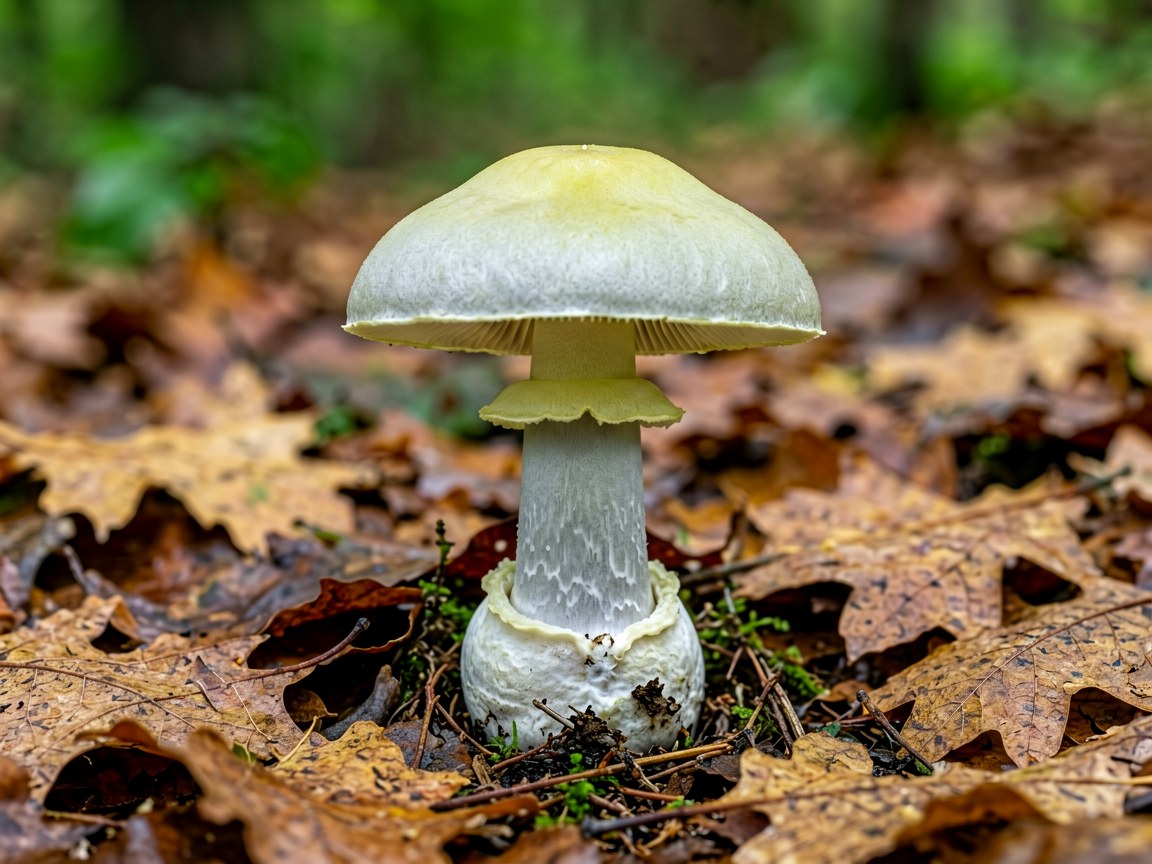
Amanita citrina | False Death Cap
Introduction
Amanita citrina, the false death cap, is a pale, sometimes faintly yellow-green mushroom of the summer and autumn woods, famous chiefly for resembling the deadly death cap yet being, by comparison, of little danger to eat. It is a member of the notorious genus Amanita, home to the world’s most poisonous toadstools, and it sits in the same group as the fly agaric and the death cap, but it is a smaller, quieter thing, with a smooth, pale cap that may carry a faint lemon tint and a thick, ringed, club-shaped stem. It grows on the ground in broadleaved and mixed woods, especially under beech and oak, and it is common across Europe and western Asia. The name “false death cap” warns the forager of the family resemblance while reassuring that this species lacks the lethal amatoxins of its infamous cousin, though it is still not worth eating. Like its relatives it is a woodland toadstool of autumn, and it belongs to the same gilled group as Amanita muscaria, the fly agaric, though it is far less showy.
Taxonomy
The false death cap is a basidiomycete in the family Amanitaceae, in the large and important genus Amanita, which includes the fly agaric, the death cap and the destroying angels. The genus name is thought to come from a word for a mountain or from the ancient Roman name for a mushroom, and the specific epithet citrina means “lemon-yellow,” referring to the faint yellow or greenish tint that some caps show. It is placed in the section Phalloideae along with the death cap and the destroying angels, a group defined by a bulbous stem base enclosed in a sack-like volva and by pale, often greenish caps, but the false death cap is set apart by its smell of raw potatoes and by the absence of the deadly amatoxins that make its relatives so feared. It was formerly known as Amanita mappa and is still found under that name in older books. The most dangerous confusion is with the true death cap, Amanita phalloides, from which it is told by the fainter colour, the potato smell, and the volva, which in the false death cap is a loose, sac-like bag at the base rather than the tight, cup-like sheath of the death cap. Positive identification of any Amanita is a matter of examining the base, the ring and the volva, and the false death cap is a good species on which to learn those features safely.
Physical Characteristics
The cap is five to ten centimetres across, at first rounded and later flat, smooth, and pale greyish-white to greenish-yellow, sometimes with a few scattered, soft fragments of the universal veil on the surface; the margin is smooth, not striated, and the centre may be slightly darker. The gills are free from the stem, crowded and white, and do not discolour. The stem is five to ten centimetres tall and one to two centimetres thick, white, with a membranous, pendulous ring partway down, and it arises from a swollen, bulbous base that is enclosed in a loose, sac-like, often lobed volva. The flesh is white and firm, and the whole mushroom smells distinctly of raw potato or radish when cut, a useful identification clue. The spore print is white, and the spores are round and smooth under the microscope. The combination of a pale, smooth, non-striated cap, a ringed stem, a bulbous volva-bearing base and a potato smell is distinctive, and the lack of a green, striated cap separates it from the death cap. Size and colour vary with age and weather, younger caps being more rounded and older ones paler.
Habitat
The false death cap is a fungus of summer and autumn that grows on the ground in broadleaved and mixed woodland, with a strong preference for beech and oak and other nemoral trees, and it is also found in parks, avenues and churchyards where such trees grow. It favours calcareous to neutral soils and is often seen among leaf litter in dry, open woods and along shady paths, fruiting from mid-summer into late autumn, sometimes in troops. It is a mycorrhizal species, partnering with the roots of trees to exchange nutrients for sugars, and it is therefore tied to living woodland rather than to dead wood or litter alone. Across Europe and western Asia it is common and widespread, and it has been introduced to other regions with planted trees. It is one of the more frequently encountered Amanitas on a woodland walk, and because it grows in the same places and season as the death cap, learning it is a practical safety measure for anyone gathering mushrooms. It avoids the wettest and most acid grounds and is a plant, in the fungal sense, of base-rich, well-drained woodland soils.
Diet
The false death cap is mycorrhizal, forming a partnership with tree roots through which it receives sugars made by the tree’s leaves and in return helps the tree take up water and mineral nutrients; its underground mycelium also explores the soil and helps to break down organic matter. It is not a parasite and not a decomposer in the simple sense, but a partner of the wood. As food for animals, the fruit bodies are little eaten, presumably because of their chemistry and their relative toughness, and they are mostly left to decay and release spores. For people the question is more serious by association: although the false death cap lacks the amatoxins of the death cap, it contains other compounds, including ibotenic acid in small amounts and compounds that can cause gastric upset, and it is considered inedible or at best risky, with a raw-potato taste that discourages the cook. The lesson it teaches is that in the genus Amanita, resemblance is not safety, and only expert examination of the base, ring and volva can separate the harmless from the fatal; this species is best admired and identified, not eaten.
Reproduction
As a basidiomycete, the false death cap produces its white spores on the gills, releasing them into the air when the weather is damp. The spores are carried by the wind to the soil, where they must meet a compatible mate and a suitable tree root to form the mycorrhiza that allows the fungus to fruit. Once established, the mycelium persists for years beneath its tree partners and produces caps annually through the late-summer and autumn season. The fruit bodies are short-lived and are often found in small groups or scattered troops, and the universal veil that covers the young mushroom splits to leave the ring on the stem and the volva at the base, features that are key to the genus. Because the fungus depends on living trees, its reproduction is bound up with the health of the woodland: a felled wood may fruit for a season or two on old mycelium but will not be recolonised once the roots decay. The white spore print and the ringed, volva-based base are the marks a forager learns to read before trusting any pale Amanita.
Conservation
The false death cap is common and widespread across its European and west Asian range and is not considered threatened; it is a regular and abundant fungus of beech and oak woods and a standard record on forays. Its populations are stable, and it tolerates plantation and parkland as long as its tree partners survive, so it is resilient in the managed landscape. It is not legally protected and no conservation action is aimed at it specifically. Its main ecological interest is as an indicator of broadleaved, base-rich woodland with intact mycorrhizal communities, and as a teaching species for the safe identification of Amanitas, a group where mistakes can be fatal. For public safety the message attached to it is the same as for the whole genus: never eat a mushroom with a ring and a bulbous, volva-bearing base unless an expert has named it with certainty, and treat the false death cap as a free lesson in how the deadly and the merely inedible can look alike.
Fun Facts
- It smells strongly of raw potato or radish when cut, a useful clue that separates it from the deadly death cap.
- The “citrina” refers to a faint lemon-green tint some caps show, though many are almost pure white.
- It has the classic Amanita safety features: a ring on the stem and a sack-like volva at the swollen base.
- Unlike the death cap, it lacks the amatoxins that make its cousin lethal, but it is still best not eaten.
- It is mycorrhizal with beech and oak, so it is a sign of living, healthy broadleaved woodland.