 By st20113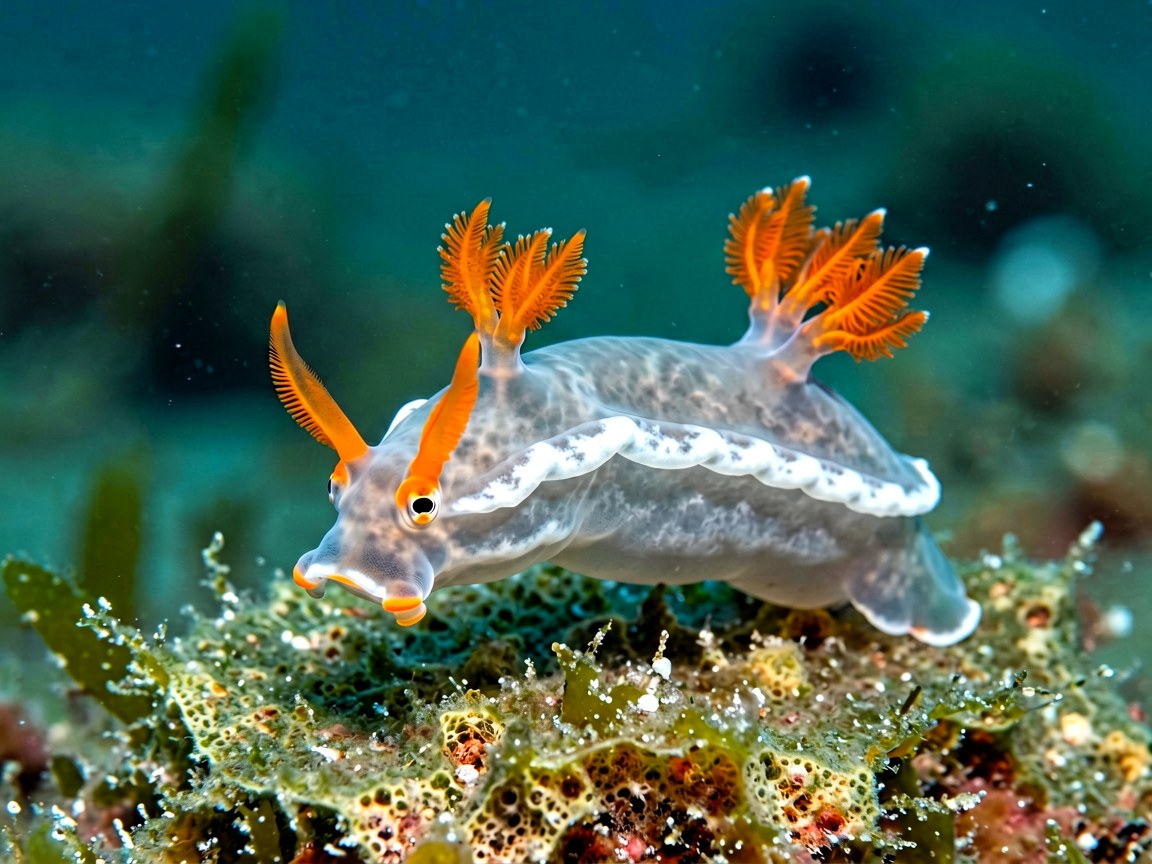
Facelina auriculata | Orange-tipped Facelina
Introduction
The orange-tipped facelina (Facelina auriculata) is a slender, handsome sea slug of rocky shores and shallow water, and although it is small it is one of the more striking nudibranchs of north-west European coasts. The body is translucent and tinged with purple or reddish-brown, and along the back it carries a series of clusters of long, tapering, finger-like processes, each one flushed with red or orange at the tip and ringed with white below; the head carries a pair of oral tentacles and a pair of ridged rhinophores tipped with the same bright orange. It lives on and among the hydroids it eats, and it is often found by divers and rock-pool naturalists who learn to look for the hydroid first and the slug second.
Taxonomy
Facelina auriculata is a gastropod mollusc and a member of the order Nudibranchia, the sea slugs, within the superfamily Aeolidioidea and the family Facelinidae, a large group of aeolid nudibranchs that feed on hydroids and other colonial animals. The aeolids are distinguished by the numerous finger-like processes, or cerata, on their backs, and by the absence of the gill rosette seen in the dorid nudibranchs: in their place, the cerata themselves do the work of breathing. The genus name refers to the small, face-like area at the front of the body, and the specific epithet auriculata means “eared” or “with small ears”, a reference to the shape of the head tentacles or of the rhinophores. It is a mollusc in the same broad group as Octopus vulgaris, though the two are separated by a great deal of evolutionary distance: the octopus is a cephalopod, whereas this is a snail that has lost its shell entirely and taken to a soft-bodied, creeping life.
Physical Characteristics
The body is slender, tapering, and elongated, usually up to about three centimetres long, with a long, pointed tail and a somewhat rounded head. The ground colour is translucent whitish to pale grey, typically overlaid with a purple, reddish, or brownish flush that is strongest on the back and on the sides of the head, and there are often scattered pale or white specks. Along each side of the back there are five to eight clusters, or rows, of cerata: long, smooth, tapering, finger-like processes, each of which is flushed at the tip with bright orange to red and has a distinct ring of white or opaque cream just below the tip. The head carries a pair of long, slender, tapering oral tentacles, and above them a pair of rhinophores — club-shaped in some related species but here usually smooth, wrinkled, or with faint oblique ridges — which are tipped with the same bright orange and are often tipped with white as well. There is no gill rosette, and the anus opens on the side of the body among the cerata. The foot is narrow, with a slightly expanded, rounded front end.
Habitat
It lives on rocky shores and in shallow sublittoral water, down to depths of thirty metres or more, and it is found among seaweed, on the stipes and holdfasts of kelp, on rocks, under stones, on vertical faces, and on the bottoms of boats and floating structures, wherever its hydroid prey grows. It is particularly associated with the feather-like hydroids that form soft, bushy tufts on rock and weed, and it is most often found directly on or beside a colony. It occurs in the north-eastern Atlantic from Norway and the British Isles south to the Mediterranean and north-west Africa, and it is found all around the coasts of Britain and Ireland, though it is local and more often recorded in the south and west. It is present through much of the year but is most often noticed in spring and summer, when the hydroid colonies are at their best.
Diet
It is a specialist predator of hydroids, the small colonial animals related to sea anemones and jellyfish that form delicate, branching, feather-like tufts on rock, seaweed, and shells. It feeds by rasping at the colony with its radula, tearing open the little feeding polyps and drawing out the soft contents, and different individuals and populations often show a preference for particular hydroid species. Hydroids are armed with stinging cells, or nematocysts, and the remarkable thing about the aeolid nudibranchs is what they do with them: rather than digesting them, the slug passes the unfired stinging cells through special branches of the gut into the tips of its cerata, where they are stored in little sacs, the cnidosacs, and held ready for use. A fish that bites a ceras gets a dose of the hydroid’s own stinging cells, and this theft of weapons, known as kleptocnidy, is one of the most extraordinary defences in the sea.
Reproduction
Like all nudibranchs it is a hermaphrodite, and two individuals mate and exchange sperm reciprocally, storing it internally until the eggs are ready to be fertilised. Spawning occurs in spring and summer, and the eggs are laid in a thin, gelatinous, thread-like ribbon, usually wound in an irregular coil or a series of loops and attached to the hydroid, seaweed, or rock on which the adult is feeding. The ribbon contains many small eggs, and development proceeds through a veliger larva which spends some time in the plankton before settling and metamorphosing into a small slug. The planktonic stage allows the species to find new hydroid colonies and to colonise new ground, and since the adults are short-lived and their food is patchy and seasonal, this dispersal is essential. Adults probably live for less than a year, and many die after spawning.
Conservation
The species is local rather than abundant and is not considered globally threatened, but it is not one of the commoner sea slugs, and it is probably under-recorded because of its small size and because it lives among hydroids, where it is well camouflaged. Its fortunes follow those of the hydroid colonies it depends on, which need clean, well-lit, hard surfaces and reasonably strong water movement, and which are reduced by sedimentation, by nutrient enrichment that favours fast-growing smothering algae, and by physical disturbance of the seabed. Because it is a specialist feeder, it cannot switch to an alternative food when its particular hydroids disappear, and this makes it a sensitive indicator of the condition of weedy and hydroid-rich rock. Recording by divers and rock-pool naturalists contributes much of what is known about its distribution.
Fun Facts
- It steals the stinging cells from the hydroids it eats and stores them in the tips of its own cerata for defence.
- The cerata are flushed bright orange at the tip with a white ring beneath, which gives it its name.
- It has no gill rosette; the finger-like cerata along its back do the breathing instead.
- It is a hermaphrodite, and pairs exchange sperm rather than one acting only as male or female.
- The eggs are laid in a fine, gelatinous thread coiled among the hydroids it feeds on.