 By st20113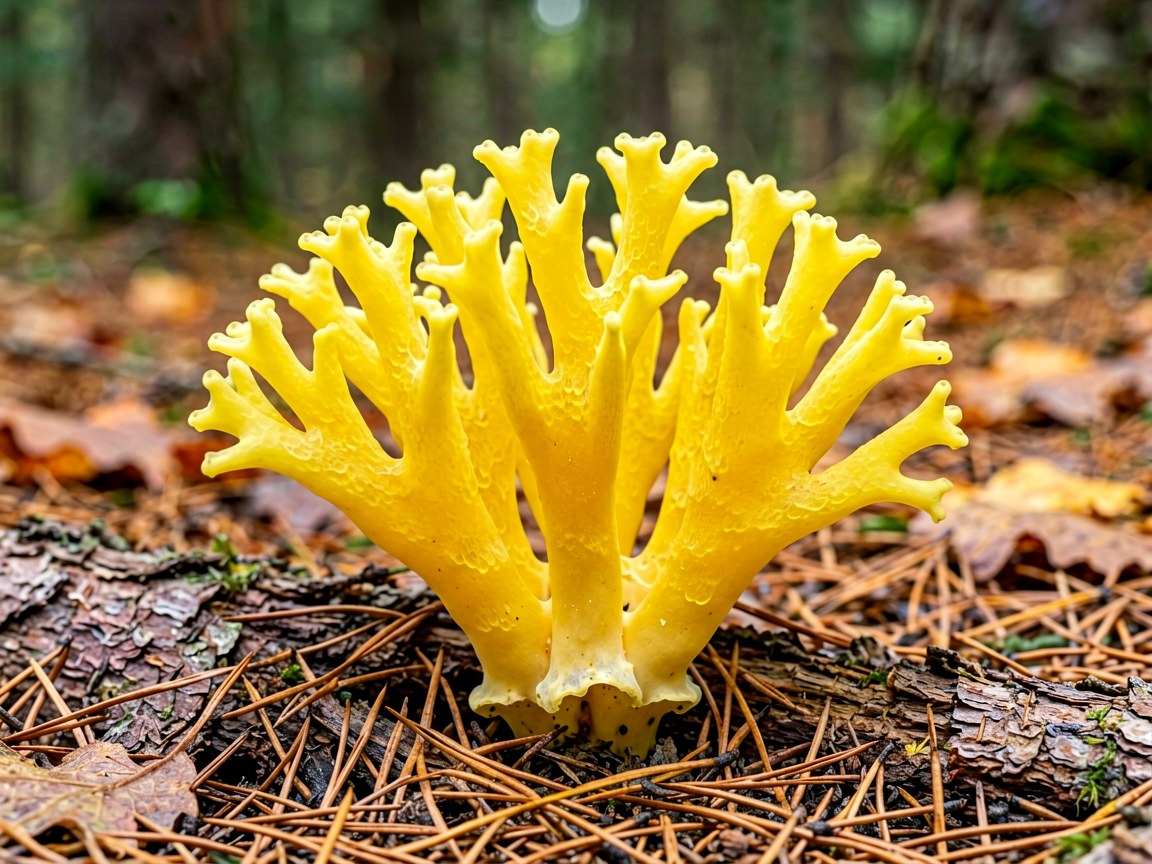
Calocera viscosa | Yellow Stagshorn
Introduction
The yellow stagshorn (Calocera viscosa) is one of the most cheerful and unmistakable fungi of conifer woodland, a small, bright golden-yellow, jelly-like structure that rises from buried pine wood in a tuft of upright, flattened, repeatedly forking branches, like a tiny set of antlers or a handful of yellow coral. It is firm and gelatinous rather than soft, with a slightly sticky, greasy feel, and it appears in dense clusters on and around pine stumps, buried roots, and wood chips in autumn. Despite the coral-like shape it is not a coral fungus in the usual sense but a jelly fungus whose relatives include the small, simple, club-shaped species that grow on wood in rows. It is one of the easiest fungi to identify with confidence, since nothing else in the conifer woods is both bright yellow and branched in this way.
Taxonomy
Calocera viscosa is a basidiomycete in the class Dacrymycetes and the family Dacrymycetaceae, the jelly fungi with forked basidia, a group quite separate from the Tremella jelly fungi despite the similar consistency. Its relatives include the small, unbranched, orange-yellow club of Calocera cornea, which grows on damp worked timber, and the various small, cushion-like Dacrymyces species. The genus name means “beautiful horn”, and the specific epithet viscosa means “sticky”, a reference to the slightly greasy surface. As a basidiomycete it produces its spores externally on club-shaped basidia, as does Amanita muscaria, but the basidia of this group are distinctively forked into two long, curved arms like a tuning fork, and the spores are borne one at the tip of each arm — a characteristic that gives the whole class its name.
Physical Characteristics
The fruit bodies are upright, cylindrical, and repeatedly branched, usually two to six centimetres tall, arising in tufts of several to many individuals from a common, buried base. Each is flattened rather than round in section, tapering towards the tips, and it divides two or three times into a small, antler-like or coral-like structure with blunt to slightly pointed, often slightly twisted branches. The whole thing is a bright, clear golden-yellow to deep egg-yolk yellow, sometimes slightly more orange when young and fading to a duller orange or ochre with age, and the surface is smooth, slightly shiny, and distinctly sticky or greasy to the touch. The flesh is firm, tough, and gelatinous — rubbery rather than soft, and able to bend considerably without breaking, which distinguishes it from the brittle coral fungi. It shrinks and hardens in dry weather and revives after rain. The spores are elongated, smooth, and become divided by one to three cross-walls as they mature, and the spore print is pale yellow to ochre.
Habitat
It grows on dead conifer wood, and above all on pine: on stumps, on buried roots and logs, on wood chips and sawdust, and on worked timber, and it is one of the characteristic fungi of pine plantations and of the sandy, acid ground where pine is grown. It is most often seen apparently growing from the soil or from among needle litter, but it is always attached to buried wood beneath. It is also recorded on spruce and larch, and occasionally on other conifers. It grows in woodland, in plantations, on heathland, in parkland, and on any pile of conifer wood chips, and it fruits from late summer into autumn, sometimes in large numbers. The species is widely distributed through the temperate northern hemisphere, in Europe, Asia, and North America, and it is common throughout Britain and Ireland wherever pine is planted.
Diet
It is a saprotroph and a brown-rot fungus, decomposing the dead wood of conifers and breaking down the cellulose while leaving the lignin largely intact, so that the attacked timber becomes brown, dry, and crumbly and cracks into small cubes. It is one of the significant decomposers of conifer debris in plantation forestry, and because it colonises stumps and buried roots, it does much of its work out of sight; the antler-like fruit bodies appear above ground wherever the buried wood comes close to the surface. Its ability to fruit on small pieces of wood, on wood chips, and on sawn timber makes it one of the most successful fungi of plantation forestry, and it is often abundant on the chip beds and stump fields left after felling. In this way it performs a quiet but essential service, returning the carbon and minerals locked in conifer timber to the soil for the next generation of trees. It is not a parasite of living trees.
Reproduction
The spores are produced over the whole surface of the branches, on the characteristic tuning-fork basidia, and are released into the air; they germinate on suitable dead conifer wood and give rise to a mycelium that spreads through it. Compatible mating types must meet before the fungus can produce fruit bodies, and once established the mycelium can persist in a stump or a buried root for years, fruiting whenever the weather is damp and mild. The fruit bodies themselves are tough and gelatinous and are well adapted to survive the fluctuating conditions of autumn: they lose water and shrink in dry spells and take it up and swell again when it rains, so a single individual can produce and release spores over a long period rather than in one brief flush. Spore production continues from the tips of the branches downwards as the season advances.
Conservation
The species is common, widespread, and not threatened, and it is one of the fungi that has clearly benefited from commercial conifer forestry, since pine plantations, stump fields, and wood-chip beds provide ideal conditions for it. It is abundant in most pine-growing districts and is one of the more conspicuous fungi of autumn in plantation woodland. Because it depends on dead conifer wood, it declines where stumps are removed, where wood is chipped and taken away, and where plantations are cleared without leaving debris, but it is resilient and quickly recolonises any new supply of chips or buried timber. It is frequently recorded in fungal surveys and is a standard species for beginners to learn, both because it cannot be confused with anything else and because it demonstrates the jelly fungus body plan and the forked basidium so clearly. There are no dangerously poisonous look-alikes in its habitat, since the only other brightly coloured, branched fungi of conifer woods are themselves either jelly-like or clearly different in colour, so the yellow stagshorn is a safe and satisfying fungus for novices to put a name to on their first autumn walk.
Fun Facts
- The forked basidia look like tiny tuning forks, each arm carrying a single spore.
- It is firm and gelatinous rather than soft, and it can be bent without breaking.
- It fruits on buried pine wood, so it often looks as though it is growing from the soil.
- It shrivels in dry weather and swells back to full size after rain.
- It thrives on wood chips and plantation stumps, and is commoner in planted pine woods than in native woodland.