 By st20113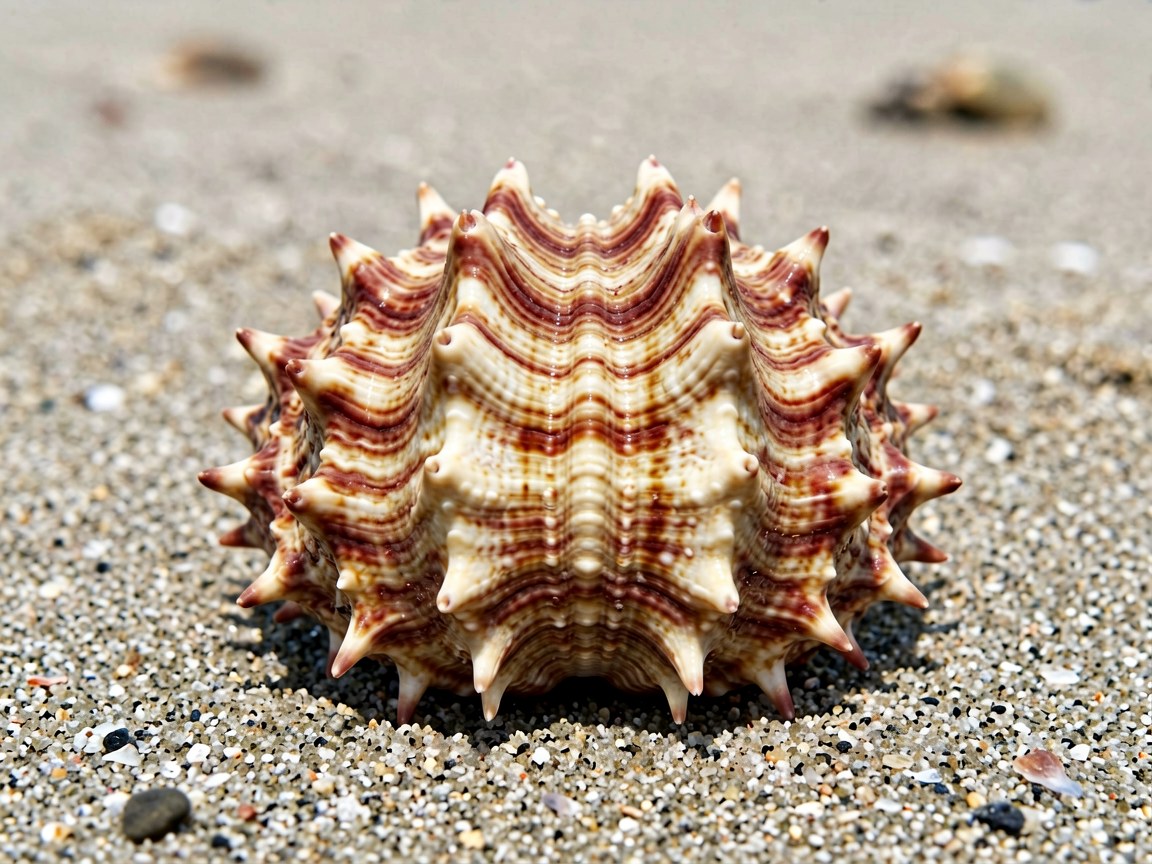
Acanthocardia echinata | Prickly Cockle
Introduction
The prickly cockle (Acanthocardia echinata) is a stout, heart-shaped shellfish of sandy and gravelly seabeds, and unlike the familiar edible cockle of sandy beaches its shell is armed with a row of short, curved, thorn-like spines along each of the radiating ribs. The effect is a distinctly prickly, almost burr-like shell, quite unlike any other bivalve in northern waters, and one that is easy to recognise even when worn. The shell itself is thick, solid, and handsomely marked with concentric bands of cream, fawn, and brown, and it is a familiar object in the strandline after storms, though live animals are rarely seen because they live buried well below the low water mark. It is one of the largest and heaviest of the European cockles, and a good one can be five centimetres or more across.
Taxonomy
Acanthocardia echinata is a bivalve mollusc in the family Cardiidae, the cockles, a large and familiar family of burrowing, suspension-feeding bivalves found in sandy sediments all over the world. Its relatives include the common edible cockle Cerastoderma edule, the lagoonal cockle Cerastoderma glaucum, and the spiny cockles of warmer seas. The genus name combines the Greek for “thorn” or “spine” with kardia, meaning heart, and so means “thorny heart”, which is exactly what the shell looks like in outline; the specific epithet echinata means “spiny” or “prickly”. As with other cockles, the two valves are equal, inflated, and heart-shaped when seen from the side, with a strongly toothed hinge and a powerful, bent foot. Like other suspension-feeding bivalves such as Mytilus edulis, it feeds by pumping water over its gills, though the mussel lives attached to rock while this is a burrower in sediment.
Physical Characteristics
The shell is solid, thick, and strongly inflated, almost globular, and distinctly heart-shaped in side view with prominent, forward-curving umbones, or beaks; it reaches four to six centimetres in length and is nearly as deep as it is long. There are eighteen to twenty-two strong, radiating ribs, and each rib carries along its crest a single row of short, stout, curved, thorn-like spines, which are longest and sharpest towards the front and the margins of the shell and are often worn away in older or beach-worn specimens. Between the ribs the surface is covered with fine concentric ridges. The colour is a handsome pattern of concentric bands and blotches in cream, fawn, yellowish-brown, and reddish-brown, usually with the young shell paler and more distinctly banded. The inside is white, often stained with reddish-brown or purple towards the umbones, and the margin is strongly and regularly toothed, interlocking tightly when the shell is closed. The hinge carries two cardinal teeth and well-developed lateral teeth. The animal has two short siphons, which are separate rather than fused, and a large, powerful, bent foot with which it burrows very rapidly.
Habitat
It lives buried in clean sand, shelly sand, gravel, and muddy gravel, from the extreme low water mark down to depths of a hundred metres or more, and it is most abundant offshore on the coarser sediments of the continental shelf. It burrows just below the surface, usually no more than a few centimetres deep, extending its short, separate siphons up into the water above, and it can rebury itself very rapidly when uncovered. It is intolerant of low salinity and of heavy silt, and it is absent from estuaries and from very fine mud. The species is distributed in the eastern Atlantic from Norway and Iceland south to west Africa and into the Mediterranean, and it is found all around the coasts of Britain and Ireland, though because it lives below the tide marks it is known to most people only from its empty shells.
Diet
Like all cockles it is a suspension feeder. Water is drawn in through one siphon, passed over the gills, where cilia and mucus trap the suspended particles, and expelled through the other; the gills sort the material by size and weight, and cilia carry the edible fraction to the labial palps and the mouth while the rejected material is bound into mucus and ejected as pseudofaeces. The diet consists of phytoplankton — diatoms, dinoflagellates, and other microscopic algae — together with bacteria, the spores and gametes of other organisms, organic detritus, and the larvae of various animals that drift with the current. Because it lives in relatively coarse, clean sediment rather than in rich mud, the concentration of food in the water it draws in is lower than in estuarine situations, and the animal compensates by pumping a larger volume. Feeding continues year-round but slows markedly in winter. The spines are thought to serve several purposes: they may help to anchor the shell in coarse sediment so that the animal is not rolled about by currents, they make the shell harder for a crab or a fish to swallow, and by raising the surface of the shell slightly above the sediment they may help to keep the inhalant opening clear of sand.
Reproduction
The sexes are separate, with males and females looking alike, and reproduction is by broadcast spawning: sperm and eggs are released into the open water, usually in spring and summer, and fertilisation takes place in the plankton. Spawning is often synchronised across a population, triggered by rising temperature and probably by the presence of gametes in the water. Development follows the standard bivalve sequence of a trochophore larva and then a veliger, which swims and feeds in the plankton for a period of weeks before settling onto suitable coarse sediment and metamorphosing into a tiny cockle. The spines on the shell begin to develop early and are thought to help anchor the young animal in the sediment and possibly to deter small predators. Growth is slow, and the species is long-lived for a cockle, with individuals thought to reach ten years or more, which makes populations slow to recover from depletion.
Conservation
The species is widespread and locally abundant and is not considered globally threatened, but it is vulnerable to the same pressures as other animals of coarse offshore sediment, and in particular to bottom trawling and dredging, which disturb the surface layers, damage the animals directly, and can remove or scatter the gravel and shell that the species needs. Aggregate extraction is a further local threat, as is the general degradation of the seabed by repeated towed fishing gear. Because it is slow-growing and long-lived, recovery from disturbance is slow, and beds that have been heavily worked may take many years to return to their former state. The empty shells are collected and sold, and the animal is occasionally taken for food, but it is of modest commercial importance compared with the edible cockle.
Fun Facts
- Each rib carries a row of short, curved, thorn-like spines, which makes the shell unmistakable.
- The shell is heart-shaped and strongly inflated, almost globular.
- It lives below the low water mark, so most people know it only from empty shells washed up on the beach.
- It can rebury itself in sand within seconds of being uncovered.
- It is slow-growing and long-lived for a cockle, which makes it slow to recover from seabed disturbance.