 By st20113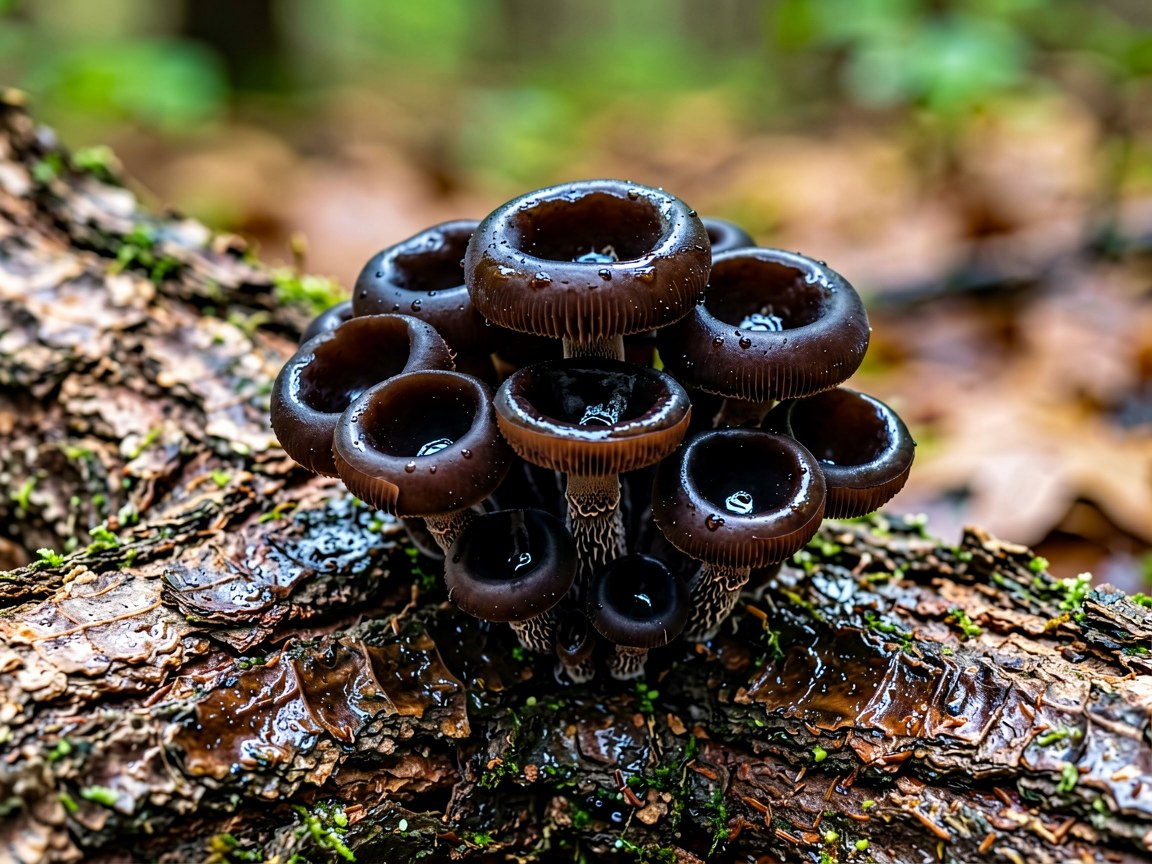
Bulgaria inquinans | Black Bulgar
Introduction
The black bulgar (Bulgaria inquinans) is a small, glossy, dark chocolate-brown to black fungus that grows in clusters on the bark of freshly fallen oak and other broadleaf timber, and it is one of the most tactile fungi there is. Young specimens are closed, rounded, top-shaped, and slightly wrinkled, looking like little blackcurrants or dark buttons pressed into the bark; as they mature they open out into shallow, slightly irregular cups with a glossy, almost liquid-looking inner surface, and they pass through a stage in which they are unmistakably rubbery and jelly-like to the touch. A finger pressed on a mature specimen leaves a visible mark, and the whole thing feels rather like a firm, dark jelly. It is common, easy to recognise, and a reliable sign of recently dead oak.
Taxonomy
Bulgaria inquinans is an ascomycete, a member of the phylum Ascomycota, placed in the order Phacidiales or, in some classifications, in the Leotiales or Helotiales, and in the family Bulgariaceae. It is a discomycete, one of the cup fungi, though unlike the bright orange cup fungi of soil and gravel it is dark, tough, and gelatinous. The genus name refers to the swollen, sack-like form of the fruit body, and the specific epithet inquinans means “staining” or “defiling”, a reference to the dark, inky stain that the fungus leaves on the hands and on the bark it grows on. As a sac fungus it produces its sexual spores inside elongated asci, usually eight per ascus, rather than externally on basidia as the mushrooms such as Amanita muscaria do, and the asci are packed together over the inner surface of the cup, where they can discharge their spores freely into the air.
Physical Characteristics
The fruit bodies are small, typically one to four centimetres across and one to two centimetres tall, and they usually appear in dense clusters of a dozen or more on the same piece of bark. Each begins as a closed, rounded, top-shaped or turbinate lump, narrowing to a short, thick, wrinkled, stalk-like base, and the outer surface is dull, dark brown to blackish, finely velvety or slightly scurfy, and often marked with small wrinkles or warts. As the specimen matures, the top flattens and then opens out into a shallow, rounded cup, sometimes irregularly lobed or wavy, revealing the inner, spore-bearing surface, which is smooth, shining, and a rich dark chocolate-brown to almost black, with a glazed, varnished, slightly sticky look. The flesh is dark brown and distinctly rubbery and gelatinous — firm enough to hold its shape when squeezed, springy rather than brittle, and able to survive being squashed and released. In dry weather the fruit bodies shrivel and harden into dark, shrivelled lumps, and they swell back to their full, glossy form after rain. The spores are dark brown, smooth, elliptical, and the spore print is effectively black.
Habitat
It grows on the bark of dead and fallen broadleaf timber, most characteristically on oak, and especially on freshly fallen logs, branches, and trunks that still have their bark attached and are in the early stages of decay. It is also recorded on beech, ash, hazel, and other hardwoods, and it occasionally appears on sawn timber, on stacked logs, and on wood that has been dead only a few months. It favours damp, shaded situations and is most abundant in autumn and early winter, though the shrivelled remains persist for a long time afterwards. The species is widely distributed across the northern hemisphere, in Europe, Asia, and North America, and it is common throughout Britain and Ireland wherever there is dead oak. It is one of the fungi to look for on any recently fallen oak trunk in autumn.
Diet
The black bulgar is a saprotroph, and it is one of the early colonisers of newly dead hardwood, appearing on bark while the wood beneath is still comparatively sound. It is usually described as a weak or non-lignin-degrading decay organism: rather than attacking the structural tissue of the trunk, it lives principally in and on the bark, obtaining its nutrients from the readily available sugars, starches, and other soluble materials in the bark and in the outer sapwood, and from material already partly broken down by bacteria and by other fungi. It therefore occupies a particular niche in the succession of decay, coming in early, exploiting the easy resources, and then disappearing as more aggressive fungi take over the wood. Its gelatinous texture is an adaptation to this lifestyle: the jelly holds water, allowing the fungus to keep functioning through dry spells that would stop a thinner, drier fruit body. The dark pigment in the outer layers, the same melanised material found throughout the group, offers further protection, making the fruit body resistant to drying, to ultraviolet light, and to attack by other microbes, so that it can persist on the bark for month after month in a way that a softer, paler fungus could not.
Reproduction
The spores are produced inside the asci that line the glossy inner surface of the open cup. When the spores are mature, the tip of each ascus opens and the spores are shot out, and because the asci are packed tightly together across the whole surface of the cup and fire more or less in unison, a group of moist, mature fruit bodies can release a visible cloud of dark spores when disturbed or when the humidity changes. This synchronous discharge is the reason the fungus opens into a cup at all: the cup shape directs the spores upward and outward into the moving air rather than trapping them. The spores are then carried by wind to new dead timber. Once on suitable bark, they germinate into a mycelium that spreads through the outer layers. The fruit bodies appear in autumn and persist in a shrivelled state through dry weather, reviving and continuing to release spores whenever conditions become damp again.
Conservation
The species is common, widespread, and not threatened, and it is one of the fungi that does well in ordinary managed woodland, parkland, and even gardens, provided that some dead hardwood with its bark is left lying about. It is a familiar and easily learned species and is regularly recorded in autumn fungal surveys. Its presence is a good indicator that recently dead timber is being retained on a site, since the fungus needs bark that is still attached and wood that is only a season or two dead, and it disappears quickly if fallen timber is removed, chipped, or burnt soon after it comes down. Leaving logs and branches where they fall, particularly oak, is enough to maintain it almost anywhere.
Fun Facts
- The fruit bodies feel like firm, dark jelly and can be squeezed and will spring back into shape.
- They grow most often on freshly fallen oak with the bark still attached.
- The name inquinans means “staining”, because the fungus leaves a dark inky mark on whatever touches it.
- Mature cups can release a visible cloud of dark spores when disturbed.
- Like other jelly-like fungi it shrivels in dry weather and swells back to full size after rain.