 By st20113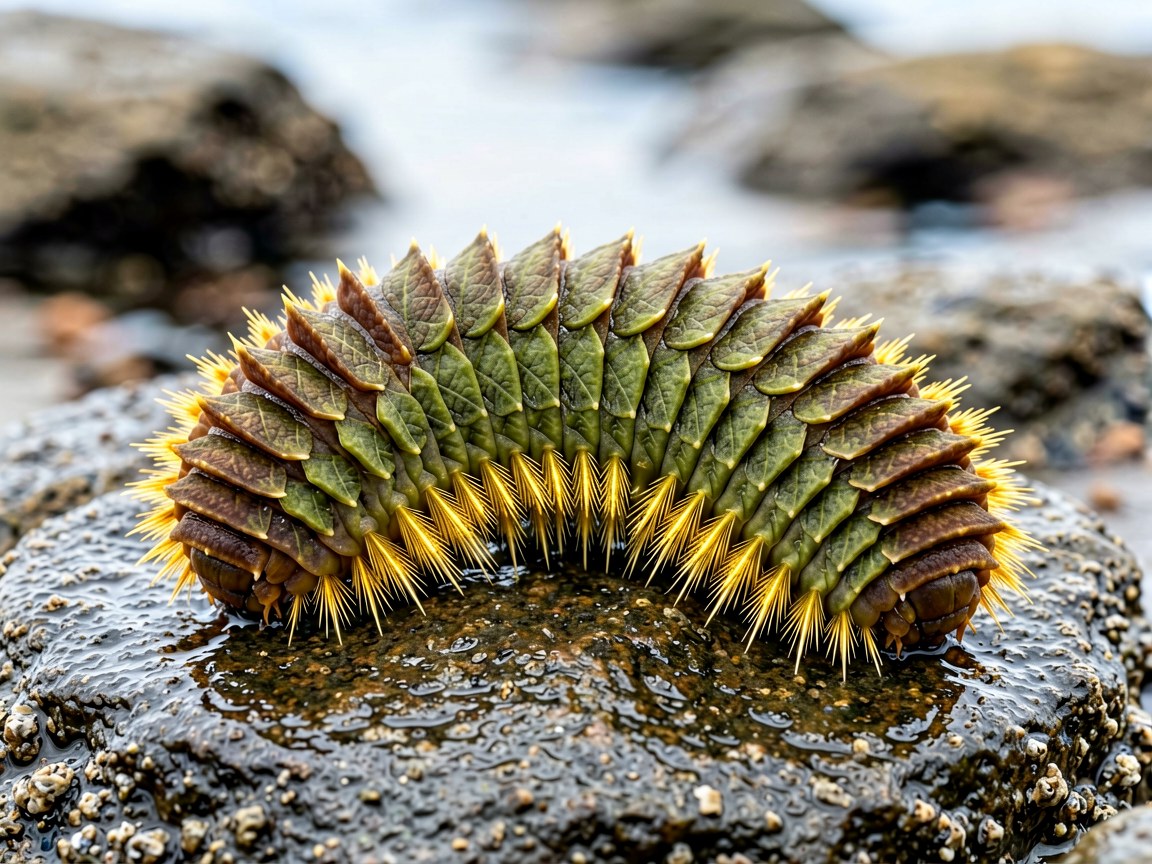
Harmothoe imbricata | Fifteen-scaled Worm
Introduction
The fifteen-scaled worm (Harmothoe imbricata) is one of the commonest and most attractive of the scale worms, a broad, flattened, bristle-bearing annelid that lives under stones and among seaweed holdfasts on almost every rocky shore. Its back is covered with fifteen pairs of overlapping, leaf-like scales, arranged like the tiles of a roof and giving the animal a neat, armoured, slightly glittering appearance; if the scales are carefully lifted, the softer, often iridescent back beneath is revealed. It is a predator, hunting small invertebrates in the dark, damp world beneath stones and in the tangled roots of seaweed, and it moves quickly on its many pairs of bristle-tipped paddles. Anyone who turns over a stone low on a rocky shore is very likely to find one, curled up or scuttling for shelter.
Taxonomy
Harmothoe imbricata is an annelid worm, a member of the class Polychaeta, the bristle worms, and it belongs to the family Polynoidae, the scale worms, a large and widespread group found in all the world’s seas from the shore to the deep ocean. The family is characterised by the paired scales, or elytra, that cover the back, and by the numerous bristles, or chaetae, borne on the paddle-like appendages of each segment. The genus name Harmothoe comes from a sea nymph of Greek myth, and the specific epithet imbricata means “overlapping like tiles”, which is precisely what the scales do. Its relatives include the larger and more conspicuous Harmothoe fragilis and the various species of Lepidonotus found on similar shores. It is a polychaete rather than an earthworm or a leech, but it is an annelid in the same broad group as Lumbricus terrestris, sharing the fundamental body plan of a long series of similar segments, each with its own bristles, muscles, and nerve supply.
Physical Characteristics
The body is short, broad, and flattened from above, typically two to five centimetres long and made up of about thirty-five to forty segments, and it tapers gently towards the rear. The upper surface is completely hidden by fifteen pairs of rounded, leaf-like or kidney-shaped scales, which overlap one another from front to back like roof tiles and are usually brownish, greyish, olive, or greenish, often with a paler centre and a fringe of small papillae around the edge; underneath them the back is soft, smooth, and often strikingly iridescent. The head bears two pairs of eyes, a central antenna, a pair of lateral antennae, and a pair of palps, all of which are short and stout. Each body segment carries a pair of paddle-like parapodia — fleshy, biramous appendages fringed with numerous stiff, golden or colourless bristles — and a pair of slender, thread-like sensory cirri that project sideways beyond the scales. The underside is paler and carries the many small, pointed, muscular structures by which the worm grips. When disturbed, the animal can curl into a tight ball with the scales on the outside, or it can shed part of its body to escape.
Habitat
It lives on rocky shores and in shallow sublittoral water, under stones and boulders, in crevices, among the holdfasts and tangled bases of seaweed, in empty barnacle shells and worm tubes, beneath the shells of mussels and limpets, and in the dense mats of algae and sediment that accumulate in damp hollows. It favours places that stay damp and dark at low tide, and it avoids exposure to direct sun and to drying air. It is tolerant of a wide range of salinities and temperatures and is found from the middle of the shore down to depths of several hundred metres. The species has a very wide distribution, occurring throughout the Arctic and the North Atlantic, in the North Pacific, and in the seas around northern Europe, and it is common and widespread around all the coasts of Britain and Ireland. It is one of the most familiar animals of the shore to anyone who turns over stones.
Diet
The fifteen-scaled worm is a predator and a scavenger. It hunts small invertebrates among the crevices and sediment beneath stones: other worms, small crustaceans such as amphipods and young barnacles, molluscs, and the larvae of various animals are all taken, and it will also feed on any dead or dying animal it finds and on the organic matter in the fine sediment that collects in hollows. It seizes prey with a pair of stout, hooked jaws on an eversible pharynx, which it can thrust out rapidly from the mouth to grasp and pull in food. Feeding takes place mostly at night and when the animal is covered by the tide, and the worm spends the hours of low water sheltering in its damp retreat. It is itself eaten by fish, by crabs, and by larger worms, and the tough, overlapping scales and the ability to curl into a ball are both thought to be defences against such predators.
Reproduction
The sexes are separate, and the males and females look much alike. Reproduction is seasonal in most populations, with spawning in spring and summer, and the eggs and sperm are released into the sea, where fertilisation takes place. The eggs are small and are either shed freely into the water or, in some populations, retained for a time beneath the scales of the female, where the developing young are protected for a short period before being released. The larva is a trochophore, a small, top-shaped, ciliated creature that swims in the plankton and feeds before settling onto the shore and metamorphosing into a young worm. Settlement is followed by rapid growth, and the characteristic scales and bristles appear early in development. The animals probably live for two or three years. Like many polychaetes, the worm is capable of regenerating lost segments, and specimens with a partly regenerated rear end are common, the result of a narrow escape from a predator.
Conservation
The species is abundant, extremely widespread, and not threatened, and it is one of the standard members of the fauna of rocky shores and of shallow sublittoral sediments across the northern hemisphere. Its abundance makes it a useful and frequently recorded species in shore and seabed surveys, and it is one of the animals most often encountered in intertidal monitoring. It is tolerant of a good deal of disturbance and of reduced salinity, and it persists in harbours and in moderately polluted conditions where more sensitive species disappear, which is why it is not usually regarded as an indicator of high-quality habitat. Local populations are affected by the same pressures as the rest of the shore fauna — oil spills, contamination, the removal of stones and seaweed, and the physical disturbance of the seabed — but the species recolonises quickly because of its planktonic larva and its broad tolerance.
Fun Facts
- The fifteen pairs of overlapping scales on its back look like the tiles of a roof.
- Lift the scales and the back beneath is often brightly iridescent.
- It hunts with a pair of hooked jaws that it can shoot out from its mouth to grab prey.
- It can curl into a tight ball with the scales outermost when disturbed, and can shed part of its body to escape.
- It is one of the commonest animals under stones on any rocky shore, and is found from the shore to depths of hundreds of metres.