 By st20113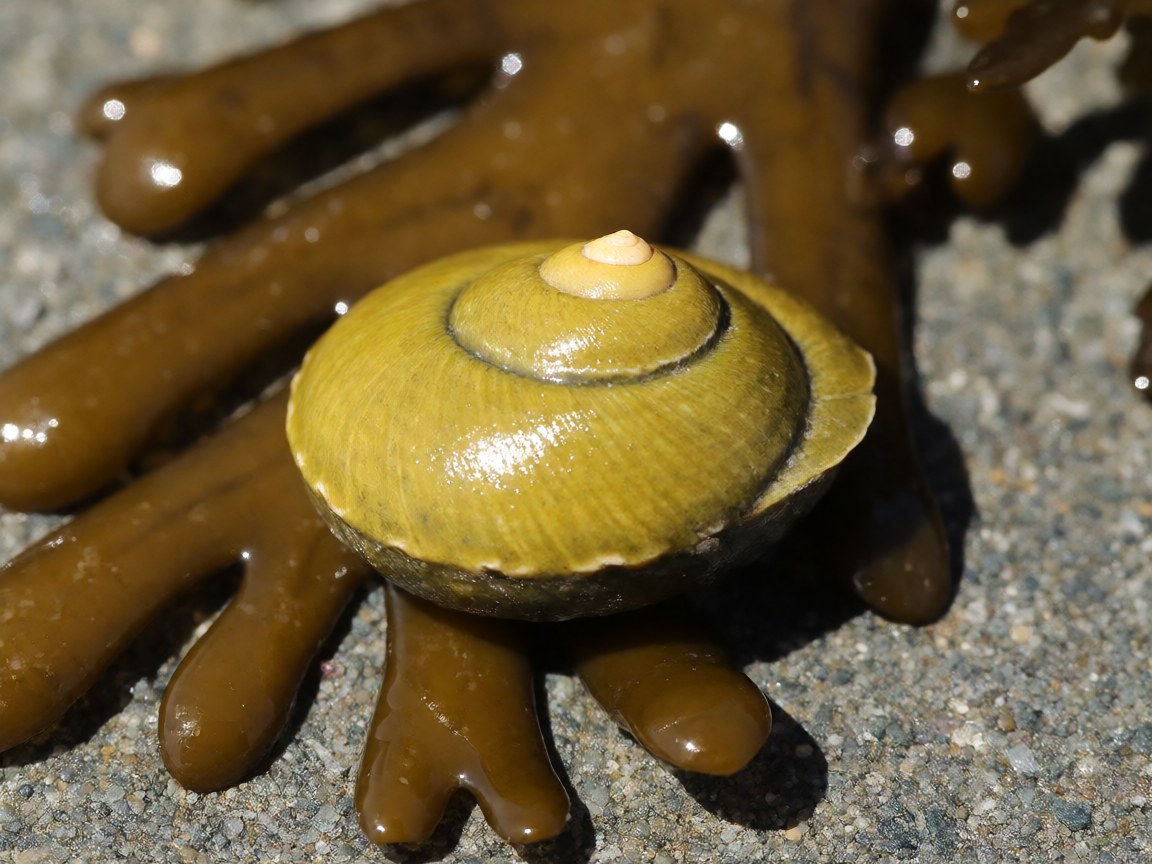
Littorina obtusata | Flat Periwinkle
Introduction
The flat periwinkle (Littorina obtusata) is the small, smooth, button-shaped snail that lives on the seaweed of the middle and lower shore, and it is almost always found sitting on the fronds of wracks rather than on bare rock. It is remarkable for its colour: within a single patch of shore it can be bright yellow, olive green, orange, brown, or almost black, often with a spiral band, and the colour very often matches the seaweed it is sitting on. This is one of the classic cases of camouflage studied on rocky shores, and the matching is not a coincidence of the individual but the combined result of inherited colour, the snail’s choice of background, and the pigment it picks up from its food. Small, neat, and easy to find, it is one of the first animals a visitor to a weedy shore learns to recognise.
Taxonomy
Littorina obtusata is a gastropod mollusc in the family Littorinidae, the periwinkles, a group of small, hardy, mostly intertidal snails found on rocky shores worldwide. The genus Littorina includes the common periwinkle Littorina littorea, the rough periwinkle Littorina saxatilis, and a number of closely related forms that have been split and re-split by taxonomists; the flat periwinkle was for a long time placed in a separate genus, Littorina or Neritrema, on account of its smooth shell and its habit of living on weed. Its closest relative on British shores is Littorina fabalis, a very similar and only recently separated species that lives lower down, on smaller, finer wracks, and which differs in the shape of the penis and in details of the shell and radula. Both are snails rather than sea slugs, but they are molluscs in the same broad group as Octopus vulgaris, and they share the basic molluscan arrangement of a muscular foot, a mantle cavity, and a feeding organ armed with a toothed ribbon.
Physical Characteristics
The shell is small, up to about fifteen millimetres high and slightly wider than it is tall, and it is distinctive in being smooth, glossy, and almost flat in profile: the spire is very low and the body whorl is large and rounded, so the shell looks like a small, compressed button or a flattened globe. There is no umbilicus, the aperture is large and rounded, and the outer lip is thin in young animals and slightly thickened in adults. The shell surface is smooth apart from fine growth lines. Colour is the striking feature and is extremely variable: plain yellow, orange, olive-green, mid-green, reddish-brown, or dark brown, sometimes with a darker spiral band around the whorls or with faint spiral striping, and the animal’s own body is usually a matching shade. The operculum is horny, thin, and oval. The head bears a pair of short, blunt tentacles with the eyes at their bases, and the foot is broad and muscular, well suited to gripping the slippery, moving surface of a seaweed frond.
Habitat
It lives on rocky shores, on the seaweed itself rather than on the rock, and it is particularly associated with the brown wracks — serrated wrack, bladder wrack, and spiral wrack — on sheltered to moderately exposed coasts from the middle of the shore downwards. It is most abundant where there is a good cover of weed to shelter in, and it is absent from very exposed, wave-beaten shores and from silty or sandy places. It grazes the surface of the fronds and the microscopic film on them, and it shelters in the damp holdfasts and in the folds and bladders of the weed at low tide, where the humidity stays high. It occurs on both sides of the North Atlantic, from Scandinavia and Britain and Ireland south to Iberia and the Mediterranean, and from eastern Canada to New England, and it has been introduced to the north-eastern Pacific.
Diet
It is a herbivorous grazer, feeding with a radula, the ribbon of tiny teeth with which it rasps the surface of the seaweed it lives on. The diet is dominated by the wracks themselves: the snail scrapes away the outer layers of the frond, taking the plant tissue together with the diatoms, bacterial film, sporelings, and detritus that coat it. It therefore feeds on its own habitat and its own shelter, which is why it is usually spread thinly over the weed rather than gathered in dense clusters. Feeding is done mainly when the weed is wet, either submerged at high tide or damp at the surface during low water, and the animal can remain active in the humid microclimate inside a dense clump of wrack long after the tide has gone out. The pigments that give the shell its colour are partly derived from the seaweed eaten, which is one reason the match between snail and background is often so close.
Reproduction
The sexes are separate, and fertilisation is internal, following the usual gastropod pattern of copulation with the male transferring sperm to the female, who stores it until the eggs are ready. The female lays her eggs in masses of jelly, typically in the damp hollows, bladders, and axils of the seaweed fronds, where they are protected from drying out; each gelatinous mass contains a number of eggs embedded in a firm, transparent matrix. Development is direct in this species — the young emerge from the egg mass as tiny snails rather than as free-swimming larvae, which means there is no planktonic dispersal stage and populations are consequently rather local, with limited exchange between neighbouring stretches of shore. This direct development is shared with the rough periwinkle and contrasts strongly with the common periwinkle, whose young spend a period in the plankton. Growth is relatively quick and the animals live for a few years.
Conservation
The species is common and widespread and is not considered threatened, but it is a standard and sensitive component of rocky-shore monitoring because it depends directly on a canopy of wrack. Anything that removes that canopy — oil spills and their dispersants, chronic hydrocarbon contamination, the effects of trampling, and the loss of seaweed cover through warming or through changes in grazing and nutrient regimes — will remove the snail with it. It is a routine species in shore surveys and in the assessment of oil spill damage, since the difference between a shore with wrack and a shore without is immediately visible in the periwinkle populations. Because dispersing juveniles are absent, recovery after local extinction depends on recolonisation by adults crawling in from neighbouring areas and is correspondingly slow.
Fun Facts
- The shell colour often matches the seaweed it is living on, and the pigments partly come from its food.
- It lives on the fronds of the wracks rather than on the bare rock.
- Unlike the common periwinkle, its young hatch as tiny snails, with no swimming larval stage.
- Yellow, green, orange, and brown individuals can all be found in the same clump of weed.
- It is one of the standard species used to assess damage after oil spills.