 By st20113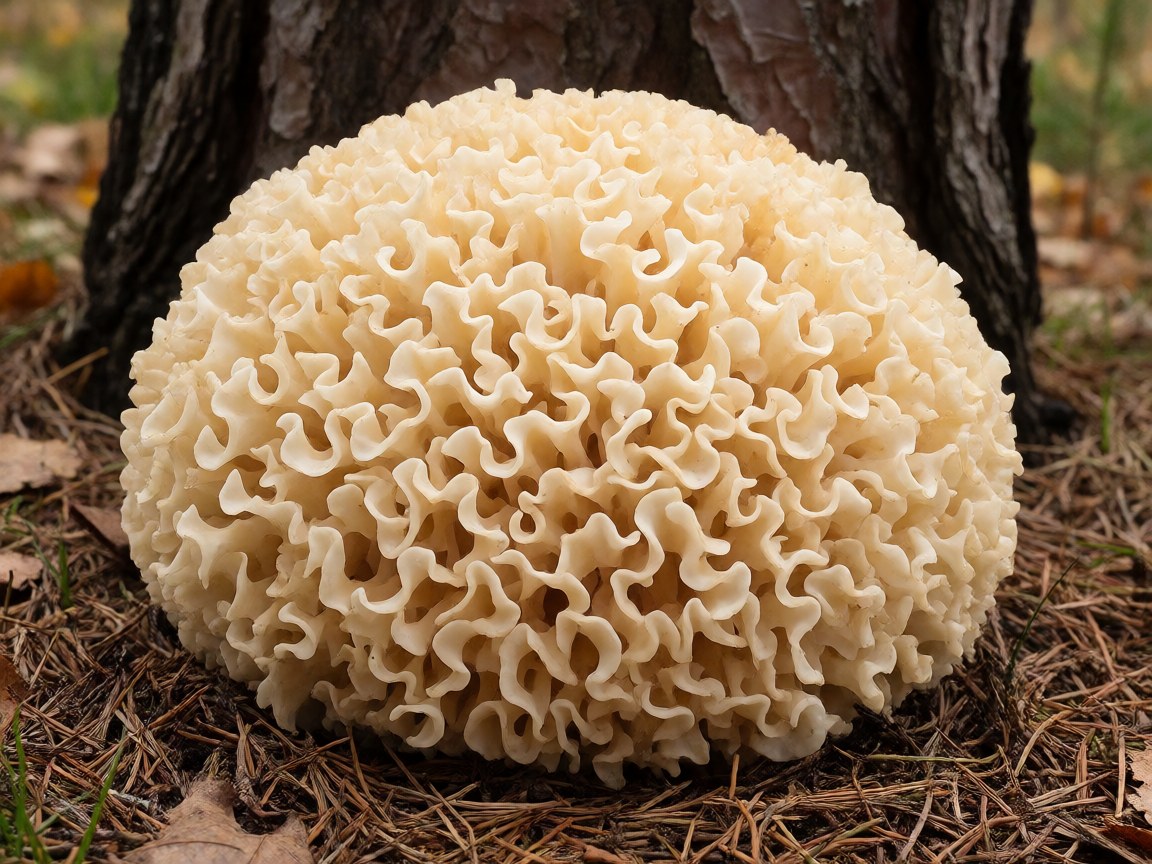
Sparassis crispa | Cauliflower Fungus
Introduction
The cauliflower fungus (Sparassis crispa) is one of the most extraordinary-looking fungi in European woodland: a pale, rounded mass up to half a metre across, made not of a cap and stem but of hundreds of flattened, ruffled, curly lobes packed together like a giant brains or, as the name has it, like a cauliflower. It grows at the base of conifer trunks and on their roots, and it is usually discovered by a walker who takes it for something thrown out of a kitchen rather than for a living organism. It is a good edible when young and fresh, prized in some countries and ignored in others, largely because cleaning the maze of frills is a serious job. Despite its size, it often grows for years from the same buried food source before anyone notices it, and a productive tree will produce a new specimen in the same spot season after season.
Taxonomy
Sparassis crispa is a basidiomycete in the order Polyporales and the family Sparassidaceae, though it has been placed at various times with the bracket fungi and the crust fungi. The genus Sparassis contains a small number of species worldwide, all of which produce the same distinctive mass of flattened, curly branches, and the European S. crispa is separated from the North American S. radicata and the Asian S. latifolia partly by host and partly by microscopic details of the spores and hyphae. Molecular work has shown that the group is close to the bracket fungi rather than to the coral fungi it superficially resembles, which is a useful reminder that the elaborate shape evolved more than once. Like the familiar Amanita muscaria, it produces its spores on club-shaped basidia, but the basidia line the surfaces of the flattened lobes rather than the undersides of gills, and the whole structure is built to expose as much fertile surface as possible.
Physical Characteristics
The fruit body is a rounded to irregular mass, typically fifteen to forty centimetres across but occasionally much larger, and it can weigh several kilograms. It is made up of a central, buried, fleshy base from which arise a great many flattened, leaf-like, wavy lobes, each only a few millimetres thick, closely packed, with crinkled, finely toothed, and irregularly lobed edges. The colour is cream, pale yellow, or pale buff when fresh and in the light, deepening to ochre or dull yellow-brown with age, and the tips of the lobes are usually the palest part. The flesh is whitish, firm but brittle, and breaks rather like a firm cheese; it has a pleasant, faintly nutty smell when fresh and a taste that has been described as mild and slightly sweet. The spore-bearing surface is on both sides of the flattened lobes and towards their edges. The spores are small, smooth, elliptical, and hyaline, and the spore print is white to pale cream. Older specimens darken, become tough and leathery, and are eventually reduced by insects and moulds to a shapeless brown mass.
Habitat
It is a fungus of coniferous woodland, growing at the base of living conifer trunks, on their large roots, and on buried conifer wood and stumps, and it will also appear beside paths and in gardens where conifers have stood. The principal host in Europe is Scots pine, but it is also recorded from spruce, larch, and Douglas fir, and very occasionally from broadleaf trees. It favours well-drained, often sandy or acidic soils and open, light woodland, and it is most frequent in the pine woods of central and northern Europe. The species is widely distributed across Europe, Asia, and North America; in Britain it is local and more frequent in the pine-growing districts of Scotland and East Anglia, and it appears from late summer into autumn. A productive tree may fruit for many years in succession, and once a site is known it is usually worth revisiting each year.
Diet
For a long time the cauliflower fungus was assumed to be a straightforward saprotroph, decaying the dead wood of the roots and lower trunk of its host. It is now understood to be a brown-rot fungus and, importantly, a parasite as well as a decay organism: it causes a butt rot in the heartwood and larger roots of living conifers, weakening them over many years and eventually killing them, and it can continue to live on the dead wood after the tree has gone. Brown-rot fungi characteristically break down the cellulose and hemicellulose of the wood while leaving the lignin largely intact, so that attacked timber becomes brown, dry, and crumbly and cracks into cubical pieces. Because the mycelium lives inside the root system and lower trunk, it is invisible for years at a time and produces a visible fruit body only when it has accumulated enough resources, which is why the sudden appearance of a large specimen is not the beginning of the infection but merely the first visible sign of it.
Reproduction
Spores are produced over the surfaces of the flattened lobes and are released into the air in the usual way, carried off by wind and by the air currents moving through the woodland. They germinate to produce a mycelium that must find and colonise suitable woody tissue, and infection is thought to occur largely through wounds at the base of the trunk or through the roots, where damage by other fungi, by insects, or by forestry operations gives access to the wood. Once established, the mycelium spreads through the root system and lower trunk and may persist for many years, and the fruit bodies appear only in favourable seasons, usually after warm rain in late summer or autumn. Sexual reproduction follows the standard basidiomycete pattern of nuclear fusion and meiosis in the basidia, and compatible mating types must meet for the cycle to be completed; the persistent mycelium is what allows a single individual to produce enormous fruit bodies and to reappear in the same place year after year.
Conservation
The species is widespread but local and is regarded as scarce enough in parts of its range to appear on national red lists; in Britain it is considered vulnerable in places and is a characteristic species of old pine woodland. The threats are the same as for most woodland fungi: the removal of old conifers and of dead and dying wood, clear-felling and replanting, the drainage and ploughing of plantation ground, and the tidying away of stumps and root plates. Because the fungus lives inside the root system for years before fruiting, a site can be destroyed by felling long before anyone knew it was occupied, and because it fruits from buried wood, the necessary habitat is invisible. Conservation measures are essentially habitat measures: retaining old conifers, leaving stumps and root plates in place, and avoiding intensive cultivation of known sites.
Fun Facts
- A single specimen can be half a metre across and weigh several kilograms.
- It is a brown-rot fungus, meaning it eats the cellulose of the wood and leaves the brown lignin behind.
- Despite growing on living trees, it is partly a parasite and can cause serious butt rot in conifers.
- It is a good edible when young and fresh, but the frills are difficult to clean.
- The same tree will often produce a specimen in the same spot year after year.
[…] the family Tuberaceae, an assemblage of subterranean ascomycete fungi. It is a close cousin of the Sparassis crispa (Cauliflower Fungus) and other edible fungi in the broader fungal tree of life, though truffles are unusual in ripening […]