 By st20113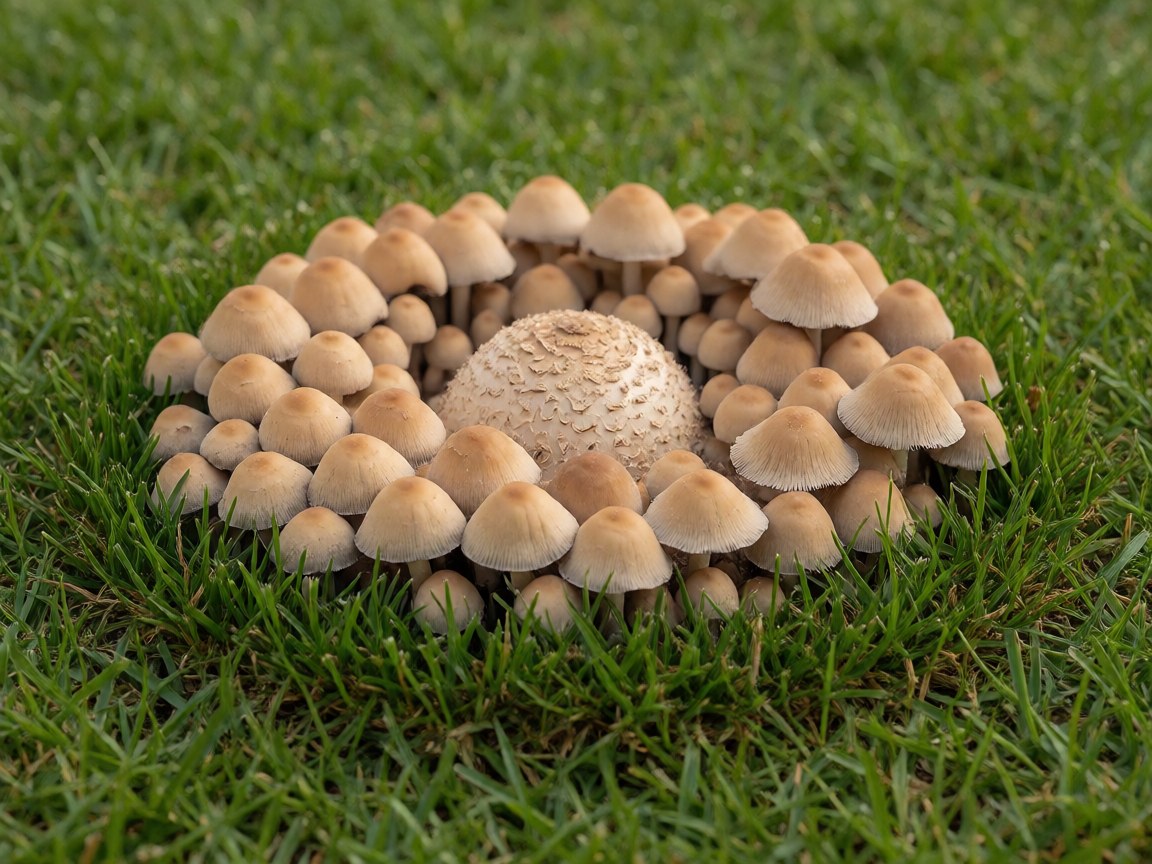
Marasmius oreades | Fairy Ring Champignon
Introduction
The fairy ring champignon (Marasmius oreades) is the mushroom that makes rings in lawns and pasture, a small, tough, buff-coloured grassland fungus with a talent for geometry. Its mycelium spreads outward through the soil at a steady rate from a single point, and because the fungus fruits at the growing edge, the mushrooms appear in a circle that can be a metre across in a young ring and tens of metres across in an old one; some European rings are believed to be several hundred years old. The grass over the ring margin is usually a deeper, richer green than the surrounding turf, because the fungus releases nitrogen as it digests dead roots and thatch. Long before anyone understood what was happening, these rings were woven into folklore as the dancing places of fairies, witches, or the devil, and the names survive in half a dozen languages. In the kitchen, the species is a genuinely good edible — one of the few grassland mushrooms worth collecting — though it must be told apart from some dangerously similar white species.
Taxonomy
Marasmius oreades is a basidiomycete in the order Agaricales, and it is placed in the family Marasmiaceae or, in some modern classifications, in the Omphalotaceae. The genus Marasmius is a large group of mostly small, tough, litter- and grass-decomposing mushrooms, and the species epithet oreades refers to the oreads, the mountain nymphs of Greek myth, a nod to the ring-dancing tradition. Its nearest relatives among familiar fungi are the garlic-scented Marasmius alliaceus and the little pinwheel mushroom Marasmius rotula. As a gilled mushroom it produces its spores on the surface of club-shaped basidia on the gills, in the same broad way as Amanita muscaria, though the two are not closely related and live entirely different lives. The family is characterised by tough, wiry stems and by the ability of the fruit body to shrivel in dry weather and revive when it rains — a trait so characteristic that it gives the genus its common name of “resurrection mushrooms”.
Physical Characteristics
The cap is one and a half to five centimetres across, at first bell-shaped or convex, then flattening with a broad, low central bump, or umbo, which is one of the best field characters. The colour is variable and depends on moisture: leathery tan, reddish brown, or honey brown when damp, drying to a pale buff or almost cream from the centre outwards — the species is strongly hygrophanous, and a single troop in drying weather can show a two-tone pattern of dark margin and pale centre. The surface is smooth and slightly greasy-looking when wet, and the cap margin is often faintly lined. The gills are thick, widely spaced, and free to slightly attached, cream to pale buff, and they remain pale rather than darkening. The stem is four to eight centimetres tall, slender, wiry, and remarkably tough — too tough to snap cleanly, and it will often twist and resist being broken. There is no ring and no volva. The spore print is white. The flesh is thin, pale, and has a faint, pleasant, slightly almondy smell. The whole mushroom shrivels to a leathery husk in dry weather and swells back to full size after rain, sometimes repeatedly.
Habitat
It is a fungus of grass: lawns, pastures, meadow, parkland, roadside verges, golf courses, churchyards, sand dunes, and rough grazing. It is saprotrophic, growing on and around dead grass roots, thatch, and other buried plant debris, and it is tolerant of mowing, trampling, and full sun. Rings are the classic field sign, though mushrooms also appear in arcs where part of the circle is blocked by a path, wall, or hedge, and occasionally in scattered troops where the mycelium is young or irregular. The species is common and widespread across Europe and North America and is found throughout Britain and Ireland. It fruits mainly from late spring to late autumn, with peaks after rain in early summer and again in autumn, and in a good year a single ring can produce several flushes of mushrooms in successive weeks. Ring expansion is slow but relentless: most rings grow outward by somewhere between ten and thirty centimetres a year, which is how an old ring can end up tens of metres in diameter.
Diet
The fungus is a saprotroph, decomposing dead organic matter in the root layer rather than partnering with living plants. It breaks down cellulose and lignin in grass roots, rhizomes, and thatch using enzymes released from the mycelium, and it absorbs the soluble products. The striking consequence is visible above ground: as the fungus digests material rich in nitrogen, it releases more nitrogen into the soil than it needs, and the grass rooted at the active ring margin responds with a band of darker, faster-growing, more vigorous growth. Older parts of the ring, where the mycelium has exhausted the available material, frequently show the opposite effect — the dense fungal network makes the soil water-repellent, the grass there dies back, and a bare or brown inner zone develops. This combination of a green outer band and a bare inner one is what gives a mature fairy ring its two-tone structure.
Reproduction
Spores are produced on the gill surfaces and are dispersed by wind, but in practice most rings are not started by spores alone so much as expanded by the relentless vegetative growth of a single mycelium. The mycelium grows radially outward through the soil at a fairly even rate in all directions, and because it fruits where it is most active, the mushrooms appear at the circumference. Each ring therefore represents one individual organism, and the mushrooms around it are all genetically the same individual, which is why a ring is effectively the largest organism in the meadow by area. Sexual reproduction does occur: the basidia on the gills carry out nuclear fusion and meiosis in the usual way, producing white basidiospores that can establish new rings elsewhere, and the mating of compatible strains generates the genetic variation that allows populations to adapt. Fruiting is triggered by warm, humid weather after rain, and the tough, reviving fruit bodies allow the fungus to make use of short wet windows that would destroy a more delicate mushroom.
Conservation
The species is common, widespread, and not threatened, and it is one of the few fungi that actually prospers in regularly mown and grazed grassland. The conservation interest lies in the habitat rather than the fungus: large, old fairy rings are a feature of long-established, unimproved, low-input grassland, and they are lost when pasture is ploughed, reseeded, or heavily fertilised, or when amenity turf is treated with fungicide and nitrogen. Old rings in churchyards, ancient parkland, and traditionally managed downland are among the most reliable places to find them, and in some countries they are noted as indicators of grassland continuity. There is also a safety dimension: the rings attract people who collect the mushrooms, and the main risk is confusion with toxic white grassland species.
Fun Facts
- The ring forms because the fungus grows outward at an even rate and fruits only at its active edge.
- A single fairy ring is one individual organism and can be hundreds of years old.
- The grass at the ring edge is greener because the fungus releases nitrogen as it feeds.
- It shrivels in dry weather and revives after rain, so it is called a “resurrection mushroom”.
- It is a good edible, but collectors must avoid the poisonous white Clitocybe species that share its habitat.