 By st20113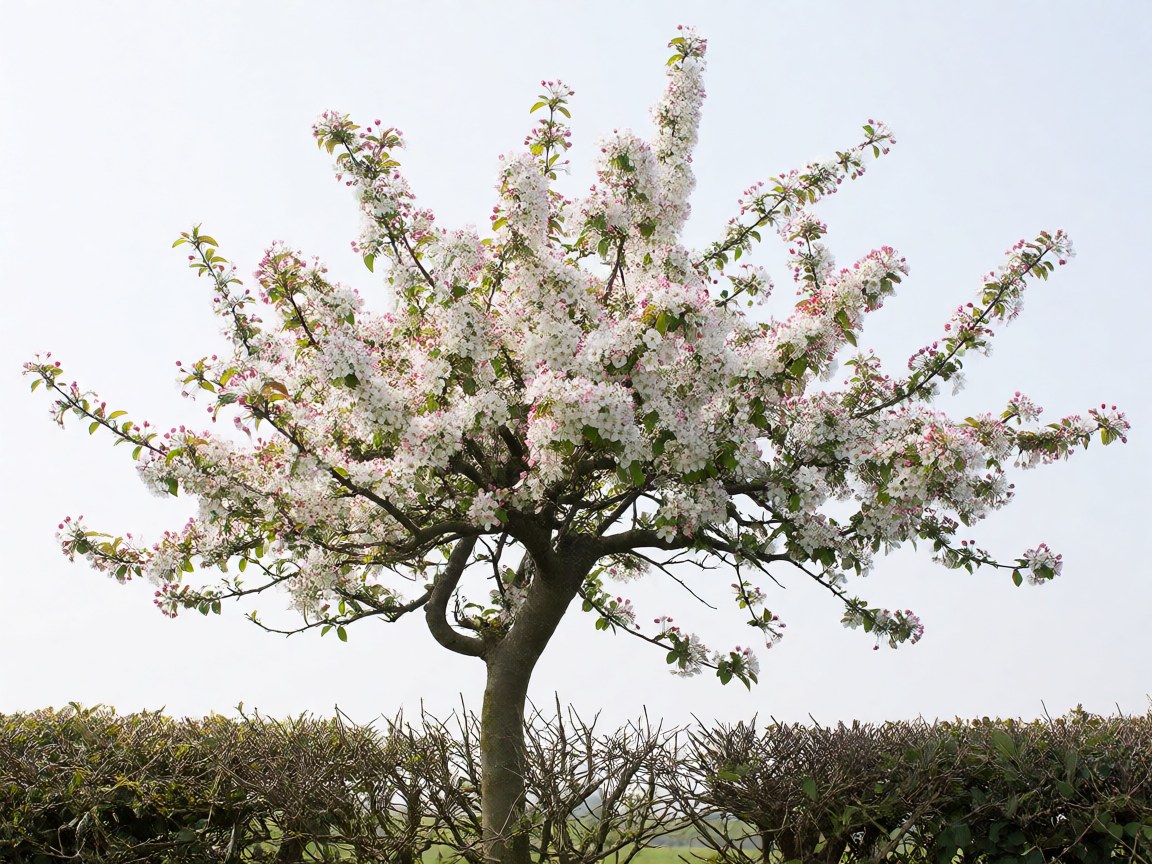
Malus sylvestris | Crab Apple
Introduction
The crab apple (Malus sylvestris) is the wild ancestor of the orchard apple and one of the most characterful small trees of European hedgerow and woodland edge. A thorny, crooked, short-lived tree, it carries a mass of pink-tinged white blossom in May and then hard, sour, yellow-green fruits the size of a cherry, far too sharp to eat raw but superb for jelly. It is also a plant with a complicated identity: genuine wild crab apples are now scarce in many areas, because centuries of hybridisation with cultivated apples have blurred the boundary, so that many “wild” trees in hedgerows are in fact hybrids or feral domestic stock. For a taxonomist this makes it an awkward, arguable plant; for everyone else it is simply one of the most welcome signs of the year, a cloud of blossom at the hedge top when the blackthorn has finished and the hawthorn has not yet begun.
Taxonomy
Malus sylvestris is a member of the family Rosaceae, the rose family, and belongs to the genus Malus, which contains around thirty to fifty species of apple and crab apple across the temperate northern hemisphere. The domestic apple, Malus domestica, is a separate species in its own right, largely descended from the Central Asian wild apple Malus sieversii, but genetic studies show that the European crab has contributed significantly to it as well: as early apples were carried westward along the Silk Road and the trade routes of the Roman world, they met and crossed with local wild trees, and modern apples carry traces of both parents. The crab hybridises readily both with the domestic apple and with ornamental crabs planted in gardens, which is why pure wild trees are hard to identify with certainty. Botanists separate the true wild crab by a combination of characters: thorny twigs, hairless leaves and leaf stalks, relatively small flowers, and small, very sour fruit. Feral seedlings of domestic apples usually lack thorns and have noticeably downy undersides to the leaves. As a green plant it depends on Photosynthesis, and like other fruit trees it times its whole annual cycle around producing and then provisioning a crop of sugary fruit for seed dispersers.
Physical Characteristics
Crab apple is a small, often crooked and rather untidy deciduous tree, usually two to ten metres tall, with a broad, low, spreading crown and dark grey-brown bark that fissures into small plates on older trunks; the wood is hard, heavy, fine-grained, and takes a good polish, which is why it has long been used for tool handles and small turned objects. The twigs are distinctive: stiff, spreading, and frequently ending in a sharp woody thorn, which is one of the best field characters separating wild crab from feral domestic apples. These thorns are modified short shoots, and on a young, vigorously growing tree they can be formidably sharp. The leaves are oval to elliptical, two to five centimetres long, finely toothed, dark green above and paler beneath, and—on a true wild tree—almost hairless when mature. In autumn they often turn a clear yellow before falling. The flowers open in May in clusters of three to six, each two to three centimetres across with five rounded white petals, strongly flushed pink on the outside and in bud, and a dense brush of yellow stamens. The fruit is a small, hard, rounded pome two to three centimetres across, green turning yellowish, sometimes flushed red on the sunlit side, and extremely sour and astringent. It is rich in malic acid and in pectin, the combination that makes it set so firmly when boiled.
Habitat
It grows in hedgerows, woodland edges and clearings, old scrub, wood-pasture, and on the margins of fields, favouring moderately fertile, well-drained but not too dry soils and open, sunny positions. It is native across most of Europe and into western Asia, and it tolerates a wide range of soils from calcareous clays to light sandy loams, though it dislikes waterlogged ground. Wild crab apple is a light-demanding tree and rarely survives under a closed canopy, so it is most often found where woodland meets farmland, in thick hedges, and in the scattered scrub of old common land. Because it cannot compete with tall forest trees, it is essentially a tree of edges and gaps, and it benefits from the kind of rough, semi-open ground created by traditional grazing, coppicing, and hedge-laying. In dense, dark plantation woodland it may persist for a while in the seed bank and as suppressed seedlings, but it will not flower there.
Diet
The tree is autotrophic, photosynthesising in its leaves through the spring and summer and moving the sugars into wood, roots, and developing fruit; a mature tree in full sun can carry several thousand fruits in a good year, and the cost of filling them is considerable. Like most members of the rose family it depends on mycorrhizal fungi in the soil to help it take up phosphorus and other nutrients, and it grows slowly on poor ground, sometimes adding only a few centimetres of height a year. It is a modest feeder by orchard standards and needs no fertiliser, though it responds to the enriched soils of old field edges. The sugars concentrated in the fruit are a deliberate investment: the tree manufactures a reward, in the form of pulp, in order to have its seeds carried away by animals. It takes nothing from animals itself except this dispersal service, and its thorns exist to deter browsing deer and livestock rather than to help it feed. In dry summers the tree may shed a proportion of the developing fruit, sacrificing part of the crop to keep the remainder alive.
Reproduction
The blossom appears in May and is a rich source of both nectar and pollen, drawing honeybees, bumblebees, solitary bees, hoverflies, and many other insects; crab apple is one of the most valuable early nectar sources in hedgerow and orchard, and it is often deliberately planted near hives. The flowers are largely self-incompatible, so a tree needs pollen from a different individual to set a good crop, which encourages cross-pollination and the genetic mixing that blurs the line between wild, feral, and cultivated trees. Seed set varies greatly from year to year, with heavy crops in good flowering seasons and very light ones after a cold, wet spring. The fruits ripen in autumn and are eaten by birds such as thrushes, blackbirds, and waxwings, and by mammals including badgers, foxes, and deer, which swallow the fruit and pass the seeds intact. Germination is helped by the hard seed coat being scarified in an animal’s gut and by the cold of winter, which breaks seed dormancy; without a period of chilling the seed will not grow. The tree also suckers occasionally from the base, and old hedgerow trees sometimes persist as a small clump.
Conservation
The species is not globally threatened, but genuine wild crab apple is considered scarce and declining in several countries, including Britain and Ireland, where centuries of hybridisation with cultivated apples have swamped the pure wild form and where hedgerow removal, the intensification of field margins, and the loss of old scrub have destroyed habitat. Because hybrids look intermediate and are often counted as wild, the true number of genetically pure trees may be much lower than records suggest; surveys using genetic markers have found that many hedgerow trees previously recorded as wild crabs are in fact hybrids. Conservation effort focuses on identifying and protecting verified wild trees, collecting their seed into ex-situ collections, and maintaining the open, scrubby edge habitats where the tree naturally belongs. Wild populations are also of practical value: they carry disease resistance and hardiness that apple breeders want, and gene banks across Europe maintain collections of verified wild material for exactly that purpose. The tree is also vulnerable to fireblight, a bacterial disease that can kill whole branches within a season, and to apple scab and the codling moth, all of which it shares with its cultivated relatives.
Fun Facts
- Wild crab apple is the main European ancestor of the cultivated apple.
- The fruits are far too sour to eat raw, but make excellent jelly because they are rich in pectin.
- The twigs frequently end in sharp thorns, a useful clue for telling wild trees from feral ones.
- Its May blossom is one of the most important nectar sources of the hedgerow year.
- Because it hybridises so freely, botanists have great difficulty deciding which trees are truly wild.