 By st20113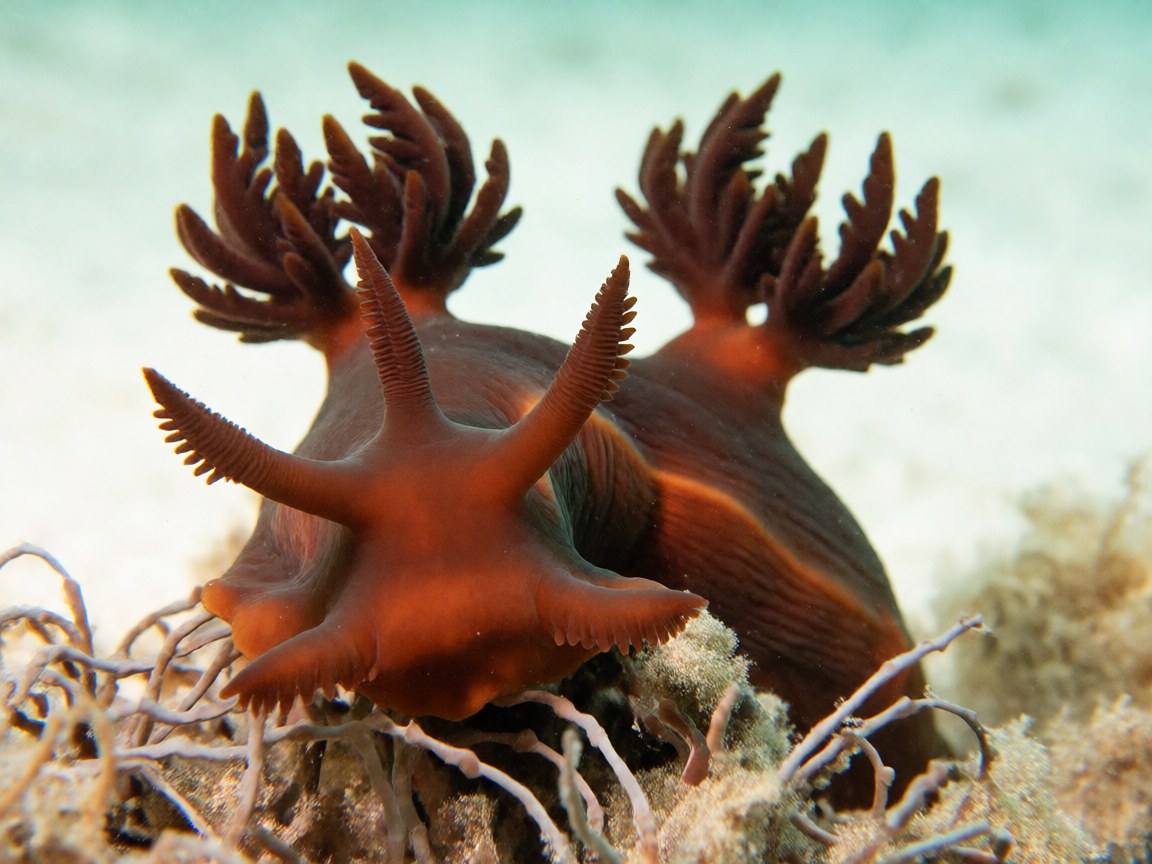
Dendronotus frondosus | Frond Nudibranch
Introduction
The frond nudibranch (Dendronotus frondosus) is one of the largest and most ornate sea slugs of northern waters: a soft, slender body, usually reddish-brown or cream, bristling with pairs of bushy, branching gills down its back and fringed extensions around its head. It looks more like a piece of seaweed than an animal, which is exactly the point. It lives among hydroids on rocky seabeds, and it is a predator despite its vegetable appearance.
Taxonomy
Dendronotus frondosus is a nudibranch, a shell-less sea slug, in the family Dendronotidae. It belongs to the molluscs, sharing the basic plan of a muscular foot and a radula with far more active relatives such as Octopus vulgaris, the common octopus, but it has lost the adult shell altogether and instead defends itself with chemicals taken from its prey and with camouflage among the hydroids it lives on.
Physical Characteristics
The body is elongate and soft, tapering to a pointed tail, and can reach five to ten centimetres or more—among the largest nudibranchs in northern seas. Along the back run four to eight pairs of large, much-branched, bushy gills, the cerata, which look like tiny trees. The head is expanded into a veil bearing several pairs of branching extensions, and there are two tall, club-shaped rhinophores. Colour is variable: reddish-brown, orange, cream, or white, often mottled, and the whole animal blends closely with the hydroids among which it lives.
Habitat
It is found on rocky and stony seabeds, on kelp stipes and holdfasts, on harbour walls, and among hydroid-covered rock, from the very low shore down to considerable depths. It occurs in the north Atlantic and Arctic, around Britain, Ireland, and northern Europe, and in the north Pacific. It favours places with a good growth of the hydroids it feeds on, and it is often found by divers rather than on the shore.
Diet
It is a predator, feeding mainly on hydroids—the small, branching, colonial animals related to anemones and jellyfish. It bites off pieces of the colony with its radula and swallows them. Many of the hydroid’s stinging cells pass through the gut undamaged and are stored in the tips of the slug’s cerata, where they continue to function and defend the nudibranch. The stolen weapons, plus the branching shape that mimics the hydroid colony itself, make it doubly hard to attack.
Reproduction
As with most sea slugs, it is a hermaphrodite, and two animals mate and exchange sperm. It lays long, coiled, ribbon-like strings of eggs, usually wound around the hydroid colonies it feeds on, each ribbon containing thousands of eggs in a jelly matrix. The eggs hatch into swimming larvae that drift for a time before settling and metamorphosing into the crawling adult form. Adults are thought to live for about a year.
Conservation
The species is widespread and not considered threatened, though it is a northern species and is sensitive to sustained increases in sea temperature. Because it depends on hydroid colonies for both food and egg-laying, it disappears where the seabed is dredged, smothered by sediment, or colonised by different growth. Where hydroid turf is intact it can be locally common, and it is a favourite subject for underwater photographers.
Fun Facts
- It is one of the largest nudibranchs in northern waters, sometimes over ten centimetres long.
- Its branched gills look so much like hydroid colonies that it is very hard to spot.
- It steals the stinging cells of the hydroids it eats and uses them for its own defence.
- The head is fringed with several pairs of branching tentacles, which give it a bearded look.
- It lays long coiled egg ribbons, usually wrapped around the hydroids it has been eating.