 By st20113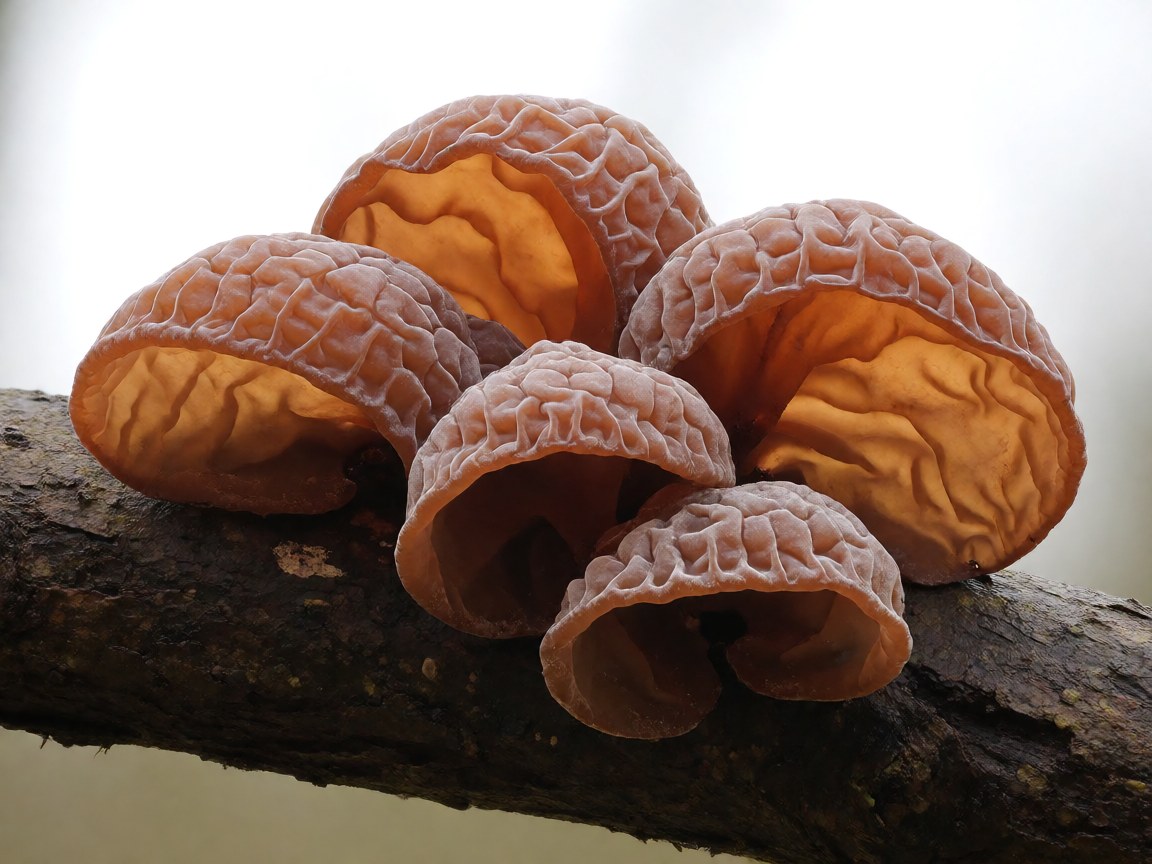
Auricularia auricula-judae | Jelly Ear
Introduction
The jelly ear (Auricularia auricula-judae) is a rubbery, ear-shaped fungus that grows on dead elder and other wood, translucent reddish-brown and wrinkled like a human ear when fresh, shrinking to a hard, dark, curled scrap when dry and swelling again in rain. It is one of the few fungi that can revive repeatedly after drying out, and it is the wood fungus behind the “black fungus” of Chinese cooking. Its old name, Judas’s ear, refers to the elder on which Judas was said to have hanged himself.
Taxonomy
Auricularia auricula-judae is a basidiomycete in the family Auriculariaceae, within the jelly fungi. Its spores are produced on a smooth to veined outer surface rather than on gills or in pores, and the whole fruit body is gelatinous. This places it well away from the familiar capped, gilled mushrooms of the genus Amanita, such as the fly agaric, both in structure and in the way the spore-bearing surface is organised.
Physical Characteristics
The fruit body is ear- or cup-shaped, three to ten centimetres across, attached to the wood at one side, with a smooth, veined, and wrinkled outer surface and a slightly hairy, paler underside. Fresh specimens are translucent, rubbery, and gelatinous, in shades of reddish-brown, purple-brown, or greyish-brown; on drying they shrink to a hard, dark, brittle curl. They can reabsorb moisture and become fleshy again. Several fruit bodies often grow in overlapping clusters along a branch.
Habitat
It grows on dead and dying wood, especially elder, but also beech, ash, sycamore, elm, and many other broadleaved trees, on standing dead branches, fallen wood, and stumps. It fruits throughout the year but is most conspicuous in damp weather in autumn and winter. It is found across Europe, Asia, and elsewhere and is one of the commonest fungi on elder, often appearing year after year on the same branch.
Diet
The fungus is a saprotroph, causing a white rot in dead wood. Its threads grow through the timber, breaking down both cellulose and lignin and absorbing the released nutrients. It usually attacks dead wood rather than living trees, though it can occasionally appear on weakened branches. Along with many other white-rot fungi, it plays an important part in returning fallen wood to the soil.
Reproduction
Spores are produced over the smooth, wrinkled outer surface and are released into the air, especially in humid conditions. The gelatinous structure depends on moisture: when dry, the fruit body shrivels and spore release stops, and when rain returns it swells and resumes. This ability to dry out and revive repeatedly lets a single fruit body go on producing spores over a long period, which is unusual among fleshy fungi.
Conservation
The species is common, widespread, and not threatened. It depends on dead and decaying wood, so it declines where woodland is tidied and all dead branches and stumps are removed, and it is quick to return wherever old wood is left in place. It is gathered for food in some countries and is widely cultivated, particularly in Asia, where a close relative is a standard ingredient.
Fun Facts
- It can dry out to a hard, brittle scrap and then swell back to fleshy and rubbery in the rain.
- Its old name, Judas’s ear, comes from the legend that Judas hanged himself from an elder tree.
- It is best known as the “black fungus” or wood ear used in Chinese cooking.
- It grows most often on elder, though it will take many kinds of broadleaf wood.
- Fresh fruit bodies are translucent enough to see the veins and wrinkles through them.