 By st20113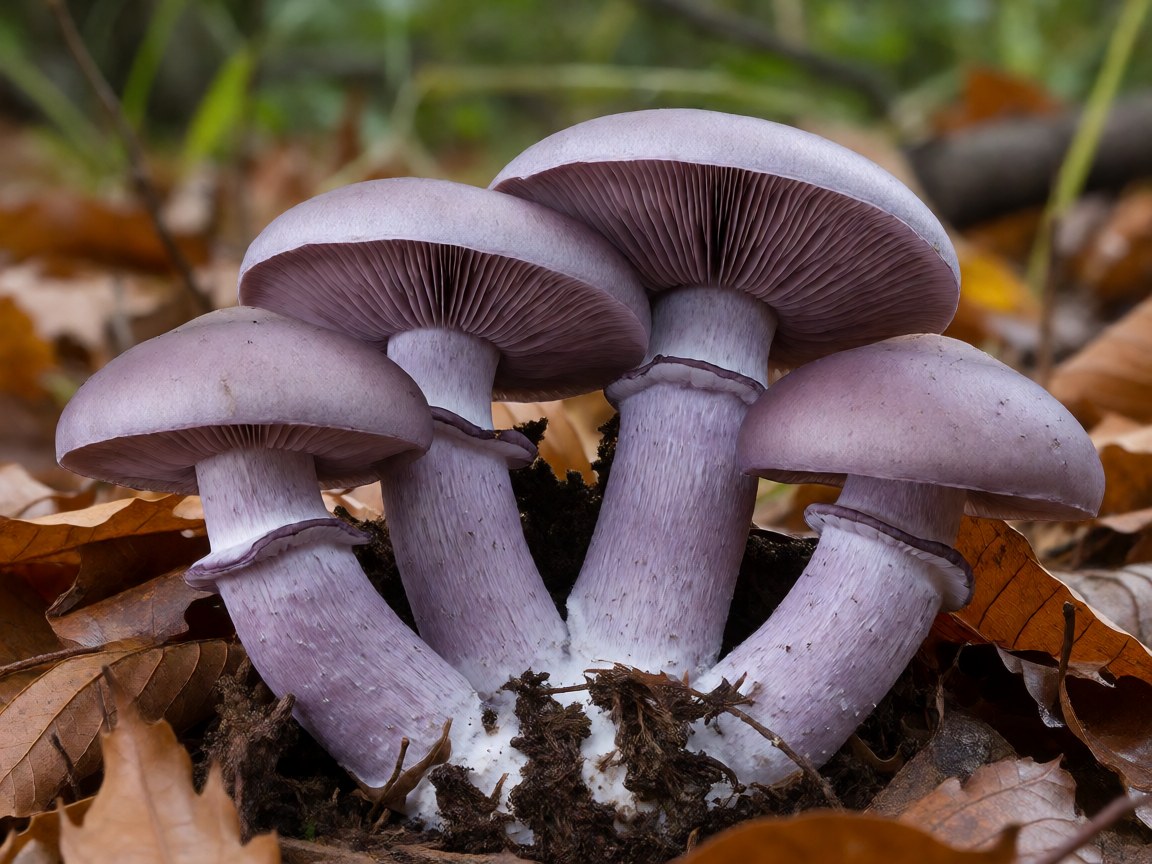
Lepista nuda | Wood Blewit
Introduction
The wood blewit (Lepista nuda) is one of the most beautiful and easily recognised fungi of late autumn: a stout mushroom in shades of lilac, violet, and pale blue, with a lilac stem and pale lilac gills, often fruiting in rings in woodland leaf litter or under hedgerows. The colour fades with age and weather, but the smell is constant—a strong, sweet, flowery scent something like frozen orange juice. It is a popular edible species.
Taxonomy
Lepista nuda is a basidiomycete in the family Tricholomataceae. It has true gills and a fleshy cap, so it looks like a typical mushroom, but its spore print is pale pinkish-buff rather than white, and it belongs to a different lineage from the classic woodland genus Amanita, such as the fly agaric. It also differs in habit: it feeds on dead organic matter rather than forming partnerships with living tree roots.
Physical Characteristics
The cap is six to fifteen centimetres across, convex at first then flattening, often with a slightly wavy, inrolled edge, smooth and moist-looking, in an unmistakable lilac to violet-blue when young, fading to pale brownish-lilac with age and weather. The gills are crowded, sinuate, and the same lilac colour, fading to pinkish-buff. The stem is stout, four to ten centimetres tall, fibrous, lilac with a woolly lilac base, and flushed violet inside. The flesh is thick, pale lilac, and firm, with a strong, sweet, perfumed smell.
Habitat
It grows in woodland, in hedgerows, on compost heaps, in gardens, parks, and among leaf litter and grass, fruiting from late autumn into early winter and often surviving light frosts. It is found across Europe and North America and is most common where there is plenty of decaying leaf litter. Rings and arcs are typical, since the fungus spreads outward through the litter from a central point.
Diet
Wood blewit is a saprotroph. Its threads grow through fallen leaves, wood chips, compost, and other decaying plant material, releasing enzymes that break the material down and absorbing the nutrients released. It is one of the relatively few larger fungi that specialise in leaf litter, and it is an important agent of decomposition in woodland. It does not partner with tree roots and does not attack living plants.
Reproduction
Spores are produced on the gills and are shed into the air, giving a pale pinkish spore print. Spores that land on suitable damp litter germinate into a new network, which spreads outward through the leaf layer, and older parts of the ring die back while new growth continues at the edge—which is why the mushrooms appear in rings and arcs. Fruiting happens when temperatures drop and moisture is plentiful in autumn and early winter.
Conservation
The species is common, widespread, and under no threat. It thrives wherever leaf litter and woody debris are left to decay, and it is often more abundant in gardens and parks with mulch than in intensively tidied woodland. It is a well-regarded edible mushroom, though it should always be cooked, and a few people find it causes stomach upset.
Fun Facts
- Its strong, sweet scent is often compared to frozen orange juice or violets.
- Lilac colour is strongest in young, fresh specimens and fades markedly with age.
- It often fruits in rings through leaf litter, sometimes surviving into December.
- The spore print is pale pink, not white, which helps separate it from look-alikes.
- It must be cooked before eating; raw blewits can cause digestive upset in some people.