 By st20113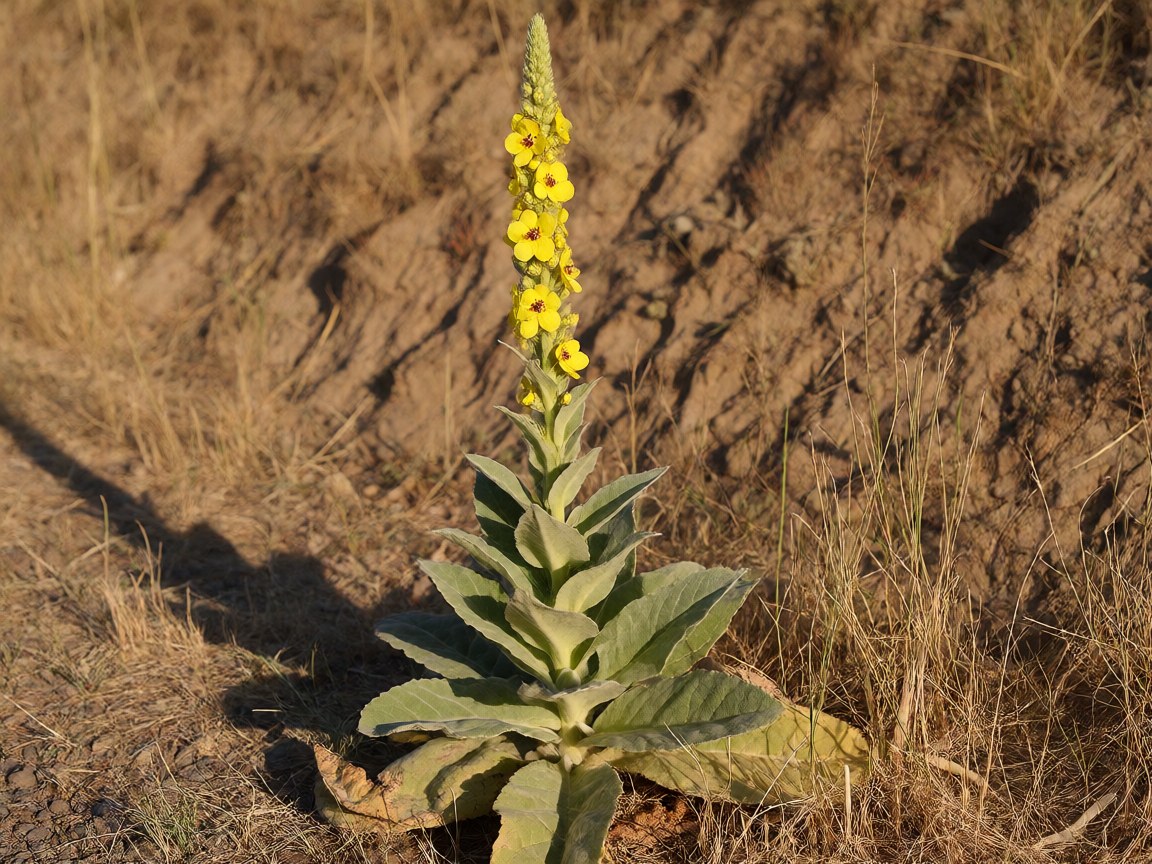
Verbascum thapsus | Great Mullein
Introduction
Great mullein (Verbascum thapsus) is the tall, unmistakable plant of dry banks and waste ground: a single woolly grey spike, sometimes two metres high, topped with a dense column of yellow flowers. Its felted, pale, flannel-soft leaves gave it the folk name ” Aaron’s rod”, and the whole plant is covered in a dense coat of branched hairs. It is a familiar weed of roadsides and quarries, and a plant with a long history of medicinal and practical use.
Taxonomy
Verbascum thapsus is a member of the family Scrophulariaceae, the figwort family, and belongs to the genus Verbascum, the mulleins, most of which are European and Asian plants of dry, open ground. It is usually a biennial, producing a rosette in its first year and a flowering spike in its second. As a green plant it depends on Photosynthesis, and its thick felt of hairs helps it keep that process running in hot, dry, exposed places where a smooth-leaved plant would lose too much water.
Physical Characteristics
In its first year the plant is a low rosette of large, oval, grey-green leaves, ten to fifty centimetres long, densely covered in soft, woolly, branched hairs that give them the texture of flannel. In the second year a single stout, unbranched stem rises one to two metres, carrying smaller leaves that run down the stem as wings. The spike of flowers occupies the upper half: dense, five-petalled, bright yellow, two to five centimetres across, opening a few at a time from the bottom upward. The seed capsule is a rounded, hairy box packed with hundreds of tiny seeds.
Habitat
It grows on dry, open, disturbed ground—roadsides, railway banks, quarries, gravel pits, walls, chalk grassland, and woodland clearings—on well-drained, often poor soils. Native to Europe, Asia, and north Africa, it has been introduced to North America, Australia, and elsewhere, and in some places it is regarded as an invasive weed of pasture. It needs bare ground and full sun, and it colonises freshly disturbed soil readily.
Diet
Mullein is fully autotrophic. The dense covering of hairs reduces air movement over the leaf surface, cutting water loss, and reflects excess light, which lets the plant keep photosynthesising through hot, dry weather on bare ground where moisture is scarce. A long taproot reaches water deep in the soil, and the rosette spends its first year building the reserves needed to produce the huge flowering spike in the second.
Reproduction
The yellow flowers open in succession up the spike over many weeks, producing a long, reliable supply of nectar and pollen for bees, hoverflies, and other insects. The flowers are self-compatible but are usually cross-pollinated by visitors. A single plant can produce well over a hundred thousand tiny, dust-like seeds, which fall close by or are scattered by wind and passing animals. The seeds can remain viable in the soil for many decades, germinating in quantity when the ground is disturbed.
Conservation
The species is common, widespread, and not threatened anywhere in its native range, and it is increasing in some regions as disturbance creates more of the open ground it likes. Outside that range it can be invasive, particularly on overgrazed or drought-struck pasture in North America, where stock tend to avoid it and it spreads unchecked. It is controlled there by hand-pulling rosettes and by maintaining good grazing cover.
Fun Facts
- Its soft, woolly leaves were once used as lamp wicks, candle wicks, and even as emergency toilet paper.
- The dense felt of hairs is made of branched hairs that reduce water loss in dry, open places.
- A single plant can produce well over 100,000 seeds, which stay viable in the soil for decades.
- Folk names include Aaron’s rod, hag’s taper, and shepherd’s staff, after the tall flower spike.
- The tall dried stem was dipped in tallow and burned as a torch in classical times.