 By st20113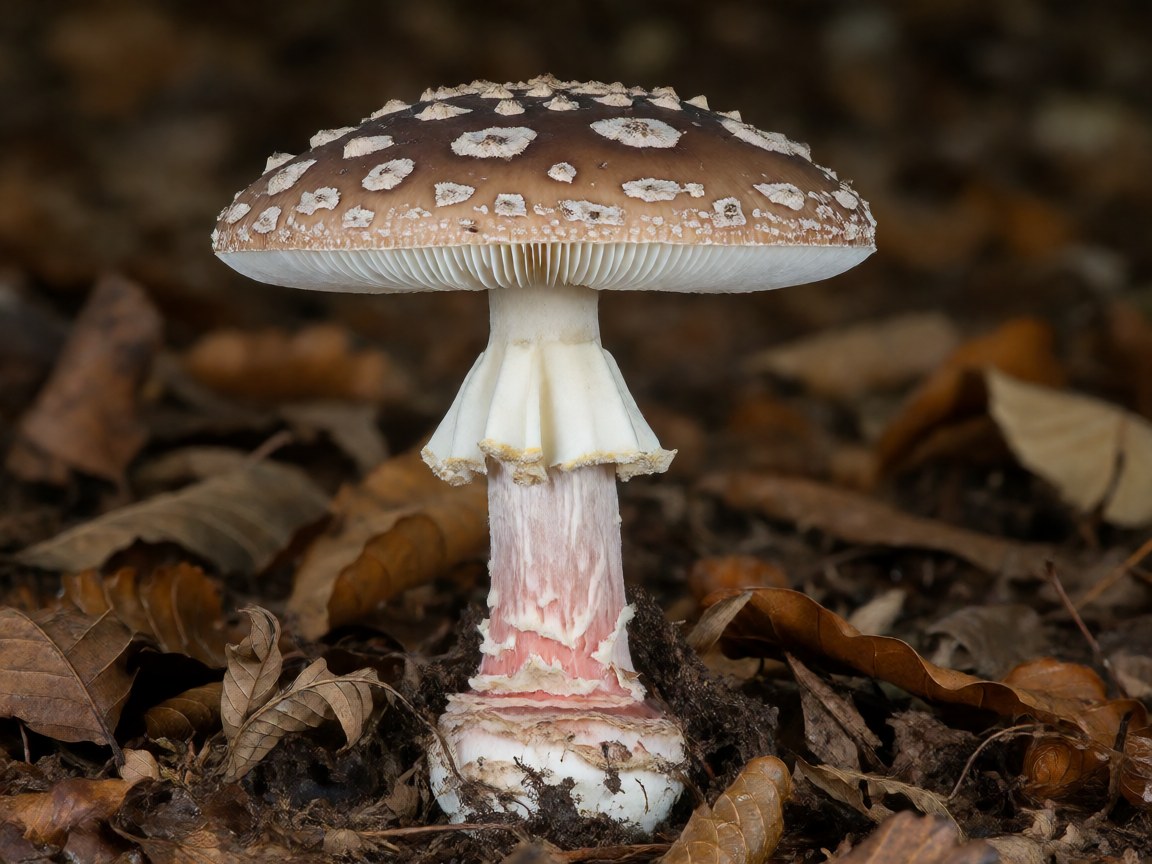
Amanita rubescens | Blusher
Introduction
The blusher (Amanita rubescens) is a large, sturdy woodland mushroom named for its habit of slowly turning pinkish-red where the flesh is bruised or cut. With a warty brownish cap, a ringed stem, and a bulbous base with ragged scales, it looks alarming to beginners—but unlike the death cap it does not have a clean sac-like cup, and it is a good edible species when thoroughly cooked. It is one of the commonest large Amanitas of European woodland.
Taxonomy
Amanita rubescens is a basidiomycete in the family Amanitaceae, within the genus Amanita, the genus that also includes the fly agaric and the death cap. It shares with them the universal veil that leaves remnants on the cap and at the stem base, the ring on the stem, white spores, and free gills. Within the genus it sits in the same broad group as the death cap, which is exactly why beginners are taught to leave large brown Amanitas alone.
Physical Characteristics
The cap is five to fifteen centimetres across, convex then flattening, varying from pale brown and reddish-brown to grey-brown or olive, and covered with scattered greyish, powdery warty patches—remnants of the universal veil—which often wash off in rain. The gills beneath are white, crowded, and free of the stem, and they redden when damaged. The stem is stout, six to fifteen centimetres tall, whitish to pale pinkish, with a prominent, grooved ring and a bulbous base marked with concentric ragged scales rather than a clean cup. The flesh is white and slowly stains pinkish-red where cut.
Habitat
It grows in mycorrhizal association with broadleaved trees, especially oak, beech, and birch, and also with conifers, in woodland, parkland, and occasionally gardens. It fruits from summer into autumn, often in ones and twos rather than large troops. The species is found across Europe and North America and is one of the commonest of the larger Amanita species in northern Europe.
Diet
The blusher is mycorrhizal, not a decomposer. Its threads form a sheath around the fine roots of a host tree and extend out into the soil, taking up water and minerals—especially phosphorus and nitrogen—and passing some to the tree in return for sugars the tree has made by photosynthesis. The underground partnership persists for years; the mushroom is only the short-lived fruiting stage that appears when conditions suit.
Reproduction
Spores are produced on the gills beneath the cap and are shed into the air, drifting to land near a suitable tree root. A compatible spore that reaches a host root may germinate and establish a new partnership. The fruit bodies appear through summer and autumn, and the same mycelium often fruits in the same place for many years, so a reliable spot will keep producing.
Conservation
The species is common, widespread, and not threatened. It depends on mature woodland and trees with living root systems, so it declines where ancient woodland is cleared or converted, but it is adaptable and survives well in parks, churchyards, and gardens with mature trees. It is collected as food in many countries, and careful picking does not harm the underlying network.
Fun Facts
- Its name comes from the way the flesh slowly blushes pinkish-red where it is bruised or cut.
- Unlike the death cap, its stem base has ragged scales, not a clean cup-shaped sac.
- It is edible but must be cooked thoroughly; raw or undercooked it can cause stomach upset.
- The warty patches on the cap wash off easily in rain, so old specimens can look smooth.
- It is one of the very few Amanita species that experienced pickers regularly eat.
[…] mushrooms that share a wood-decaying, often parasitic lifestyle. It is closely allied with other Amanita rubescens (Blusher) and fellow saprotrophs in the broader agaric clade, though Armillaria is distinguished by its […]