 By st20113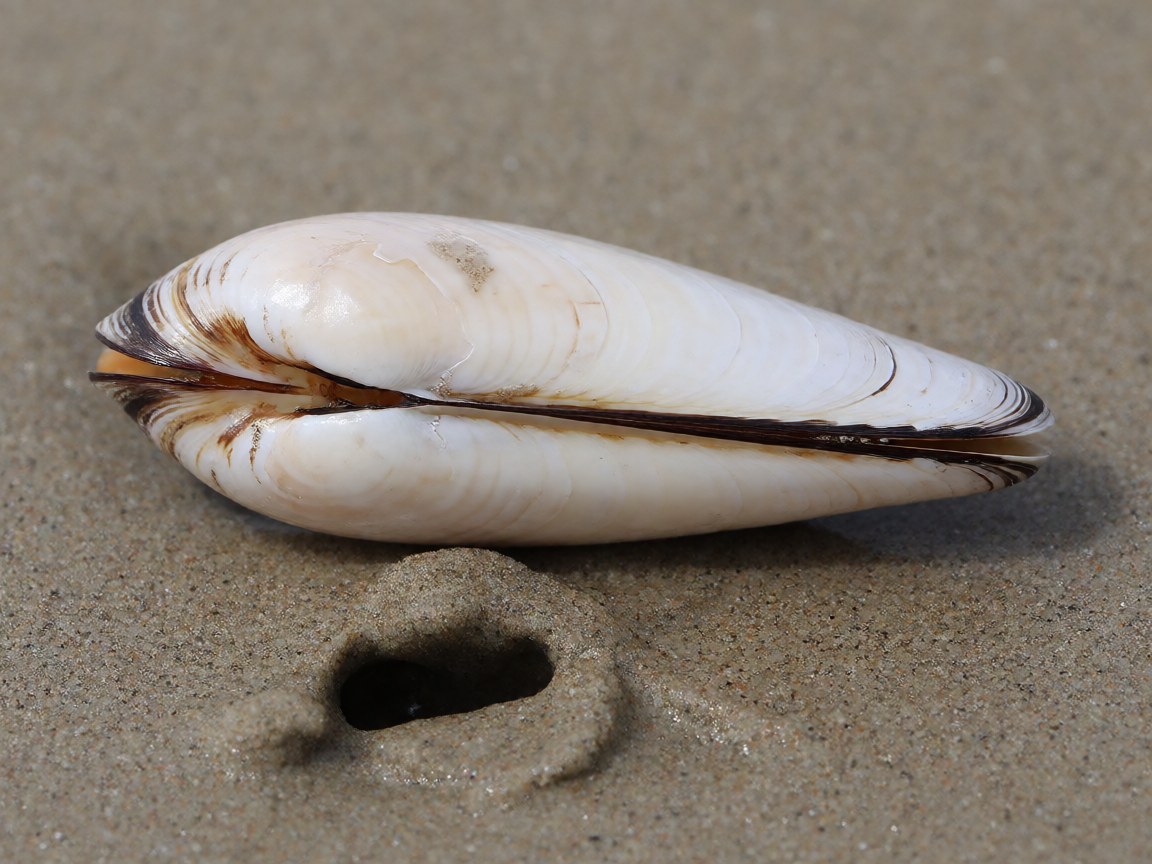
Ensis siliqua | Pod Razor
Introduction
The pod razor (Ensis siliqua) is the long, straight, knife-shaped bivalve that burrows deep into clean sand on exposed beaches, leaving only a keyhole-shaped slit in the surface to betray it. Its smooth, glossy shell can reach over twenty centimetres, which makes it the largest European razor clam. Finding one means digging fast: at the first vibration the clam shoots downward and can vanish half a metre into the sand in seconds.
Taxonomy
Ensis siliqua is a marine bivalve mollusc in the family Pharidae, the razor shells, a group specialised for rapid burrowing. It belongs to the same class as the common mussel, Mytilus edulis, sharing the two-valved shell, the muscular foot, and the filter-feeding habit, but where the mussel lives fixed to rock by threads, the pod razor has turned the elongate, streamlined shell and a powerful foot into a burrowing machine.
Physical Characteristics
The shell is long, narrow, and almost straight, with the two ends only very slightly curved, and it can reach twenty to twenty-three centimetres long, though fifteen is more typical. The valves are thin, brittle, and glossy, creamy white to pale olive-yellow, covered in a greenish-brown varnish-like outer skin that flakes away on dead shells. There is a purple-brown band near the rounded front end. Both ends gape permanently. The foot is large, white, and extremely powerful.
Habitat
It lives buried vertically in clean, firm sand, from the low shore down to depths of about forty metres, favouring exposed open-coast beaches and sandy bays with strong water movement. It is found in the eastern Atlantic from Norway south to the Mediterranean and around the British Isles. Because it needs clean, stable sand and plenty of water movement to bring food, it disappears from muddy or heavily disturbed ground.
Diet
It is a suspension feeder. Buried vertically, it holds its short siphons just at or above the sand surface, drawing in water from which the gills strain plankton and fine organic particles; the trapped food is passed to the mouth in mucus. Feeding stops instantly when the clam is disturbed, and the siphons are withdrawn before the animal begins its rapid escape downwards.
Reproduction
The sexes are separate, and spawning takes place in spring and summer, with eggs and sperm released into the water. The larvae drift in the plankton for several weeks before settling onto suitable sand and burrowing immediately. Razor clams grow relatively quickly for a bivalve, and their burrowing ability improves with size, which is why the largest individuals are also the hardest to dig out.
Conservation
The species is not considered threatened and remains common on suitable beaches, but it is heavily fished in places by hand-digging, dredging, and electro-fishing, and dense local beds can be depleted. Because the animals are slow to recolonise and live in a habitat easily damaged by dredging, management in some areas limits how and where they may be taken. Stocks otherwise remain stable.
Fun Facts
- It can burrow downward extremely fast, escaping deep into the sand within seconds.
- The shell gapes at both ends and cannot close completely, so it relies on depth, not sealing.
- Its shell is thin and brittle; finding an undamaged one on the beach is unusual.
- Foragers locate them by the small keyhole-shaped slit they leave in the wet sand.
- A sprinkle of salt in the slit, or a swift spade, are the traditional ways to bring one up.