 By st20113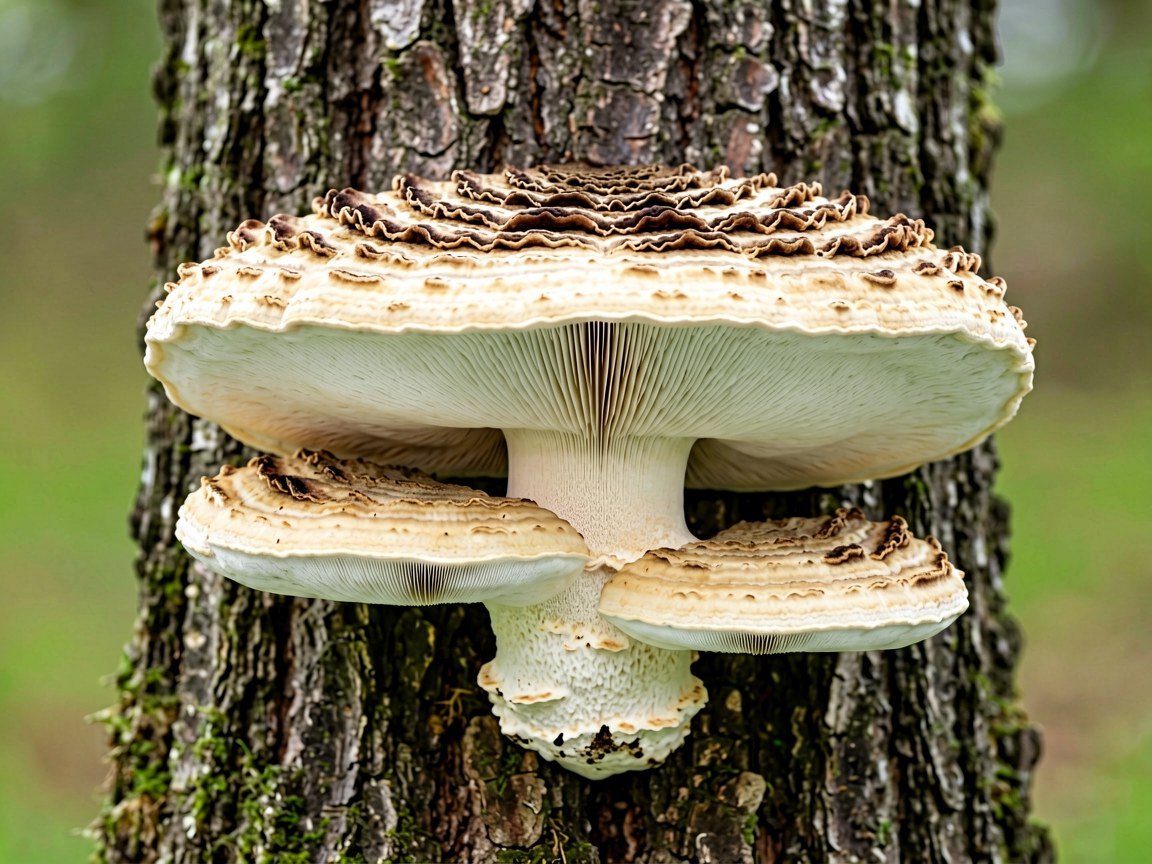
Polyporus squamosus | Dryad’s Saddle
Introduction
Dryad’s saddle (Polyporus squamosus) is a large, fan-shaped bracket fungus of broadleaf trees, named for the pale scaly cap that resembles a saddle. Its brackets can reach half a metre across and weigh several kilograms, appearing on trunks and stumps in spring and early summer, often high above the ground. Smelling faintly of watermelon or cucumber when fresh, it is a striking and easy-to-recognise fungus of parks, orchards, and woodland edges.
Taxonomy
Polyporus squamosus is a basidiomycete in the family Polyporaceae, whose members release spores from tiny pores rather than from gills. Its thick, scaly, stalked bracket sets it apart from the thin, flat, stalkless brackets of many of its relatives, and its whole way of life differs from that of the fleshy gilled mushrooms of the genus Amanita, such as the fly agaric, which feed in partnership with tree roots rather than on the wood itself.
Physical Characteristics
The bracket is fan- or kidney-shaped, ten to fifty centimetres across, attached to the tree by a short, thick, lateral stem. The upper surface is pale cream to yellowish-buff, covered in concentric rings of darker brown, flattened scales that give the saddle-like texture. The underside is creamy-white and pitted with large, angular pores, one to two per millimetre. The flesh is thick, white, and succulent when young, becoming tough and corky with age; fresh specimens smell distinctly of watermelon or cucumber.
Habitat
It grows on living and dead broadleaved trees, especially elm, sycamore, ash, beech, maple, and willow, and is common in parks, avenues, orchards, and gardens as well as in woodland. Brackets often appear from wounds or from dead branches high on the trunk. It fruits mainly in spring and early summer, sometimes again in autumn, and is found across Europe, North America, and much of the northern hemisphere.
Diet
The fungus is both a parasite and a saprotroph: it attacks living trees, entering through wounds, and continues to feed after the tree or branch dies. It causes a white rot, breaking down both the pale cellulose and the dark lignin of the wood and leaving it pale, soft, and stringy. Structurally this weakens the timber of living trees, and a heavy bracket on a trunk is a sign that decay is well advanced inside.
Reproduction
Spores develop inside the tubes on the underside of the bracket and are released into the air, mainly in mild, humid weather. A spore that reaches a suitable wound or patch of dead wood germinates into a thread network that grows into the timber. The bracket is short-lived—often a few weeks, after which it rots, dries, or is eaten by insects—while the network inside the wood persists for years and may produce new brackets in following seasons.
Conservation
The species is common, widespread, and not threatened. It benefits from mature and decaying trees and from the practice of leaving dead wood standing, and it declines where old trees are removed and wounds sealed. Foragers value the young, tender brackets, but older ones are tough and inedible. Because it damages living trees, it is sometimes of concern to arborists managing avenues and park specimens.
Fun Facts
- Fresh brackets smell distinctly of watermelon or cucumber.
- A single bracket can weigh several kilograms and span half a metre.
- The darker concentric scales on the cap give it its saddle-like appearance.
- It causes white rot, leaving the wood pale, soft, and stringy.
- Despite its size, the bracket usually lasts only a few weeks before decaying.