 By st20113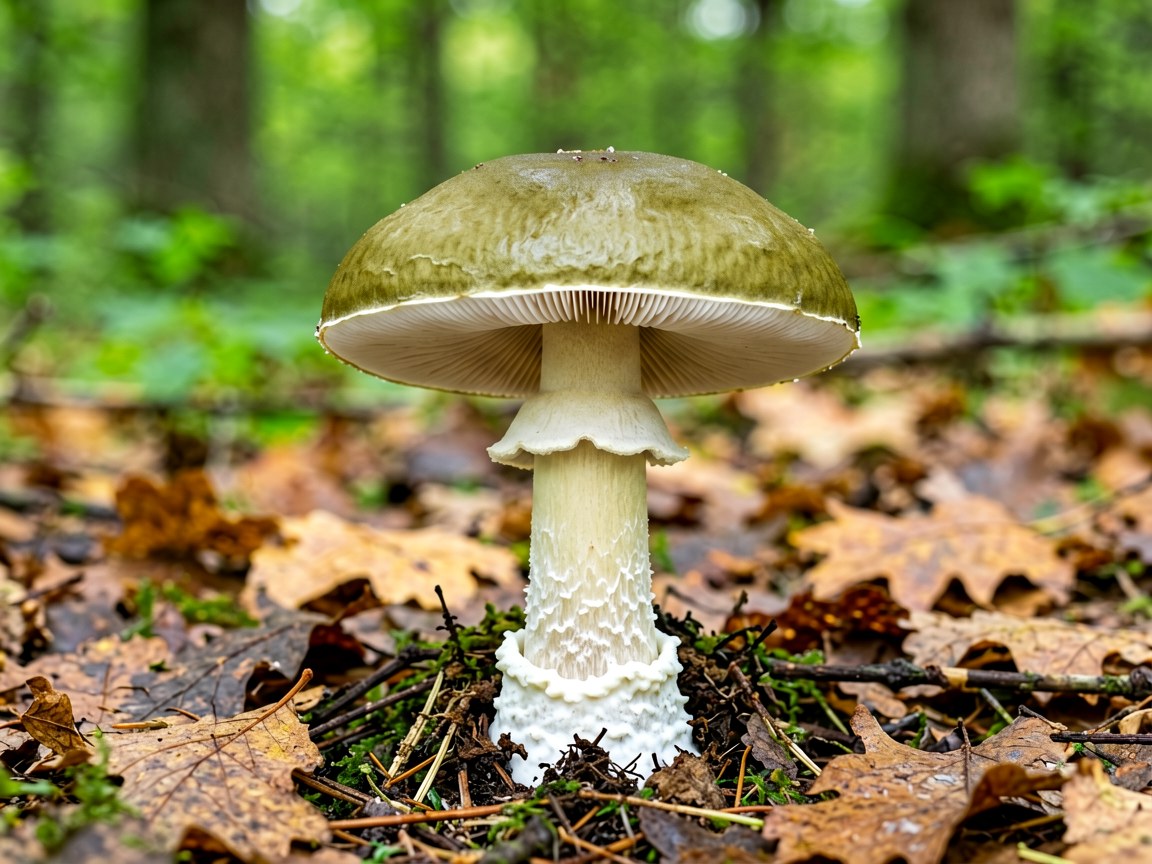
Amanita phalloides | Death Cap
Introduction
The death cap (Amanita phalloides) is responsible for more fatal mushroom poisonings than any other species in the world. An elegant, olive-green capped mushroom with a skirt-like ring and a cup at the base, it looks harmless and is said to taste pleasant, which is precisely the danger: a single cap can kill an adult, and the symptoms begin only after the poison has already done its worst damage. It fruits in broadleaf woodland in summer and autumn.
Taxonomy
Amanita phalloides is a basidiomycete in the family Amanitaceae and the type species of the section Phalloideae within the genus Amanita, the genus that also contains the red-and-white fly agaric. It shares with its relatives the distinctive combination of a universal veil that leaves a sac-like volva at the base, a ring on the stem, white spores, and free gills—features that separate the genus from the ordinary field mushrooms people pick.
Physical Characteristics
The cap is five to fifteen centimetres across, convex then flattening, and variable in colour from pale yellow-green through olive to brownish, sometimes almost white, usually smooth and slightly sticky when wet and often with a faint radial fibre pattern. The gills beneath are white, crowded, and free of the stem. The stem is eight to fifteen centimetres tall, pale, with a pendant white ring, and it rises from a loose, bag-like white volva buried in the soil—the single most important identification feature. The flesh is white and smells faintly sweet or of honey, especially in older specimens.
Habitat
Death caps grow in mycorrhizal association with the roots of broadleaved trees, especially oak, beech, chestnut, and hazel, and sometimes with conifers. They appear in woodland, parkland, and occasionally gardens from late summer into autumn, often in the same places year after year. Native to Europe, the fungus has been spread around the world on the roots of imported trees and is now established in North America, Australia, New Zealand, and southern Africa.
Diet
It is not a decomposer. The death cap forms a mycorrhizal partnership with tree roots: its fine threads sheathe the root tips and extend far into the soil, taking up water and minerals—especially phosphorus and nitrogen—and passing some to the tree in exchange for sugars the tree has made by photosynthesis. Both partners benefit, and the mushroom body people see is only the temporary fruiting stage of a network that lives underground for years.
Reproduction
Spores are produced on the gills under the cap and are shed into the air, dispersed by wind. A spore that lands near a compatible tree root may germinate and fuse with the root, establishing a new mycorrhizal partnership. The fruit bodies appear when conditions suit—warm, moist autumn weather—and last for a week or two. Because the feeding network is long-lived and hidden, a ring of mushrooms may reappear in the same spot for many seasons.
Conservation
The species is common, widespread, and of no conservation concern; if anything it is expanding as its host trees are planted and moved. The serious issue is human safety: poisoning cases still occur every year, often among people mistaking it for an edible species or among newcomers unfamiliar with local fungi. Cooking, drying, or freezing does not destroy its toxins, and there is no reliable home test to make it safe.
Fun Facts
- It causes more deaths from mushroom poisoning than any other fungus in the world.
- Symptoms may not begin for six to twenty-four hours, by which time serious damage is already done.
- The bag-like cup at the base of the stem is the key feature for telling it apart from edible mushrooms.
- Cooking, drying, and freezing do not destroy its toxins.
- It has spread worldwide by travelling on the roots of imported European trees.