 By st20113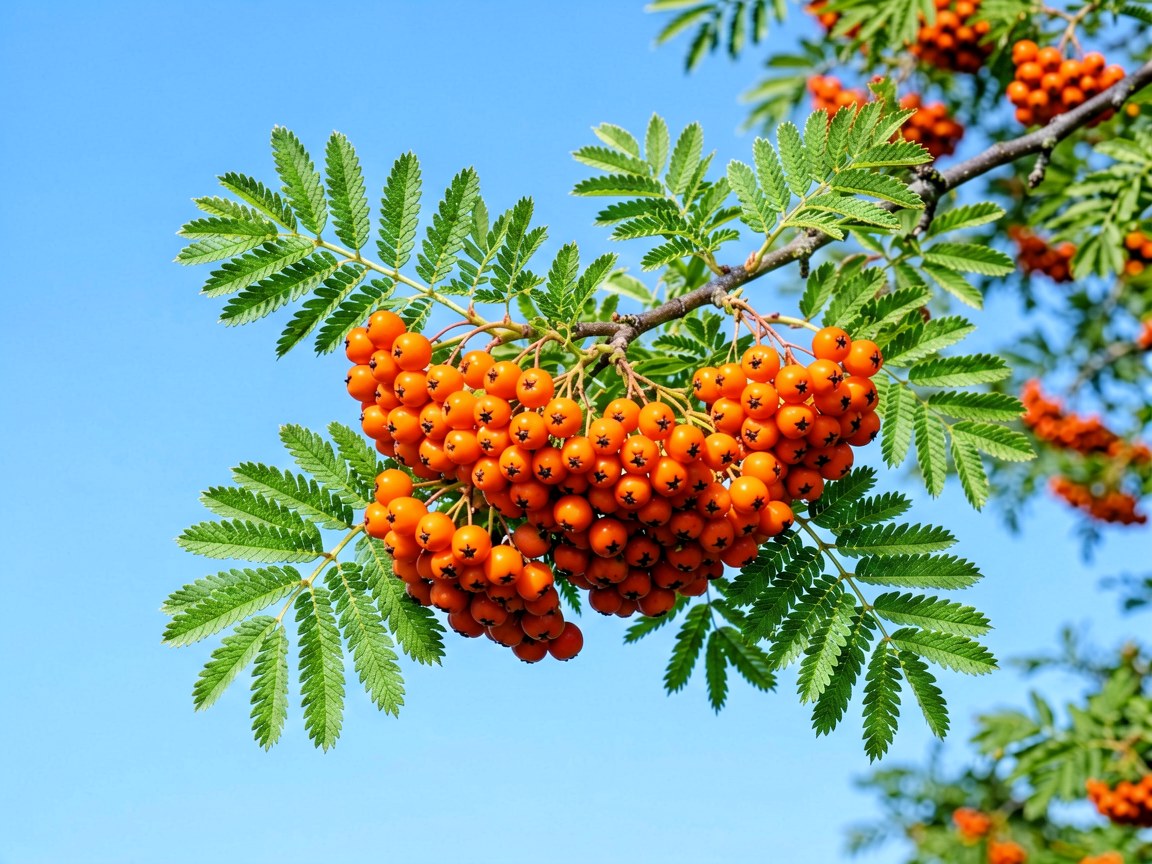
Sorbus aucuparia | Rowan
Introduction
Rowan (Sorbus aucuparia), also called mountain ash, is a slender, upright tree famous for its clouds of creamy spring flowers and its heavy bunches of bright orange-red berries in autumn. Native to much of Europe, it grows from lowland hedgerows to mountain slopes and is one of the most planted and beloved of all small trees. Its berries are a vital autumn food for birds, and the tree has long been surrounded by folklore.
Taxonomy
Rowan belongs to the family Rosaceae, the rose family, in the genus Sorbus, which holds the whitebeams and rowans. It is the common European rowan and a parent of several garden hybrids. As a green plant it depends on Photosynthesis, using its feathery leaves to make the sugars stored in its wood and, later, its berries.
Physical Characteristics
Rowan is a deciduous tree usually 8–15 m tall, with smooth grey bark and a narrow, domed crown. Its leaves are pinnate—divided into 5–8 pairs of toothed leaflets with a terminal one—giving a feathery look. In late spring it carries broad, flat heads of small five-petalled white flowers. These develop into hanging clusters of glossy, spherical berries about 8 mm across, turning vivid orange-red and lasting into winter.
Habitat
Rowan is remarkably adaptable. It grows on acidic and alkaline soils, in woodland, on rocky hillsides, along hedgerows, and in gardens and churchyards, often on sites too poor or exposed for many other trees. It tolerates wind and altitude and is common in upland Britain and Scandinavia, where it may be the only tree for miles.
Diet
Rowan is autotrophic. Through the summer its leaves perform photosynthesis, converting sunlight into the sugars that ripen the berries and feed the tree. Its roots draw water and minerals from the soil. It does not trap or consume animals; its only “diet” is light, air, and soil nutrients.
Reproduction
The flowers are pollinated chiefly by insects, and each fertilised flower becomes a berry containing a few small seeds. The berries are eaten by birds—especially thrushes and waxwings—which disperse the seeds in their droppings. Rowan also grows readily from seed and suckers, and its berries’ high sugar content fuels the birds through autumn and winter.
Conservation
Rowan is abundant and not threatened. It is widely planted as an ornamental and a street tree and is valued for the wildlife it supports, from pollinating insects to berry-eating birds. Because it thrives on poor ground, it is often used in restoration and amenity planting, helping maintain rural biodiversity.
Fun Facts
- Its berries are among the first bright autumn foods for migrating waxwings.
- The tree was long planted near houses to ward off lightning and witchcraft in folklore.
- “Mountain ash” is a misleading name—it is not an ash but a member of the rose family.
- The berries are very sour raw but make a traditional jelly that cuts the richness of game.
- Rowan can grow higher up mountains than almost any other broadleaf tree in Europe.