 By st20113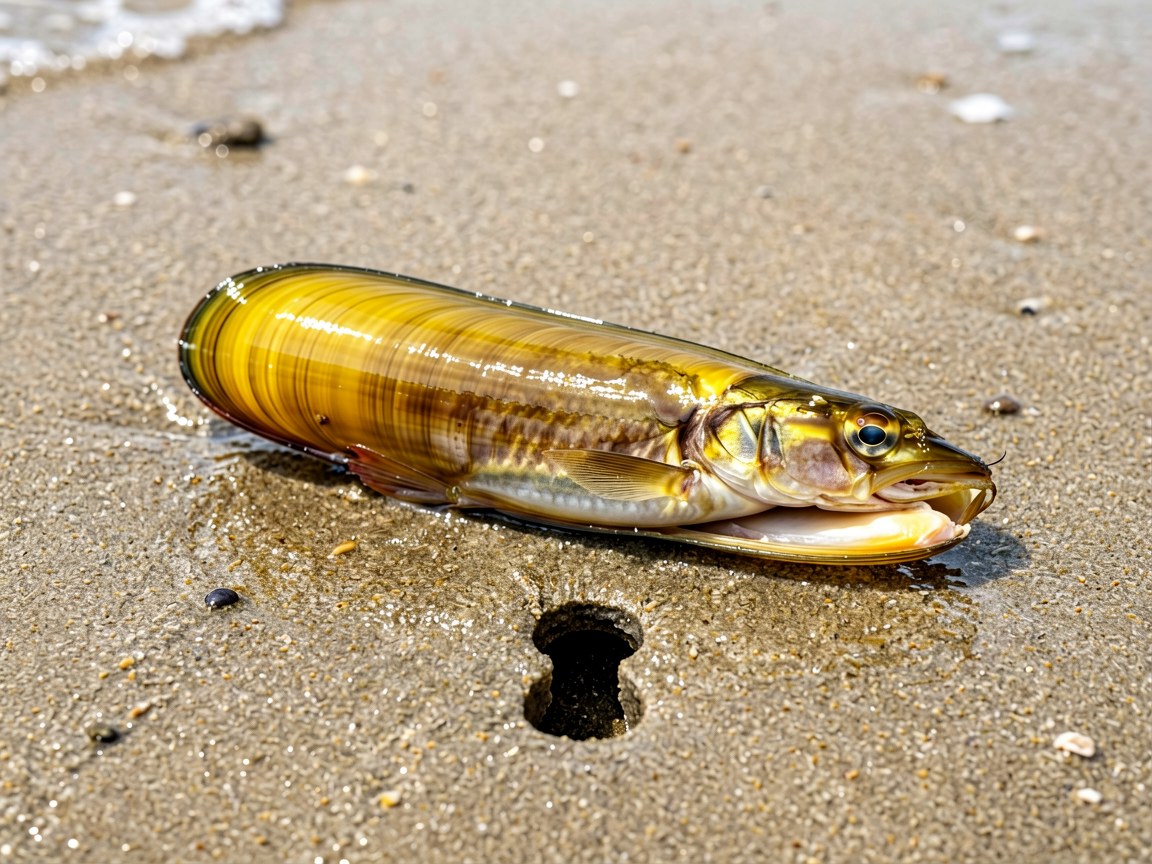
Ensis ensis | Razor Clam
Introduction
The razor clam (Ensis ensis) is a long, narrow bivalve named for its shell’s resemblance to an old-fashioned straight razor. It lives buried deep in sandy shores, where it can be remarkably fast for a clam, jetting up and down through the sediment. Found on the coasts of north-west Europe, it is a favourite of both shorebirds and human collectors, and a familiar sight when its twin shells gape at the surface.
Taxonomy
Ensis ensis is a mollusc in the class Bivalvia—the clams, oysters, and mussels—within the family Pharidae, the razor clams. It is one of several Ensis species found in European seas. Like the better-known Mytilus edulis, the common mussel, it is a filter-feeding bivalve, drawing food from the water rather than chasing it.
Physical Characteristics
The razor clam has a thin, elongated, roughly rectangular shell 10–20 cm long, glossy and pale yellow-brown with purplish markings toward the ends. The two halves are hinged at one short end and gape at the other. Inside the shell is a soft body with a long muscular foot and a pair of siphons that reach to the surface. The whole animal is built for rapid burrowing.
Habitat
Razor clams inhabit clean, soft sandy sediments, from the lower shore down into shallow subtidal waters. They prefer exposed and moderately exposed beaches where the sand is well washed by the tide. Buried vertically with only the siphon tips at the surface, they are cryptic and easily missed until the tell-tale keyhole-shaped holes appear as the tide falls.
Diet
Razor clams are filter feeders. They extend their siphons to the surface and pump water through their gills, trapping plankton and organic particles on sticky mucus and passing them to the mouth. They do not graze or hunt; instead they sieve their meals from the water column, playing a part in cleaning the surrounding sediment and water.
Reproduction
Razor clams have separate sexes and spawn by releasing eggs and sperm into the sea, where fertilisation occurs. The planktonic larvae drift and feed before settling into the sand and burrowing as tiny clams. They grow over several years, and their deep burrowing lifestyle helps them avoid many predators once they are established.
Conservation
Ensis ensis is widespread and not considered globally threatened, though it is locally fished and hand-gathered, sometimes heavily, which can reduce numbers on popular beaches. Because it depends on clean sand, water quality and undisturbed sediments matter. Sensible limits on collecting and protection of nursery beaches help keep stocks healthy.
Fun Facts
- A razor clam can bury itself in sand faster than a person can dig, using its muscular foot like a drill.
- Its shell shape gave it the name “razor”—it looks like a closed pocket knife.
- To escape, it can contract its foot and shoot water, propelling it downward in a jet.
- It breathes and feeds through two siphon tubes that just peek above the sand.
- The shell gapes open at the buried end, letting the clam stay connected to the surface.