 By st20113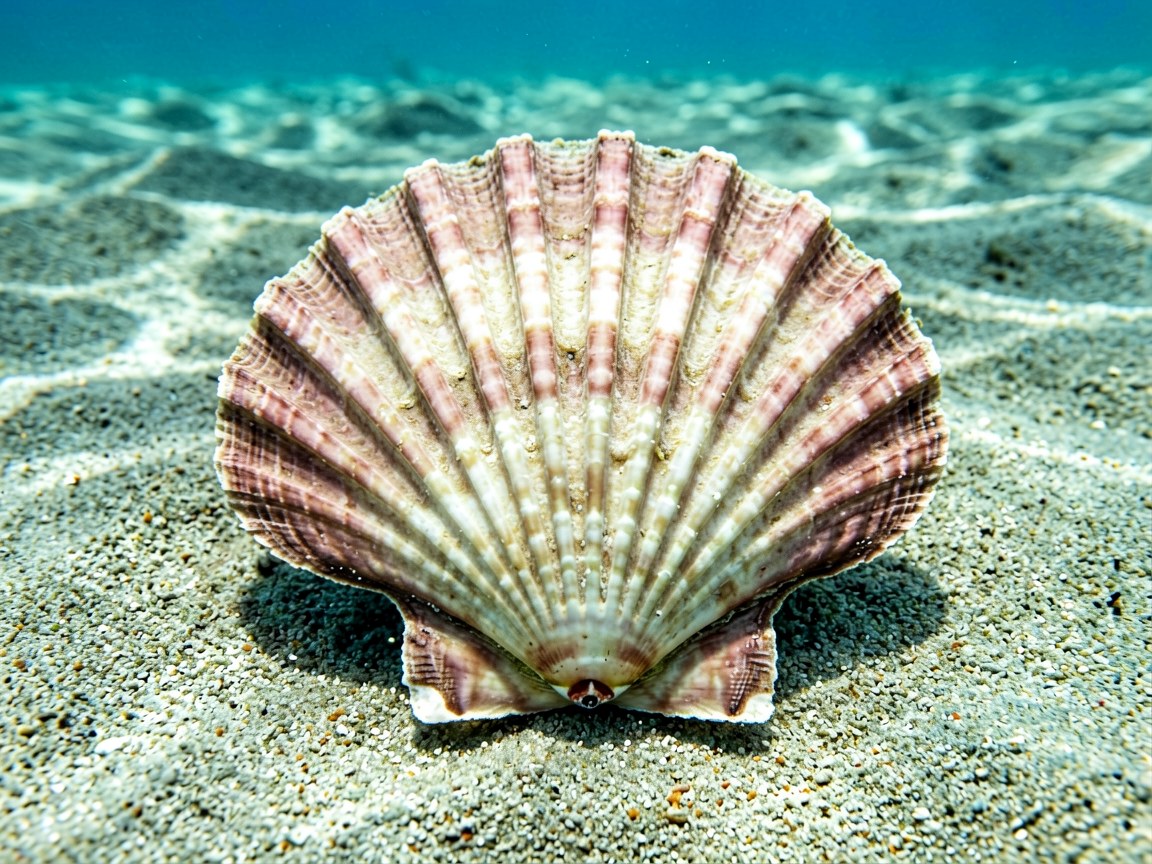
Pecten maximus | Great Scallop
Introduction
The great scallop (Pecten maximus), sometimes called the king scallop, is the largest and most striking bivalve of European shelf seas, recognised by its handsome fan-shaped shell with deep radiating ribs. Unlike most shellfish it is free-living rather than attached, and it can swim by clapping its two valves together to jet away from danger. Prized as seafood for its sweet white adductor muscle, it supports one of the most valuable shellfish fisheries in the north-east Atlantic.
Taxonomy
Pecten maximus belongs to the family Pectinidae within the class Bivalvia and the phylum Mollusca, the same great group of shellfish that includes Mytilus edulis (Common Mussel). Where the mussel anchors itself to rocks with tough byssal threads, the scallop lies free on the seabed and swims—a difference that sets the two families apart. The genus name Pecten is Latin for “comb,” a reference to the comb-like ribs.
Physical Characteristics
The shell reaches 10–15 cm, occasionally more, and is fan-shaped with a straight hinge line flanked by two wing-like “ears.” The lower valve is deeply convex and pale cream to reddish-brown, while the upper valve is almost flat and usually darker, giving the closed shell a characteristic asymmetric profile. Both valves carry 15–17 broad, rounded radiating ribs crossed by fine concentric lines. The most remarkable feature is the row of up to 200 tiny blue eyes along the edge of the mantle, each with a lens and retina, which detect movement and shadows.
Habitat
Great scallops live on the seabed on clean sand, gravel, shell, or maerl from the low shore down to about 100 meters, most commonly between 20 and 70 meters. They lie loosely on the surface rather than burrowing, often in slight depressions, and may be found in scattered beds across large areas. They are distributed from northern Norway south along the Atlantic coasts of Europe to the Iberian peninsula and into the Mediterranean.
Diet
The scallop is a filter feeder. Water is drawn into the shell between the valves, passed over the gills, and the suspended microscopic algae and organic particles are trapped in mucus and carried to the mouth; the filtered water is then expelled. Adults filter several litres of water an hour, and because beds can be dense, they play a real part in clearing and cycling nutrients in coastal waters.
Reproduction
Scallops are functional hermaphrodites, each individual carrying both male and female tissue, usually releasing sperm and eggs at different moments to reduce self-fertilisation. Spawning occurs in spring and summer, triggered by rising water temperature, with eggs and sperm released into open water. The larvae drift as plankton for around a month before settling onto the seabed and metamorphosing into juveniles. Settlement is highly variable, so year classes differ dramatically in strength.
Conservation
The great scallop is commercially valuable and is taken by divers and by dredges. Dredging can damage the seabed and the communities living on it, so management in many areas restricts gear type, sets minimum landing sizes, and uses seasonal and area closures. Several European scallop fisheries have been certified as sustainable, and scallop dredging is increasingly managed to protect sensitive habitats such as maerl beds and reefs.
Fun Facts
- It is one of the few bivalves that can genuinely swim, clapping its valves to jet away from predators.
- Up to 200 tiny blue eyes line the edge of its mantle, each able to detect movement and shadows.
- The lower shell is deeply convex while the upper one is almost flat—a distinctive asymmetry.
- The tender white “scallop” sold in shops is the adductor muscle that claps the shell shut.
- The scallop shell became a symbol of pilgrimage in medieval Europe and is still the emblem of the Camino de Santiago.
[…] animal shares the family with the Great Scallop. That animal grows much larger. It lives in deeper water on clean sand. Our animal stays in shallow […]