 By st20113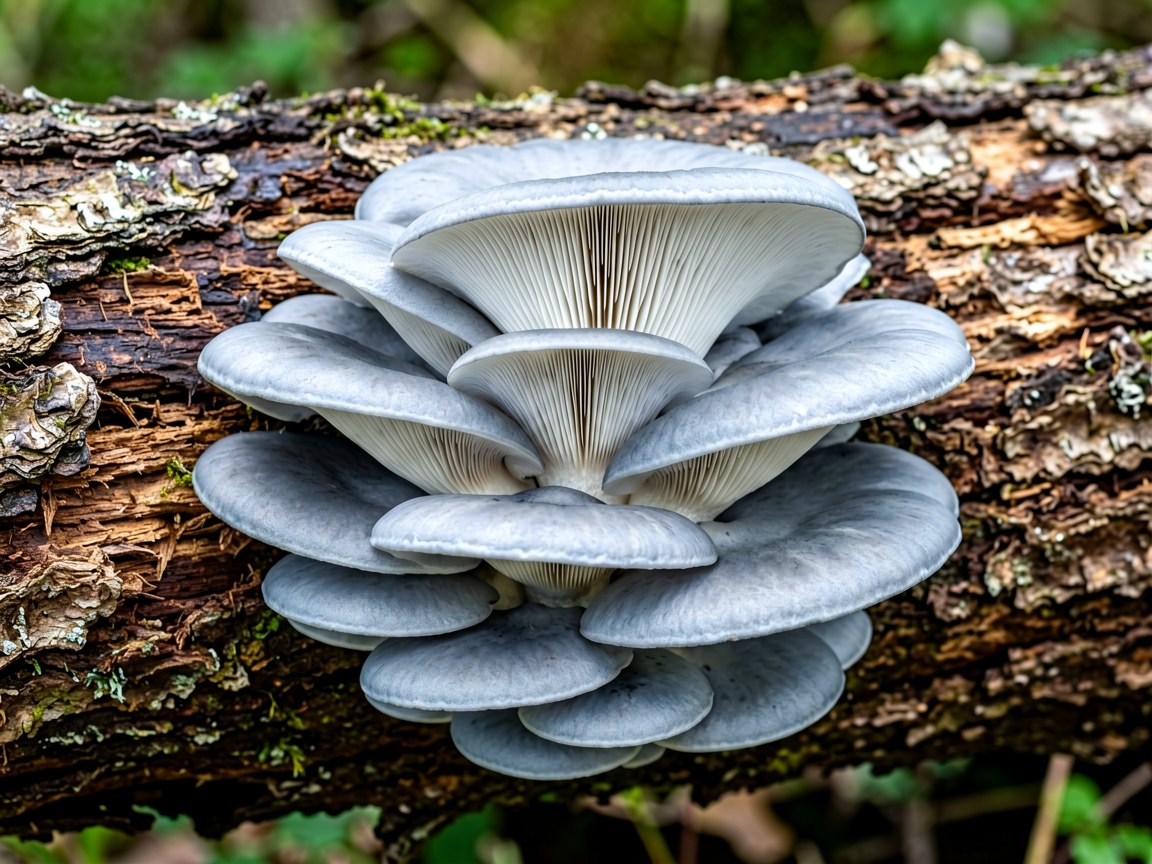
Pleurotus ostreatus | Oyster Mushroom
Introduction
The oyster mushroom (Pleurotus ostreatus) is a pale, fan-shaped fungus that grows in tiered, shelf-like clusters on decaying wood, its shell-shaped caps overlapping like a stack of oysters. Common in woodland across Europe and North America, it appears on fallen logs, stumps, and standing dead trees, often through the cooler months. It is also one of the most widely cultivated edible mushrooms in the world—and, remarkably, it is a predator that hunts microscopic worms.
Taxonomy
Pleurotus ostreatus belongs to the family Pleurotaceae within the order Agaricales, in the phylum Basidiomycota—the same large fungal group that includes Amanita muscaria (Fly Agaric). The genus name comes from the Greek pleuron, meaning “side,” referring to the way the stem attaches to the side of the cap, and the species name ostreatus means “oyster-like,” a reference to both its shape and its reputed flavour.
Physical Characteristics
The cap is 5–20 cm across, smooth, moist, and broadly fan- or oyster-shaped, attached to the wood at the side rather than at the center. Color varies with temperature and strain, from pale grey and blue-grey through buff and tan to dark brown. The gills are white to cream, crowded, and run all the way down the short, stubby stem. The stem itself is short, tough, and off-center or virtually absent. The flesh is white and firm.
Habitat
This species is a saprotroph, growing on dead and dying wood, particularly beech and other broadleaf trees, but also on many other hardwoods and occasionally conifers. It fruits on fallen logs, stumps, branches, and standing dead trees, and can be found in almost any month of the year, though it is most plentiful in autumn and winter. Because it colonises dead wood so readily, it is easy to cultivate on straw, sawdust, and other agricultural waste.
Diet
The oyster mushroom feeds primarily on dead wood, secreting enzymes that break down lignin and cellulose and absorbing the released nutrients—one of the relatively few organisms able to digest both. Unusually for a fungus, it is also carnivorous: its mycelium produces tiny toxin-containing droplets that paralyse nematodes, or roundworms, allowing the fungus to grow into them and digest their nitrogen-rich bodies. This supplements the nitrogen that wood alone cannot supply.
Reproduction
The clustered caps are the fruiting bodies of a mycelium running through the decaying wood. Spores are produced in enormous numbers on the gills and released into the air, drifted away by wind to colonise new wood. Because it grows so vigorously on a wide range of woody and fibrous substrates, it has become one of the easiest and most productive mushrooms to cultivate commercially and at home.
Conservation
The oyster mushroom is common and not threatened, and its abundance is tied to the availability of dead wood—which intensive forestry and tidy woodland management often remove. Leaving standing dead trees and fallen logs in place is the simplest way to support it and the many other species that depend on decaying wood. It has also been studied for cleaning contaminated soils, because its enzymes can break down certain pollutants.
Fun Facts
- It is a carnivorous mushroom: its mycelium paralyses and digests microscopic roundworms to obtain nitrogen.
- It is one of the most widely cultivated mushrooms in the world and will grow on straw, sawdust, and even coffee grounds.
- The caps grow in tiered, overlapping clusters that look like a stack of oysters.
- It can break down both lignin and cellulose, making it a powerful decomposer of wood.
- Some strains are pale blue-grey when young and fade to buff as they age and warm up.