 By st20113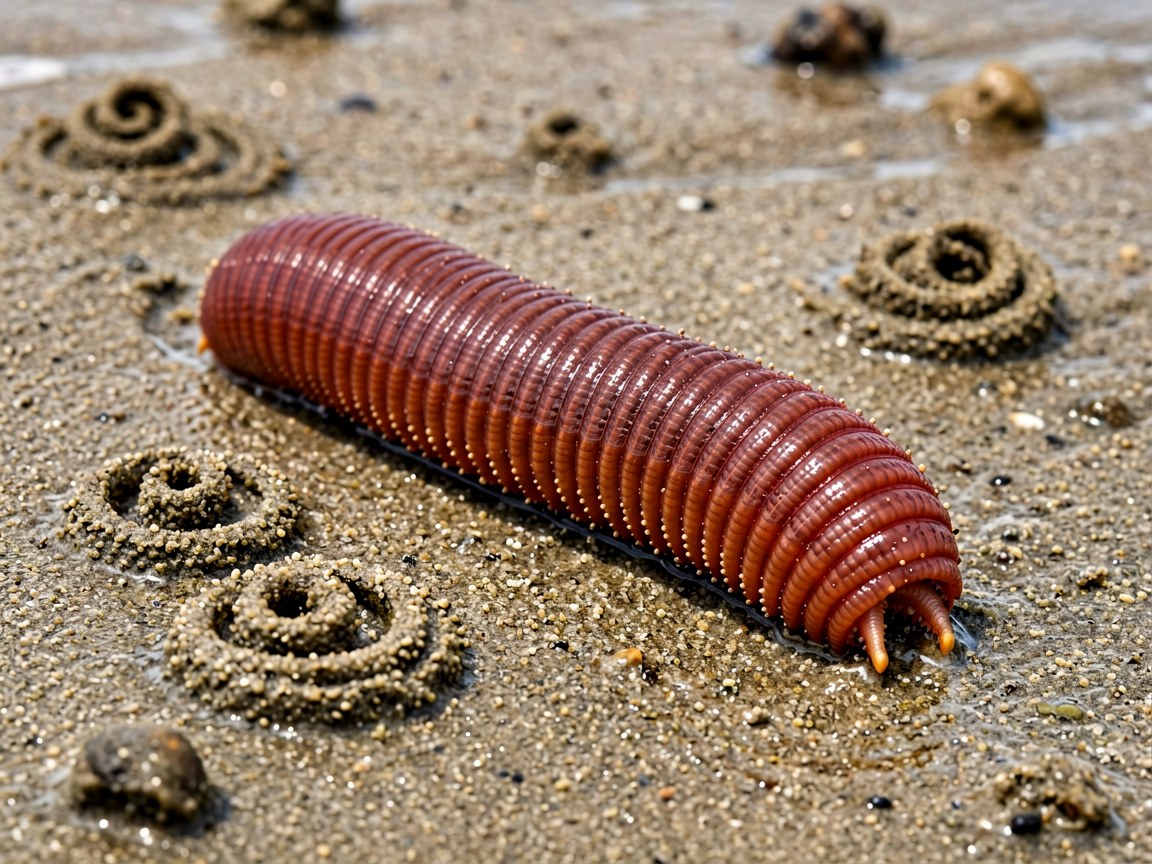
Arenicola marina | Lugworm
Introduction
The lugworm (Arenicola marina) is a large, fleshy segmented worm that lives buried in the sand of sheltered beaches and tidal flats across north-west Europe. Though the animal is rarely seen, its presence is unmistakable: at low tide the sand is dotted with coiled casts of processed sediment and small funnel-shaped depressions. A tireless recycler of the shore, it swallows sand and strains out the organic matter, and in doing so supports vast numbers of wading birds and fish.
Taxonomy
Arenicola marina belongs to the family Arenicolidae within the class Polychaeta and the phylum Annelida—the segmented worms, a group that also includes Lumbricus terrestris (Common Earthworm). Like its terrestrial relatives, its body is built from repeated segments, each bearing bristles called chaetae that grip the burrow walls. The genus name means “sand-dweller,” an accurate description of its preferred home.
Physical Characteristics
A large lugworm reaches 12–20 cm in length and is distinctly divided into three regions. The front section is thick and muscular, bearing the mouth and a large eversible pharynx used to swallow sediment. The middle section carries paired feathery red gills and is slightly thinner. The rear section is pale, thinner still, and ends at the anus. The body is reddish-brown to dark green, and the worm’s blood is unusually rich in hemoglobin, giving it a deep red color and allowing it to respire efficiently in the low-oxygen conditions of its burrow.
Habitat
Lugworms live in U-shaped burrows in soft sand, muddy sand, and mud on sheltered coasts, from the mid-shore down into the shallow sublittoral. The worm sits head-down in the vertical shaft, with a funnel-shaped depression at the surface where sand collapses inward, and a coiled cast of processed sediment marking the tail end. Burrows can reach 20–40 cm deep. Densities in good habitat can exceed 50 worms per square meter.
Diet
The lugworm is a deposit feeder. It swallows the sand around it, digesting the bacteria, microscopic algae, and detritus coating each grain, and ejects the cleaned sediment as the familiar spiral cast. A single worm can process several kilograms of sediment a year, constantly turning over and aerating the seabed. This feeding makes it one of the most important ecosystem engineers of soft shores, and the nutrient-rich casts it produces feed a host of smaller organisms.
Reproduction
Lugworms have separate sexes. Spawning takes place in autumn, when sperm is released into the water and drawn into neighboring burrows, fertilizing the eggs within. The larvae develop inside the adult’s burrow or in the sediment nearby before moving out to settle in the sand. Adults are relatively long-lived for worms—often five or six years—and populations recover slowly if the adults are removed.
Conservation
The lugworm itself is abundant and not threatened, but the way it is harvested matters. It is dug commercially and recreationally as fishing bait, and intensive bait digging can strip large areas of sediment, disturb the whole invertebrate community, and remove the food supply of wading birds that depend on the flats. Many estuaries now restrict digging through permits, closed areas, and limits on quantities. Protecting lugworm beds is essentially protecting the shorebirds that feed on them.
Fun Facts
- The curled coils of sand you see on beaches at low tide are lugworm casts—the worm’s processed sediment.
- Its blood is bright red because it is packed with hemoglobin, an unusual trait that lets it survive in oxygen-poor sand.
- It is one of the key foods of curlews, redshanks, oystercatchers, and bar-tailed godwits.
- A single lugworm can shift several kilograms of sand each year, constantly turning over the beach.
- Fishermen prize it so highly that bait digging is regulated in many European estuaries to protect the flats.