 By st20113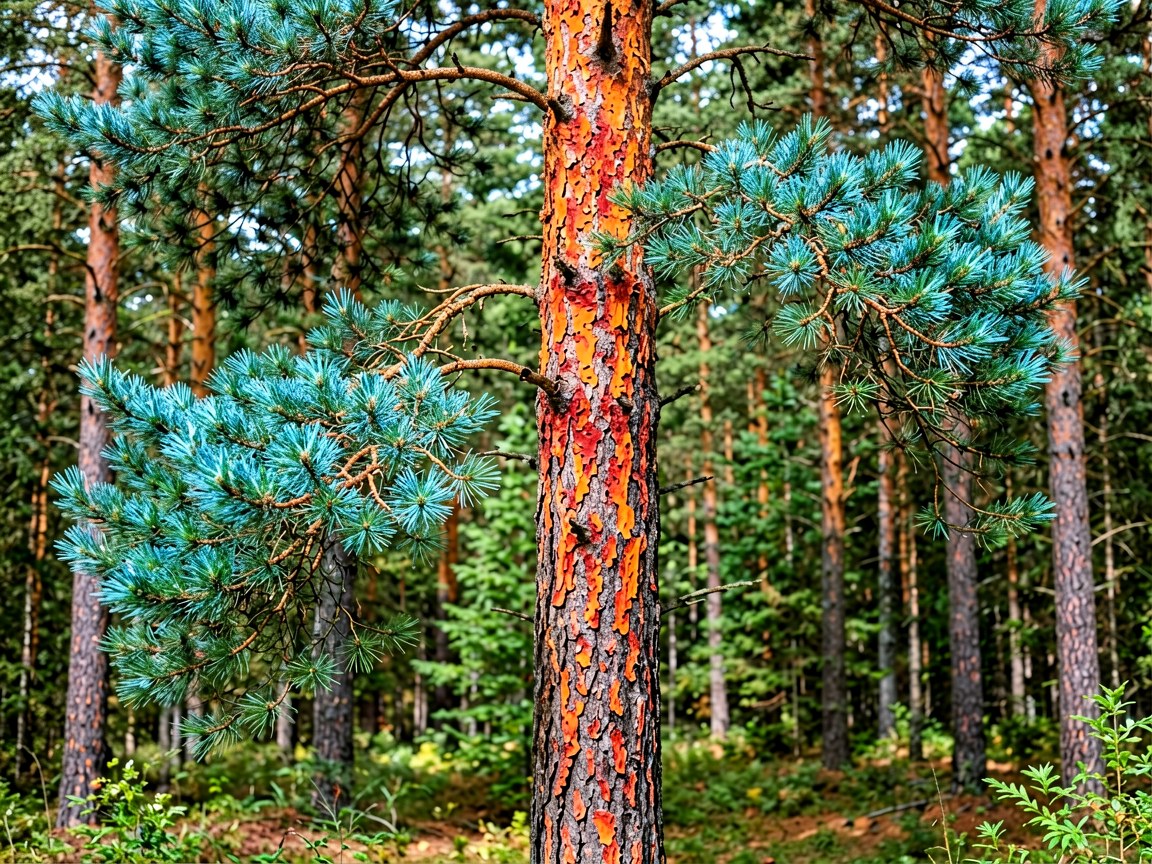
Pinus sylvestris | Scots Pine
Introduction
The Scots Pine (Pinus sylvestris) is the only pine native to Britain and one of the most widespread trees in the northern hemisphere, a hardy evergreen conifer that marches across the boreal forest from Scotland to Siberia. Typically 20–40 m tall, with a bare, reddish lower trunk and a flat-topped crown of dark green needles, it is the classic tree of heathland, moor, and northern woodland.
Tough, long-lived, and tolerant of cold, drought, and poor soils, the Scots Pine is a foundation species of some of the planet’s largest forests. Its fallen needles, open canopy, and abundant cones create a distinctive world of lichens, fungi, and birds, from the capercaillie to the crossbill that has evolved to crack its seeds.
Taxonomy
Pinus sylvestris was described by Linnaeus in 1753; the genus name Pinus is the Latin for pine, and sylvestris means “of the forest.” It belongs to the family Pinaceae, the pine family, within the conifers—ancient, needle-leaved plants quite separate from the broadleaved trees.
Like all green plants, the Scots Pine relies on the process described in our article on Photosynthesis (the plant energy process), capturing sunlight in its needles to build the sugars that carry it through long, cold winters when growth all but stops. Among Pinaceae it is the most widely distributed pine, ranging farther north than almost any other tree.
Physical Characteristics
The Scots Pine is evergreen, carrying its slender, blue-green needles in pairs on short shoots, each needle 4–7 cm long and lasting two to four years before being shed. Young trees are conical, but with age the crown opens into an irregular, flat or rounded dome, and the bark becomes strikingly orange-brown and flaky on the upper trunk while remaining dark and fissured below.
Its cones are 3–7 cm, grey-brown, and persist on the tree for several years before opening to release winged seeds. The wood is pale, resinous, and durable, prized for timber, poles, and pulp, and the tree exudes sticky resin that seals wounds and deters attackers.
Habitat
The Scots Pine favours light, well-drained, often acidic and sandy soils, and a cool to cold climate; it dominates the boreal zone and also grows on heathland, peat, and mountain slopes. It tolerates exposure and frost that would kill broadleaved trees, and it is a pioneer on bare ground after fire or felling.
It forms the backbone of northern forests alongside spruce and birch, and in Britain it is the defining tree of the Caledonian pinewoods. Because it is light-demanding, reproductive trees need open conditions, and the species depends on disturbance—windthrow, fire, or clearance—to keep renewing the next generation.
Diet
The Scots Pine is autotrophic, fixing carbon by photosynthesis in its needles and drawing water and minerals from the soil through a deep, often mycorrhiza-rich root system. As an evergreen it photosynthesises whenever conditions allow, even in mild winter spells, giving it a head start each spring.
Its energy economy is tightly linked to fungi: the tree’s roots are joined to mycorrhizal partners that help it mine nutrients from poor soils in exchange for the sugars the pine makes, and its discarded needles form an acidic, slowly rotting litter that shapes the whole forest floor community.
Reproduction
The Scots Pine is monoecious, bearing male cones that release clouds of wind-borne pollen in spring and small female cones that, after fertilisation, develop over two to three years into the familiar woody seed cones. The seeds are winged and released to drift on the wind, though most fall close to the parent.
Seedlings need bare mineral soil and full light to establish, and growth is slow at first. A mature pine may begin bearing cones at 10–15 years and can live 150–300 years; in the boreal forest it is a keystone provider of food and nest sites for countless animals.
Conservation
The Scots Pine is abundant and rated Least Concern globally, but its finest native woodland—the ancient Caledonian pinewoods of Scotland—has been much reduced by clearance and overgrazing, leaving fragmented remnants that need active restoration. Elsewhere it is widely planted for forestry, sometimes with non-native strains.
Climate change poses a mixed threat: warming expands its range northward while exposing southern and lowland populations to drought, heat, and new pests such as pine processionary moth and bark beetles. Conservation effort centres on protecting and enlarging native pinewood, controlling deer, and planting locally adapted seed to keep the forest resilient.
Fun Facts
- It is the most widely distributed pine in the world, stretching from the Arctic Circle to the Mediterranean mountains.
- The orange, flaking bark of the upper trunk is so distinctive that the tree is identifiable from a distance.
- Its seeds are a favourite food of the crossbill, a bird whose crossed bill is specialised to prise them from the cones.
- Resin from the Scots Pine was once used for tar, turpentine, and ship caulking.
- Individual trees can live for over 250 years, enduring conditions that would fell most broadleaved neighbours.