 By st20113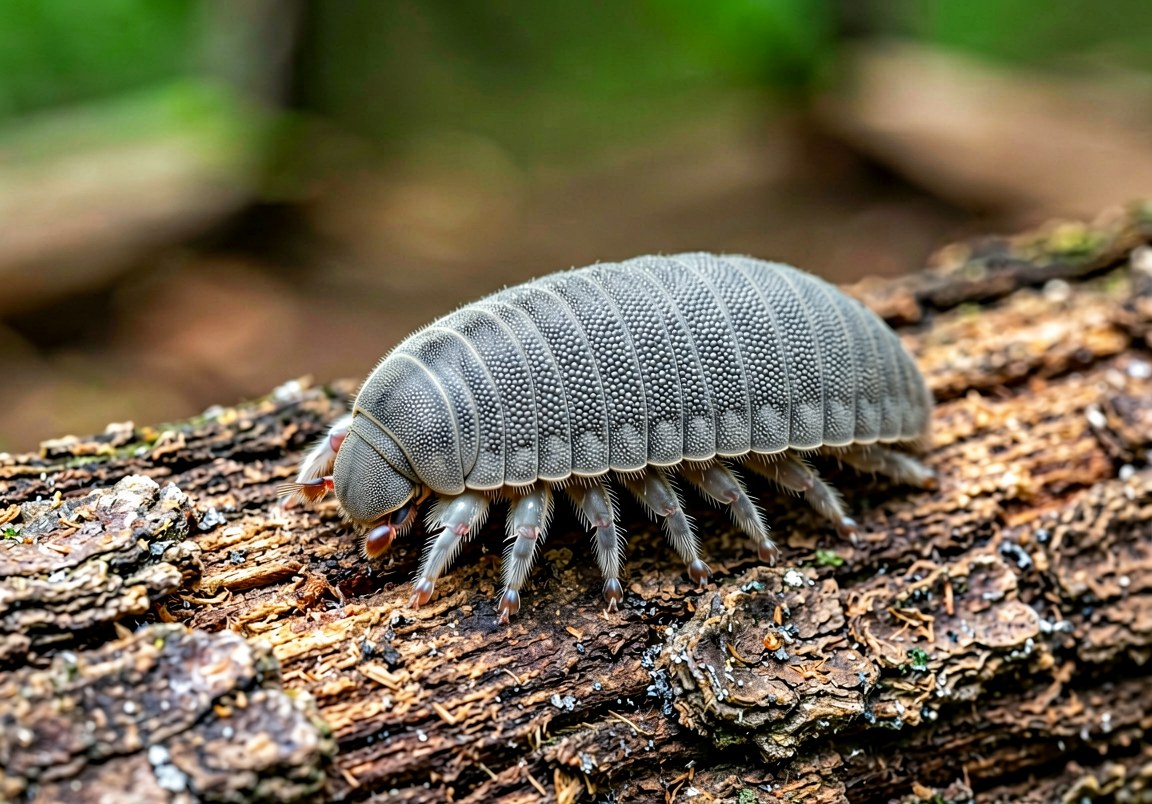
Oniscus asellus | Common Woodlouse
Introduction
The Common Woodlouse (Oniscus asellus) is the familiar flattened, grey, many-legged creature that scuttles out when a stone or log is lifted in a garden or woodland. About fifteen millimetres long, it is not an insect at all but a terrestrial crustacean, a relative of crabs and shrimps that has taken to living on land. It is one of the most widespread and numerous animals of the soil surface in Britain and Europe, and a constant companion of anyone who turns over garden clutter.
Though often called a “slater” or “pill bug”, the Common Woodlouse cannot roll into a ball; that trick belongs to its cousin the pill woodlouse. What it lacks in armour it makes up for in sheer abundance, and it is a quiet but essential worker of the litter layer, eating dead plant material and, in turn, feeding a host of larger creatures from song thrushes to toads.
Taxonomy
The Common Woodlouse is a member of the order Isopoda, the only crustacean group that has broadly colonised the land, and the family Oniscidae. It was described by the Swedish naturalist Carl Linnaeus in 1758. Along with slugs and the Cornu aspersum it is one of the commonest animals of the garden floor, but whereas the snail is a mollusc the woodlouse is a crustacean that still bears the segmented body and paired limbs of its marine ancestors.
The genus Oniscus is small, and Oniscus asellus is the typical “woodlouse” of damp, shaded places across the northern temperate zone. Close relatives such as the pill woodlouse differ in being able to conglobate, rolling into a defensive ball, a useful field character.
Physical Characteristics
The body is a flattened oval of seven overlapping armoured plates, grey to slate-brown and often mottled, with a pair of antennae, a cluster of tiny eyes on each side of the head, and seven pairs of walking legs beneath. The last segments form a small pointed tail, the telson, and the whole animal is built low and broad to slip into crevices.
Woodlice breathe through feathery gill-like organs, the pseudotracheae, on small appendages under the rear of the body, and these must stay moist, which is why the animal is confined to damp refuges. It cannot make a watertight covering against dryness the way insects and spiders can, and so it is, quite literally, a sea creature that has learned to live on land only by staying in the wet.
Habitat
Common Woodlice are creatures of shade and moisture: under stones, logs, bark, fallen leaves, plant pots, compost and the mats of root and litter at the base of walls and hedges. They avoid bright, dry, open ground and are most active at night, when the humidity rises and the risk of drying out falls.
They are found across Britain and most of Europe in gardens, parks, woodland, hedgerows and even cellars and greenhouses, wherever there is cover and decaying matter. A single log or compost heap may shelter dozens, and they are among the first animals to move into any new pile of rotting garden waste.
Diet
The diet is dead and decaying plant material, above all rotting leaves and soft wood, which the woodlouse shreds with its mouthparts and digests with the help of microbes in its gut. Like the millipede it is a recycler, turning coarse litter into fine fragments and droppings that enrich the soil.
It may also nibble fungus, dead insects and very occasionally living seedlings, but it is not a significant pest. In the food web it is important prey: hedgehogs, toads, ground beetles, shrews and many birds take woodlice readily, and its numbers help support the animals above it in the soil community. The common-hedgehog-erinusaceus-europaeus is among the predators that rely on such ground-dwelling invertebrates.
Reproduction
Woodlice carry their young in a brood pouch, the marsupium, on the underside of the female, a feature inherited from their marine crustacean ancestors. After mating the female lays eggs into this pouch, where they hatch into tiny, pale young called mancae that already look like miniature adults and that climb out to fend for themselves.
There is no free-living larval stage; the young simply grow through a series of moults, shedding the old cuticle in two halves. Females may produce several broods in a warm season, and adults live for a year or two, moulting even as grown animals, which is why one sometimes finds a woodlouse that has shed the rear half of its armour while the front is still hard.
Conservation
The Common Woodlouse is abundant and of no conservation concern, and it prospers wherever leaf litter and dead wood are left to lie. Its only real vulnerability is the loss of damp, undisturbed refuges through over-tidy gardening, paving and the use of soil-sterilising chemicals.
Because it is so common and so dependent on rotting matter, it is a useful indicator of a garden that is allowed to rot a little. Leaving logs, leaf litter and a compost heap not only sustains woodlice but also the birds, mammals and beetles that feed on them, tying the whole soil community together.
Fun Facts
- It is not an insect but a land-living crustacean, more closely related to a crab than to a beetle.
- It breathes through gill-like organs that must stay moist, which is why it hides in damp places by day.
- The female carries her eggs and babies in a pouch on her underside, like a tiny marsupial of the litter.
- Unlike the pill woodlouse, it cannot roll into a ball, only curl up a little at the edges.
- A woodlouse grows by moulting its armour in two halves, front and back, sometimes at different times.