 By st20113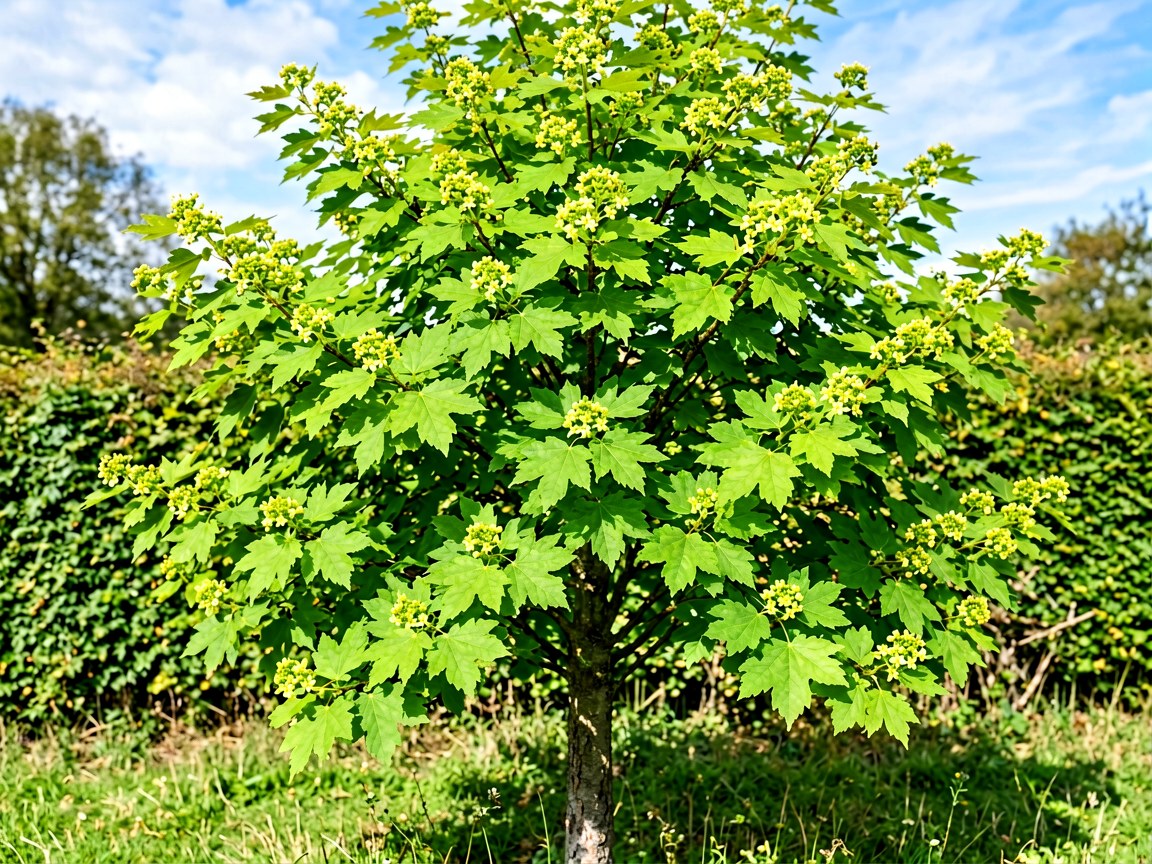
Acer campestre | Field Maple
Introduction
The Field Maple (Acer campestre) is a small, unassuming deciduous tree and one of the most characteristic inhabitants of the European countryside, more often met as a hedgerow shrub than as a forest giant. Usually 8–15 m tall, occasionally reaching 20–25 m, it is valued for its tolerance of clipping, its dense leafy cover, and the deep golden-yellow autumn colour that lights up hedgerows and woodland edges in early autumn.
Quiet and useful rather than showy, the field maple is a cornerstone of traditional hedgerows, where it is cut and laid to form living stock-proof barriers. Beneath its rounded crown a rich community of insects, birds, and small mammals finds food and shelter, making it one of the most wildlife-friendly native trees of lowland Europe.
Taxonomy
Acer campestre was described by Linnaeus in 1758; the genus name Acer is the classical Latin for maple, and campestre means “of the fields.” It belongs to the family Sapindaceae (which also includes horse chestnuts and soapberries), within the order it shares with the larger sycamore and Norway maple.
Like all green plants, the field maple depends utterly on the process described in our article on Photosynthesis (the plant energy process), by which its leaves capture sunlight to build the sugars that fuel its growth, its flowers, and the winged seeds it scatters each autumn. Among Sapindaceae it is a temperate specialist, thriving where many of its tropical relatives cannot.
Physical Characteristics
The field maple has a low, rounded, often multi-stemmed crown and smooth grey bark that becomes fissured with age. Its leaves are 5–9 cm across, with five rounded lobes and a slightly leathery, dark green surface that turns clear yellow in autumn; unlike the sycamore, the lobes have no teeth. A milky latex bleeds from cut stalks and petioles.
Its most distinctive fruit is the samara—a pair of winged seeds joined at the base and held at a wide angle, so that they spin like tiny helicopters when released. The twigs often develop corky ridges, a useful field mark. In hedgerows it is readily coppiced or laid, responding to cutting with vigorous regrowth.
Habitat
The field maple favours calcareous and neutral soils and a temperate climate, growing across most of Europe from the British Isles and Iberia east to the Caucasus, and from southern Scandinavia to the mountains of the Mediterranean. It is pre-eminently a species of hedgerows, woodland edges, scrub, and old parkland, tolerating shade when young and the repeated cutting of hedgerow management.
It establishes readily on disturbed ground and is widely planted and conserved in hedgerows because of its toughness. Where continuous woodland remains, it appears at the edges and in open groves rather than deep shade, and it is a reliable indicator of long-managed, species-rich hedgerow networks.
Diet
The field maple is autotrophic, manufacturing its own food by photosynthesis in its leaves and drawing water and mineral nutrients from the soil through its roots. It is a strong net producer, converting sunlight, carbon dioxide, and soil minerals into the wood, leaf, and reproductive tissue of a long-lived tree.
Its energy economy is bound up with its associates: the tree supplies carbon-rich sugars to mycorrhizal fungi in the soil and, in turn, receives improved access to water and nutrients, while its flowers provide pollen and nectar to a host of insects and its seeds feed finches and small mammals in autumn.
Reproduction
The field maple is hermaphrodite, bearing small, fragrant, greenish-yellow flowers in upright clusters in late spring, visited by bees, flies, and other insects. Fertilised flowers develop into the familiar paired samaras, which redden as they ripen and are carried on the wind, often spinning some distance from the parent before settling.
Seedlings germinate best in light, on bare or disturbed soil, and the tree also regenerates readily from stump and root suckers after cutting. Growth is modest but steady, and a hedgerow maple may live for several centuries as a pollard or lay, repeatedly renewed by coppicing rather than by a single trunk.
Conservation
The field maple is widespread and rated Least Concern, but its long-term future is tied to the survival of traditional hedgerows, which have been lost or neglected across much of intensive farmland. Where hedges are grubbed out or allowed to grow into gappy lines, the field maple and the wildlife it supports disappear with them.
Because it supports such a broad associated fauna—from maple-specific aphids and their predators to birds that eat the seeds—safeguarding hedgerows and wood-pasture containing field maple protects a whole food web at once. Conservation effort centres on sympathetic hedgerow management, replanting native stock, and retaining veteran laid stems rather than flailing hedges to the ground.
Fun Facts
- The field maple is the only maple native to much of lowland Britain and central Europe, and the smallest of the European maples.
- Its winged seeds (samaras) spin as they fall, a design that has inspired studies of miniature rotary flight.
- The hard, pale wood was traditionally used for carving, musical instruments, and turnery.
- Its leaves turn a vivid, almost luminous yellow, often among the first autumn colours in the hedgerow.
- As a hedgerow plant it is repeatedly cut yet keeps coming back, making it one of the most resilient native trees.