 By st20113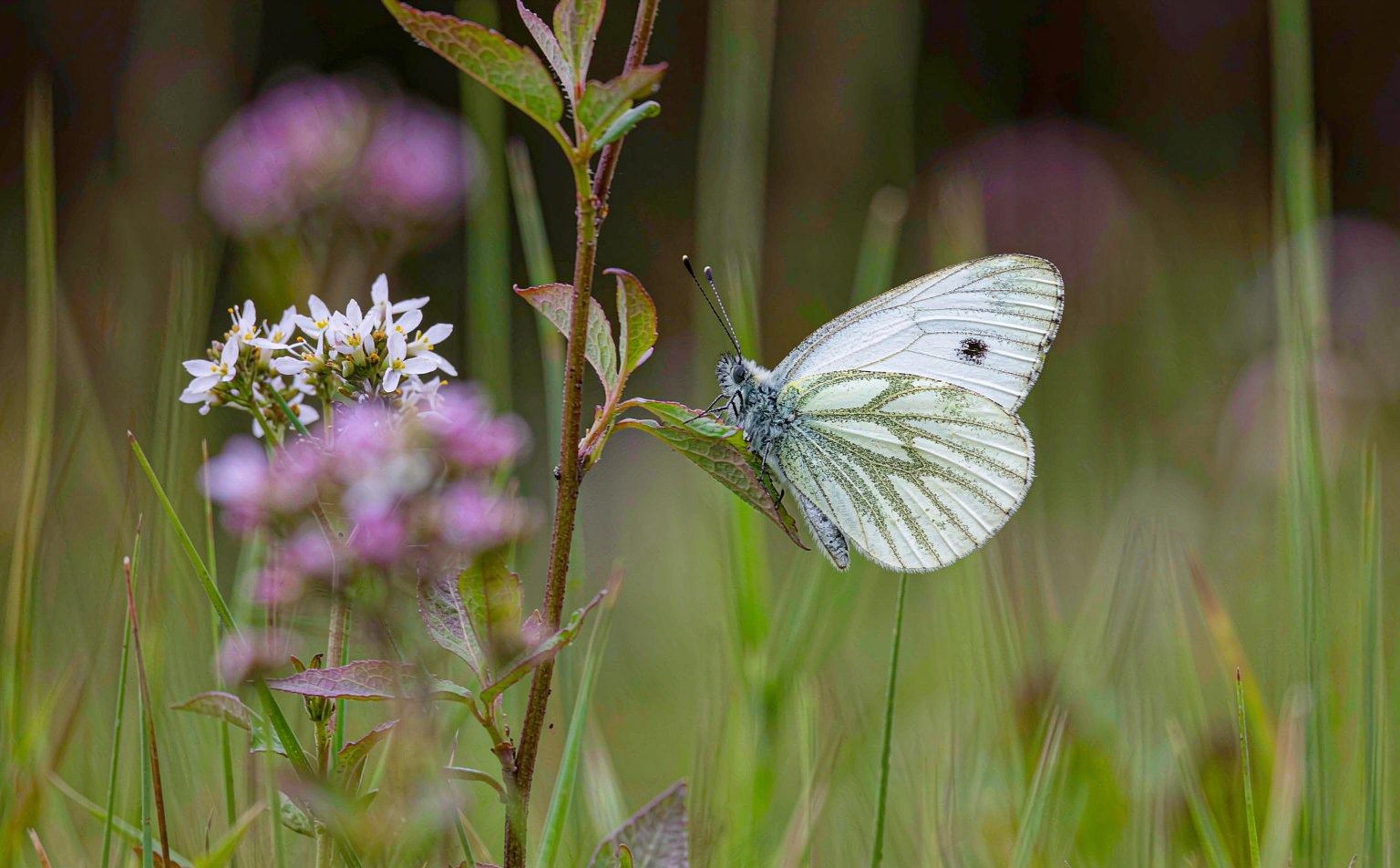
Pieris napi | Green-veined White
Introduction
The Green-veined White (Pieris napi) is a common, discreet butterfly of hedgerows, woodland rides, damp meadows and gardens across Europe, often confused at a glance with the larger Garden White. On close inspection its veins are dusted with soft green-grey scaling beneath the wing, a mark that gives the species its name. It is one of the first whites on the wing in spring and one of the last in autumn, flitting low among grasses and flowers.
A butterfly of tangled, leafy places rather than open downland, the Green-veined White is a familiar garden visitor whose modest looks hide a widespread and successful life. Its caterpillars feed on wild crucifers, linking it closely to the flowering plants of hedge and bank.
Taxonomy
The Green-veined White was described by Carl Linnaeus in 1758 and placed in the genus Pieris, the whites, within the family Pieridae. It is a close relative of the Garden White and the Large White, but the green-veined underside separates it in the field. The genus Pieris is found across Europe, Asia and North America.
It shares meadows and hedgerows with the Peacock Butterfly and the Small Tortoiseshell, and where their ranges meet it flies alongside the Meadow Brown in the same rough grassland.
Physical Characteristics
The Green-veined White has a wingspan of 35 to 45 millimetres. The upper wings are white in the male and faintly marked with a dark wing-tip in the female, but the key feature is the underside: the veins of the hind wings are outlined with grey-green scales, and the forewing underside often shows a grey smudge at the tip. The body is slim and lightly furred.
The butterfly’s flight is weak and fluttering, and it usually stays low among vegetation. Fresh individuals show the green dusting clearly, while worn late-summer specimens can look almost plain white beneath. The rounded wing shape and the grey-veined underside are the surest marks.
Habitat
Green-veined Whites inhabit a wide range of leafy, partly shaded places: hedgerows, woodland edges and rides, damp meadows, riverbanks, gardens and parks. They avoid the most open, dry grassland favoured by some other whites, preferring spots where the food plants grow in moist, sheltered soil. They are found from lowlands to the hills.
They are resident and multi-brooded, on the wing from early spring through to late autumn in milder years. The adults nectar at a variety of flowers, especially those of hedgerow and bank, and the females seek out crucifer plants in cool, shaded spots to lay their eggs.
Diet
The adult feeds on nectar from many flowers, including buttercups, bramble, hogweed, thistles and garden blooms, using its long proboscis. It is a generalist nectar-feeder and helps pollinate a range of plants as it moves through the vegetation.
The caterpillar is a leaf-eeder of crucifers (wild cabbages and cresses) such as garlic mustard, cuckooflower and hedge mustard. It chews the leaves of these plants in shady places, and the choice of food plant ties the butterfly tightly to the flowering margins of woods and hedges where such plants thrive.
Reproduction
The female lays single pale yellow eggs on the leaves of cruciferous plants in shaded, damp places. The caterpillar that hatches is green with a faint yellow line, well camouflaged against the leaf, and it feeds through several instars before pupating on a stem or fence.
There are typically two or three broods a year in Britain and Europe, so adults may be seen in almost any month from March to October. The overwintering stage is the pupa, which hangs through the cold to produce the first whites of the following spring, completing a cycle tuned to the seasons of its food plants.
Conservation
The Green-veined White is common and secure across its range, needing only the continued presence of hedgerows, woodland margins and damp grasslands with cruciferous food plants. It benefits from unmanicured habitat and is tolerant of garden and farmland edges where some wild vegetation remains.
Maintaining hedgerows, leaving shady banks unsprayed, and allowing wild crucifers to grow in damp margins all help the species. Because it uses a wide range of food plants, it is less vulnerable than specialists, but the loss of leafy, flower-rich edge habitat would still reduce its numbers locally.
Fun Facts
- Its name comes from the green-grey scales that outline the veins on the underside of its wings.
- It is on the wing from early spring to late autumn, with two or three broods a year.
- The caterpillar feeds on wild cabbages and cresses such as garlic mustard and cuckooflower.
- It is easily mistaken for the larger Garden White until you see the green veins.
- Despite its plain look, it is one of the commonest garden butterflies in Europe.