 By st20113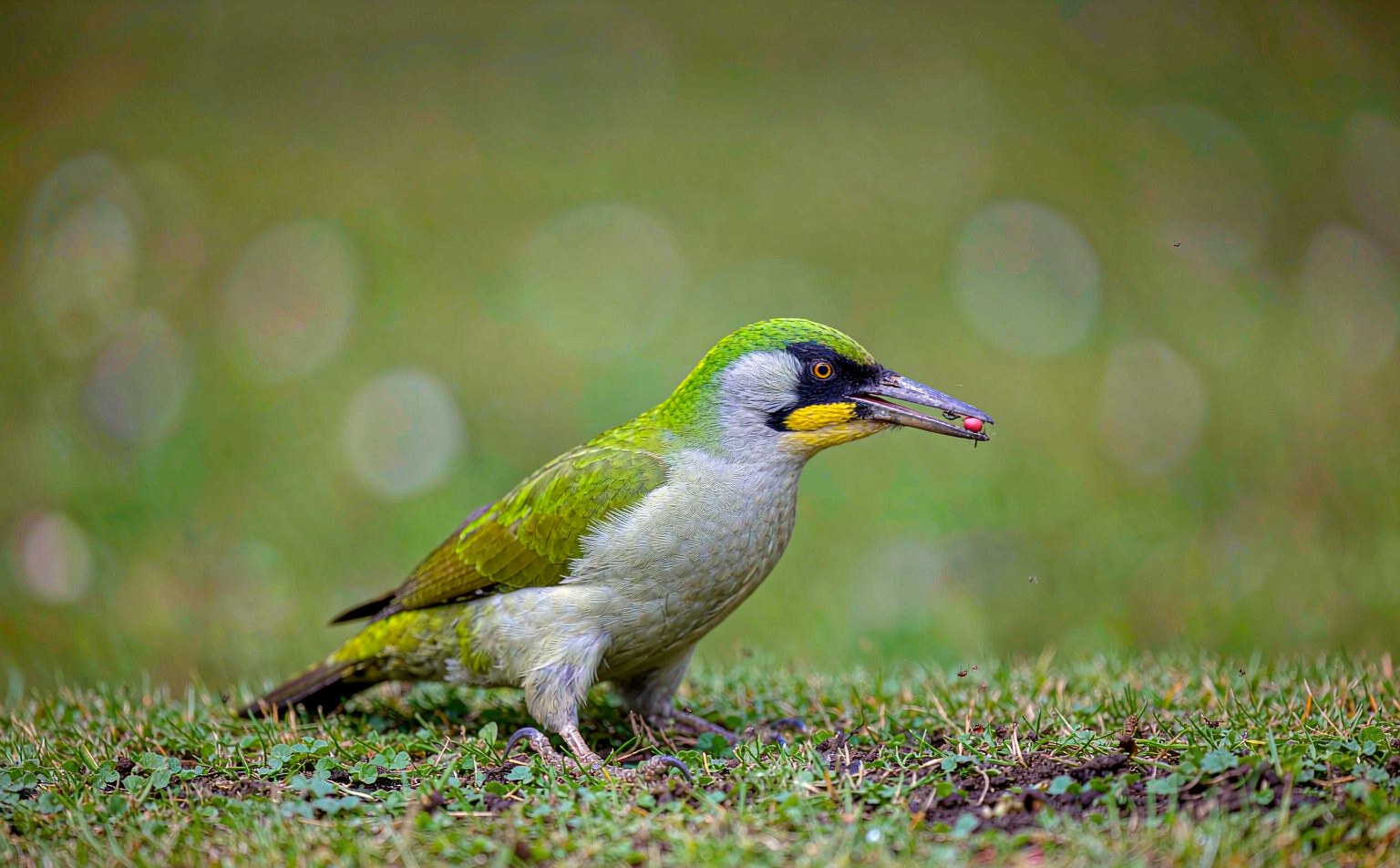
Picus viridis | Green Woodpecker
Introduction
The Green Woodpecker (Picus viridis) is the largest breeding woodpecker of much of Europe, a striking bird of open woodlands, parks, orchards and grassland with a laughing call that carries far across the countryside. Though named for its green back, it is perhaps best identified by its crimson crown, black mask and an unmistakable yelping cry, often rendered as a loud “laugh.” It is less of a tree-drummer than its relatives and more a ground-foraging specialist.
A bird of light, patchy woodland and meadow margins, the Green Woodpecker spends much of its time on the ground probing for ants, and its presence is often announced by its undulating flight between trees. It is a characteristic sound of the European countryside, associated with old pastures, parkland and woodland rides.
Taxonomy
The Green Woodpecker was described by Carl Linnaeus in 1758 and belongs to the genus Picus, which includes the green woodpeckers of Eurasia. It is distinct from the spotted woodpeckers of the genus Dendrocopos in both behaviour and appearance, relying far more on ground foraging than on trunk excavation for food.
In mixed woodland it may share territory with the Eurasian Jay, and in more open country it overlaps with the Common Magpie. Its ant-rich grassland feeding grounds are also used by the European Rabbit, whose warrens and grazed turf create the short sward the woodpecker favours.
Physical Characteristics
The Green Woodpecker is a robust bird of 30 to 36 centimetres in length, with a wingspan of 45 to 51 centimetres and a mass of 140 to 230 grams. The upperparts are olive-green, the rump and upper tail coverts bright green, and the underparts are pale greenish-grey with dark speckles on the flanks. The crown and nape are crimson in the male, while the female has a black forehead; both sexes show a bold black malar stripe through the eye.
The bill is long, stout and grey, slightly wedge-shaped for probing rather than heavy chiselling. The tongue is exceptionally long and coated with sticky saliva, an adaptation for extracting ants from deep in their nests. In flight the bird shows a pale, barred underside to the wing and a yellow rump flash, with the typical woodpecker undulation of the body between wingbeats.
Habitat
Green Woodpeckers favour a mosaic of trees and short grassland: parkland, wooded heaths, orchard country, hedgerow-rich farmland and large gardens with mature trees. They need open ground for feeding and trees or telegraph poles for nesting and roosting. The key requirement is abundant ant colonies within reach of suitable nest sites.
They are largely resident, defending all-purpose territories year-round. Where intensive agriculture has removed hedgerows and pastures, the species declines, because uniform arable land offers neither the ants nor the nesting cavities it needs. Mature trees with decay are essential for the excavated nest holes.
Diet
The Green Woodpecker is overwhelmingly an ant specialist. It feeds on the ground, probing into ant nests and lawns with its long tongue to capture workers and larvae, and a single bird may consume thousands of ants in a day. It also takes other soil invertebrates such as beetles, caterpillars and earthworms, particularly when ants are less available.
Unlike many woodpeckers, it only occasionally drills wood for insects, though it will excavate rotten timber for beetle larvae and readily visits compost heaps and disturbed ground. The species’ reliance on ants ties its distribution closely to open, ant-rich grassland and the edges of woodland rides.
Reproduction
Breeding begins in spring. The pair excavates a nest hole in a decaying or living tree, often in soft wood or a former cavity, producing a clean round entrance about 5 to 6 centimetres across. The female lays five to seven glossy white eggs on a bed of wood chips, and both sexes incubate for about seventeen to nineteen days.
The altricial chicks are fed by both parents, mainly on ants and other soft invertebrates, and fledge after roughly twenty-one to twenty-four days. The young remain dependent for a short period after leaving the hole, and the family group gradually disperses to join neighbouring territories through late summer.
Conservation
The Green Woodpecker is classified as Least Concern, with a broadly stable European population. It has expanded into some urban parks and orchards, but agricultural intensification that removes hedgerows, pasture and decaying trees has caused declines in parts of its range. The loss of ant-rich meadow is the principal limiting factor.
Conservation that helps the species includes retaining veteran and decaying trees, maintaining rough grassland and light grazing rather than close mowing, and preserving orchards and parkland. Because the bird needs both feeding ground and nest trees close together, landscape-scale habitat mosaics are more valuable than isolated woodlands.
Fun Facts
- The Green Woodpecker’s call sounds like a loud, rolling laugh, earning it the old name “yaffle.”
- It eats mainly ants and can lap up thousands of them in a single day with its long sticky tongue.
- Unlike many woodpeckers, it rarely drums on wood, preferring to forage on the ground.
- Its tongue can extend well beyond the tip of the bill to reach deep into ant nests.
- The yellow rump is a bright flash visible as the bird bounds away in flight.