 By st20113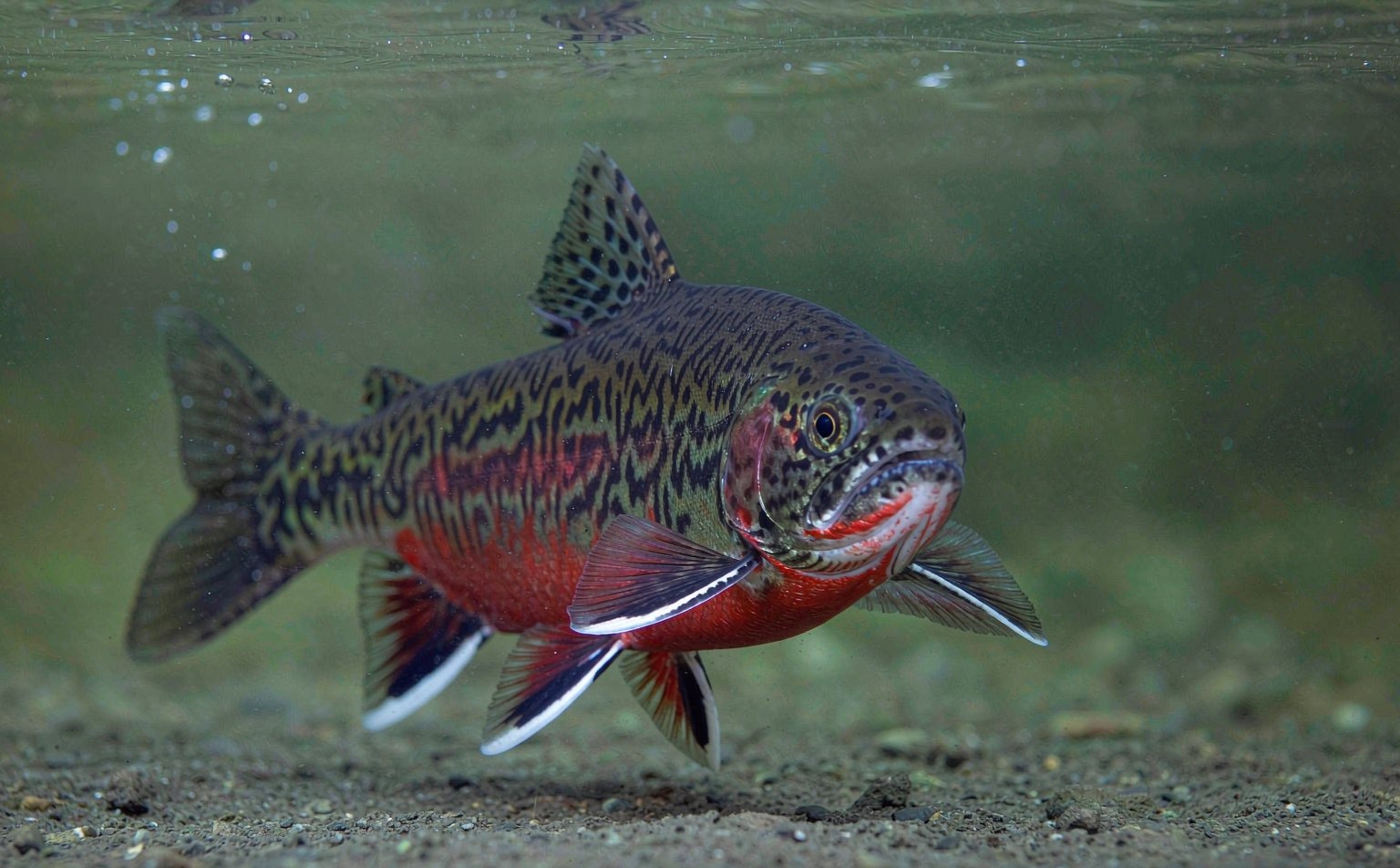
Salvelinus fontinalis | Brook Trout
Introduction
The Brook Trout (Salvelinus fontinalis) is a small, vividly coloured charr of clear, cool North American streams, long prized by anglers as one of the finest game fish. Despite the name, it is not a true trout but a member of the charr subgroup of salmonids, more closely related to the Arctic charr than to the Brown Trout. With its vermiculated back, red belly and pale wavy lines, it is among the most beautiful freshwater fish in the temperate world. Where clean, oxygen-rich water persists, wild Brook Trout populations remain a living benchmark of healthy rivers.
Taxonomy
Salvelinus fontinalis was described by the naturalist Samuel Latham Mitchill in 1814 and is the only widely distributed charr native to eastern North America. The genus Salvelinus includes the Salmo trutta‘s northern cousins such as Arctic charr and the lake charr. It is distinct from the rainbow trout, correctly Oncorhynchus mykiss, and from the brown trout of the genus Salmo. Several subspecies and many locally adapted forms are recognised, shaped by the great variety of headwater streams the species occupies.
Physical Characteristics
Brook Trout are slender, stream-lined fish, typically 15 to 35 centimetres long in the wild, though lake-dwelling individuals can exceed 50 centimetres. The body is deep olive to dark green, covered with pale, worm-like markings (vermiculations) on the back and a dusting of pale spots above a pinkish lateral band. The lower fins are edged in bright white then black, a key identification feature. The belly of breeding males flushes deep orange-red. The head is broad, the mouth moderate, and the tiny scales are buried in thick, slippery skin. Coloration intensifies in cold, acidic, peat-stained water and fades in limestone streams.
Habitat
Native Brook Trout demand cold, well-oxygenated, clean water—typically headwater creeks, spring runs, bog lakes and the upper reaches of rivers where summer temperatures stay below about 20°C. They shelter under undercut banks, root wads, boulders and overhanging vegetation that shades the surface. They are highly sensitive to warming, siltation and low oxygen, and are often replaced downstream by more tolerant species as water quality falls. Introduced populations now exist across Europe, including in Whitefish-bearing lakes and cool streams, where they sometimes compete with native salmonids.
Diet
Brook Trout are opportunistic feeders that take whatever is available by size. In streams the diet is dominated by aquatic insect larvae—mayflies, stoneflies, caddisflies—supplemented by terrestrial insects that fall on the surface, plus small crustaceans, snails and, as they grow, small fish and even smaller trout. In lakes they add plankton, fry and invertebrates from the shore zone. Feeding is visual and peaks in low light at dawn and dusk; in winter they slow but continue to feed under ice.
Reproduction
Spawning occurs in autumn, from September to November, when mature fish move into shallow gravel riffles. A female excavates a nest (redd) with her tail and deposits eggs that the male fertilises; she then covers them with gravel. The eggs overwinter and hatch in early spring, and the yolk-sac fry remain buried until they emerge as free-swimming fry. Unlike some salmon, Brook Trout do not always die after spawning and may breed in several successive years. Wild fish commonly live three to six years.
Conservation
In its native range the Brook Trout is not globally threatened but has lost much of its historic habitat to deforestation, agriculture, dams and rising stream temperatures. It is a flagship species for cold-water conservation. Outside North America, introduced populations can damage native fish and invertebrates, and management there may seek to limit their spread. Protecting streamside shade, controlling erosion and preventing barriers to movement are the main actions that keep wild Brook Trout streams intact.
Fun Facts
- The white leading edge on its lower fins is a reliable field mark that separates it from every other trout.
- It is a charr, not a trout, despite the common name—a quirk of history rather than biology.
- A single female may guard and re-dig several redds across a spawning season.
- In acidic, tannin-stained water its colours become almost jewel-like.
- Anglers nicknamed it “squaretail” for the slightly squared shape of its tail fin.