 By st20113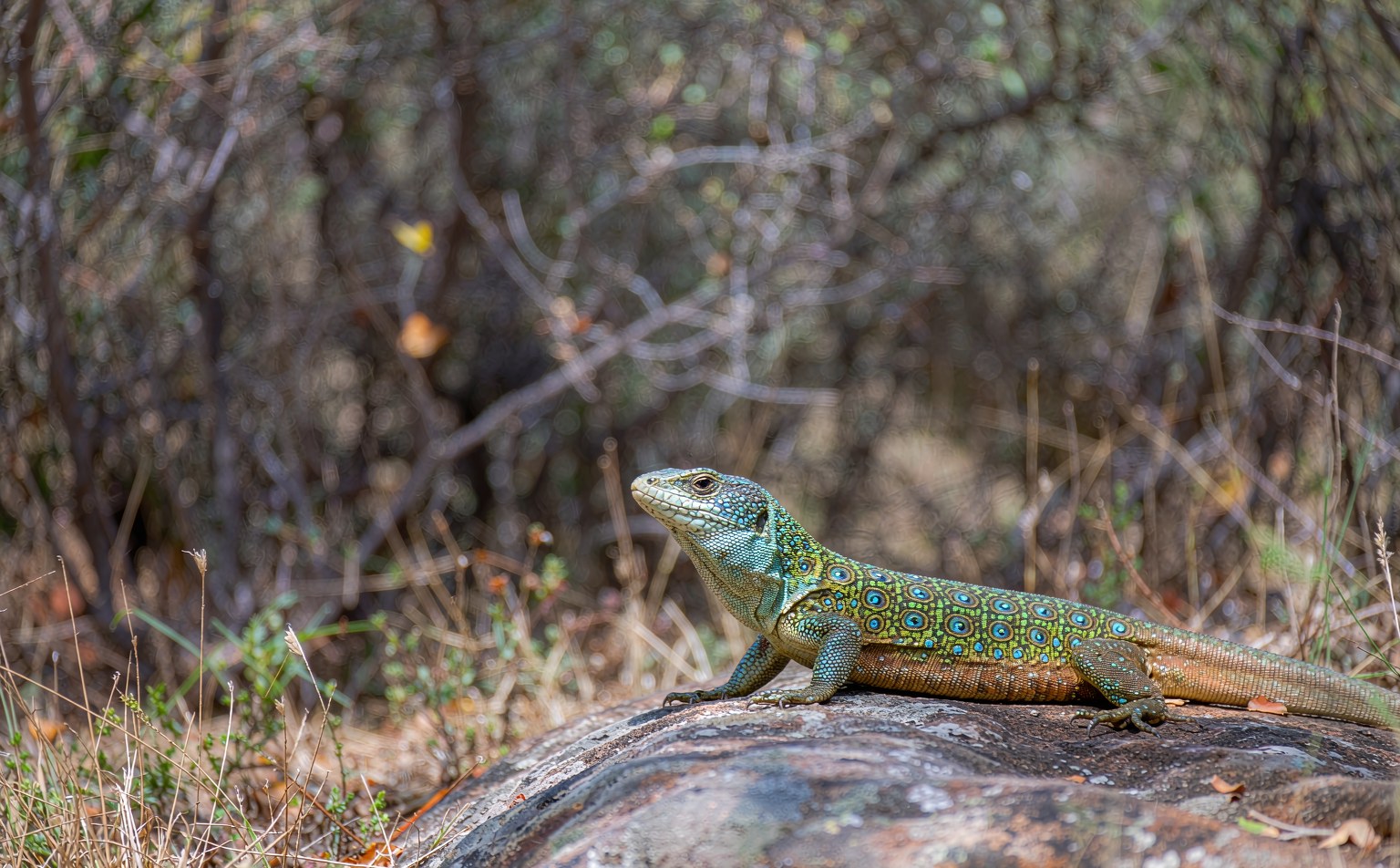
Timon lepidus | Ocellated Lizard
Introduction
The Ocellated Lizard (Timon lepidus), also called the Jewelled Lizard, is the largest lizard native to the Iberian Peninsula and one of the most striking reptiles in western Europe. Adults are powerfully built, with a broad head and a long tail that can be twice the body length. Its name refers to the vivid blue “eyes” or ocelli spotted along the flanks of males, set against a green or bronze body. Found across Spain, Portugal, southern France and parts of Italy, it favours warm, open countryside with scattered shrubs and rocks. Despite its size it is shy and quick to bolt, disappearing into dense cover at the first sign of danger.
Taxonomy
Timon lepidus was first described by the French naturalist François Marie Daudin in 1802 and is the type species of the genus Timon. The genus sits within the family Lacertidae, the true lizards, a group it shares with more familiar garden species such as the Common Lizard and the Common Wall Lizard. Other close relatives in the region include the legless European Glass Lizard and the robust Balkan Green Lizard, all members of the same broad lacertid radiation that diversified across Europe.
Physical Characteristics
Adult Ocellated Lizards reach 30 to 60 centimetres including the tail, with the stocky body alone accounting for 12 to 18 centimetres. The head is large and triangular with strong jaws. Coloration differs by sex and age: males are green to bronze-green above with a row of bright blue ocelli bordered in black along each flank, and a yellow or blue-green throat during the breeding season; females are duller olive or brown with fainter markings and fewer blue spots. The scales are small and granular on the back, larger and more plate-like on the head. The tail, used for balance and sudden acceleration, is easily shed (autotomy) and regrows shorter and paler. Juveniles are finely speckled with light spots and lack the adult’s vivid ocelli.
Habitat
This lizard prefers warm, dry, open habitats: Mediterranean maquis and garigue, oak and cork-oak woodland with sunny clearings, olive groves, vineyards, scrubby hillsides and roadside verges. It needs loose soil or deep leaf litter for burrowing and dense low cover for escape. It avoids dense forest and cool, wet uplands, though in parts of its range it ranges to moderate elevation. It is often seen basking on rocks or tracks in the morning sun before the day heats up, then retreats to shade by midday.
Diet
The Ocellated Lizard is an opportunistic carnivore and one of the few European lizards large enough to take substantial prey. Its diet includes grasshoppers, crickets, beetles, wasps and other insects, supplemented by spiders, centipedes, snails and earthworms. Larger adults add small vertebrates to the menu: young lizards, geckos, the occasional small mammal, nestling birds, frogs and even other Ocellated Lizards. It hunts by a combination of patient sit-and-wait ambush and active foraging, seizing prey with a quick lunge and crushing it in powerful jaws.
Reproduction
Mating takes place in spring, soon after emergence from winter hibernation. Females lay one or two clutches of 5 to 23 eggs between May and July, depositing them in a warm, humid site such as a rotten log, loose soil or a burrow. The eggs incubate for roughly two to three months, and hatchlings emerge in late summer measuring about 4 to 5 centimetres. Young lizards grow rapidly and reach sexual maturity in two to three years. Adults may live a decade or more in the wild where persecution and road traffic are low.
Conservation
The Ocellated Lizard is listed as Least Concern by the IUCN but is declining locally through habitat loss, agricultural intensification, afforestation of open scrub, and mortality on roads. In France it is protected by national law, and in parts of its range it benefits from agri-environment schemes that maintain open, flower-rich habitat. It is also traded in low numbers in the pet hobby, though most animals in trade should originate from captive breeding rather than wild capture. Conservation of sunlit, structurally diverse Mediterranean landscape is the single most effective measure for its persistence.
Fun Facts
- Males can flash brilliant turquoise-blue throat patches during courtship and rivalry displays.
- The blue flank “eyes” are not real eyes at all but decorative spots that may confuse predators.
- It is the heaviest lizard in western Europe, outsizing even most wall lizards by a wide margin.
- Like many lizards it can detach its tail to escape a predator, then regrow a replacement.
- In Spain it is known as “lagarto ocelado,” and rural tradition long held that it guarded hidden treasure.