 By st20113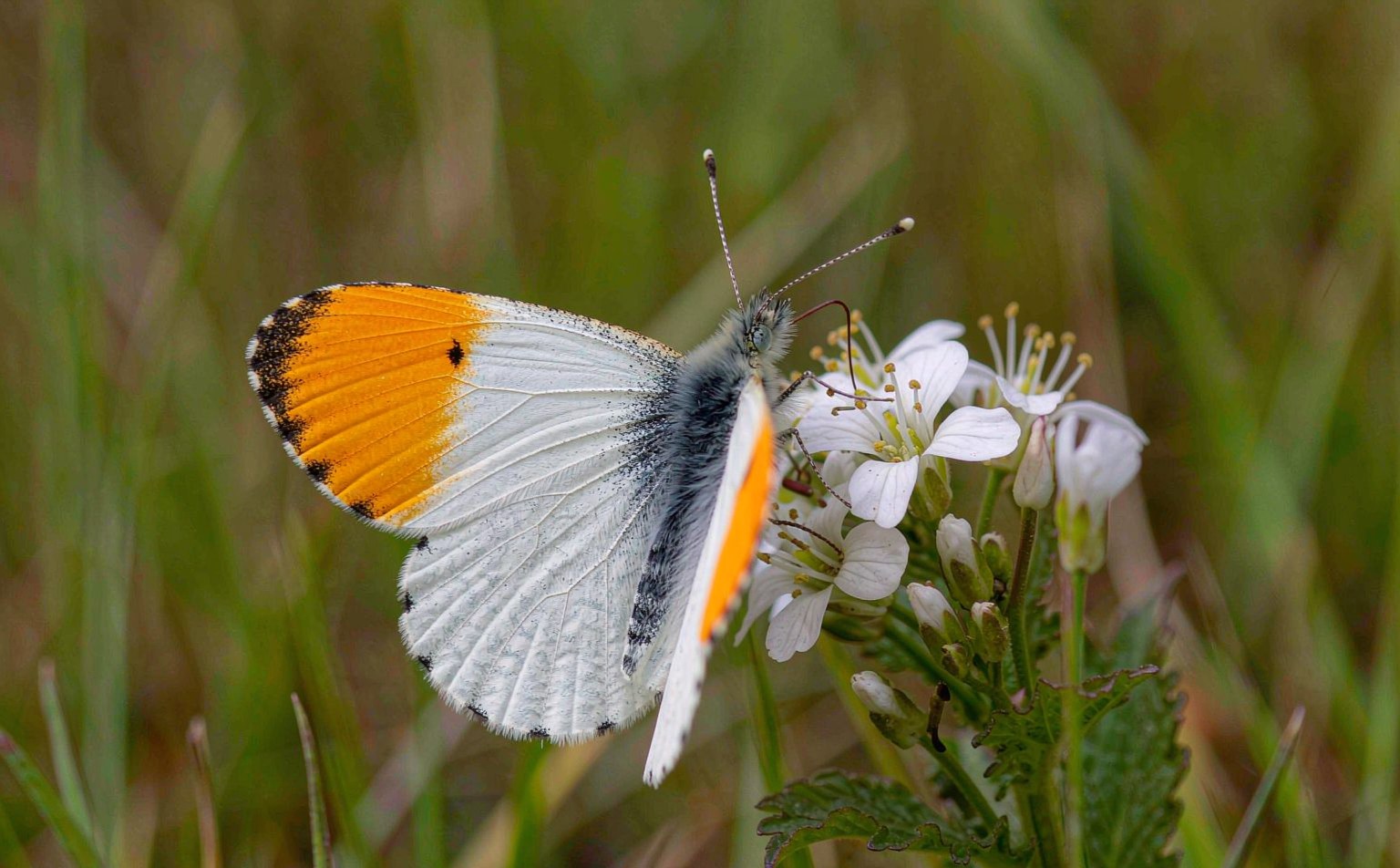
Anthocharis cardamines | Orange Tip
Introduction
The Orange Tip (Anthocharis cardamines) is one of the most welcome signs of spring in European woodlands and meadows, named for the bright orange tips of the male’s forewings. The female lacks the orange and is easily mistaken for a [Small White](https://www.gloencyc.com/small-white-butterfly-pieris-rapae/), but both sexes share a unique mottled green underside that breaks the closed wing into the pattern of a flower head. A single-brooded butterfly, it flies for only a few weeks in spring.
Taxonomy
The Orange Tip is a member of the family Pieridae, placed in the subfamily Dismorphiinae, and is the only European representative of its genus. It is closely associated with plants of the cabbage family, on which its caterpillars feed, and is related to the larger [Large White](https://www.gloencyc.com/small-white-butterfly-pieris-rapae/) through shared host-plant use rather than close form. The species ranges across Europe and temperate Asia.
Physical Characteristics
Adults have a wingspan of 40 to 52 millimetres. Males are white above with striking orange-yellow forewing tips bordered by a black wedge; females are white with grey-marked tips instead of orange. The undersides are the key feature: a mosaic of green and white marbling that looks like a cluster of flowers or young seed pods when the butterfly rests among plants.
The body is slender and grey, the antennae clubbed. The caterpillar is a slowly growing green larva with small yellow bumps, coloured to match the siliques of its food plants. The chrysalis is grey-green and angled, fixed upright to a stem where it resembles a small seed pod.
Habitat
The Orange Tip favours damp, flower-rich grassland, woodland rides, hedgerows, riverbanks, meadows and gardens where its host plants grow. It needs a mix of nectar flowers for the adult and patches of garlic mustard, cuckooflower and related brassicas for the larva. Because it flies early, it is common in places that stay lush into late spring, and it tolerates light shade better than many whites.
Diet
Adults nectar from a variety of spring flowers, including bluebell, primrose, cuckooflower, dandelion, bugle and hawthorn blossom, favouring pink and blue blooms. The caterpillars feed on the developing seed pods of brassica-family plants such as garlic mustard (Alliaria petiolata), cuckooflower (Cardamine pratensis), hedge mustard and honesty, often moving from one pod to the next as they strip the seeds.
Reproduction
Females lay a single egg on the stem of a host flower, usually away from other eggs to avoid later competition between caterpillars. The larva feeds first on flower and then on the long seed pods, and when two eggs are laid close together the first hatchling often eats the other egg. Pupation follows in a green chrysalis shaped like a pod. There is one generation a year; the chrysalis overwinters and the adult emerges the following spring.
Conservation
The Orange Tip is generally common and not threatened, though it is sensitive to the loss of damp meadows and hedgerows where garlic mustard and cuckooflower thrive. It has expanded into some urban green spaces where these plants persist. Conservation of unimproved grassland and sensitive roadside management helps maintain the early-season nectar and host plants it depends on.
Fun Facts
- The male’s orange wing tips are UV-reflective and may signal fitness to females.
- The green marbled underside is one of the best leaf-and-flower disguises among European butterflies.
- Females mimic other white butterflies, possibly to reduce harassment from males.
- Caterpillars are cannibalistic, and the first to hatch may consume unhatched rivals.
- Despite the short flight season, adults can live several weeks in cool spring weather.