 By st20113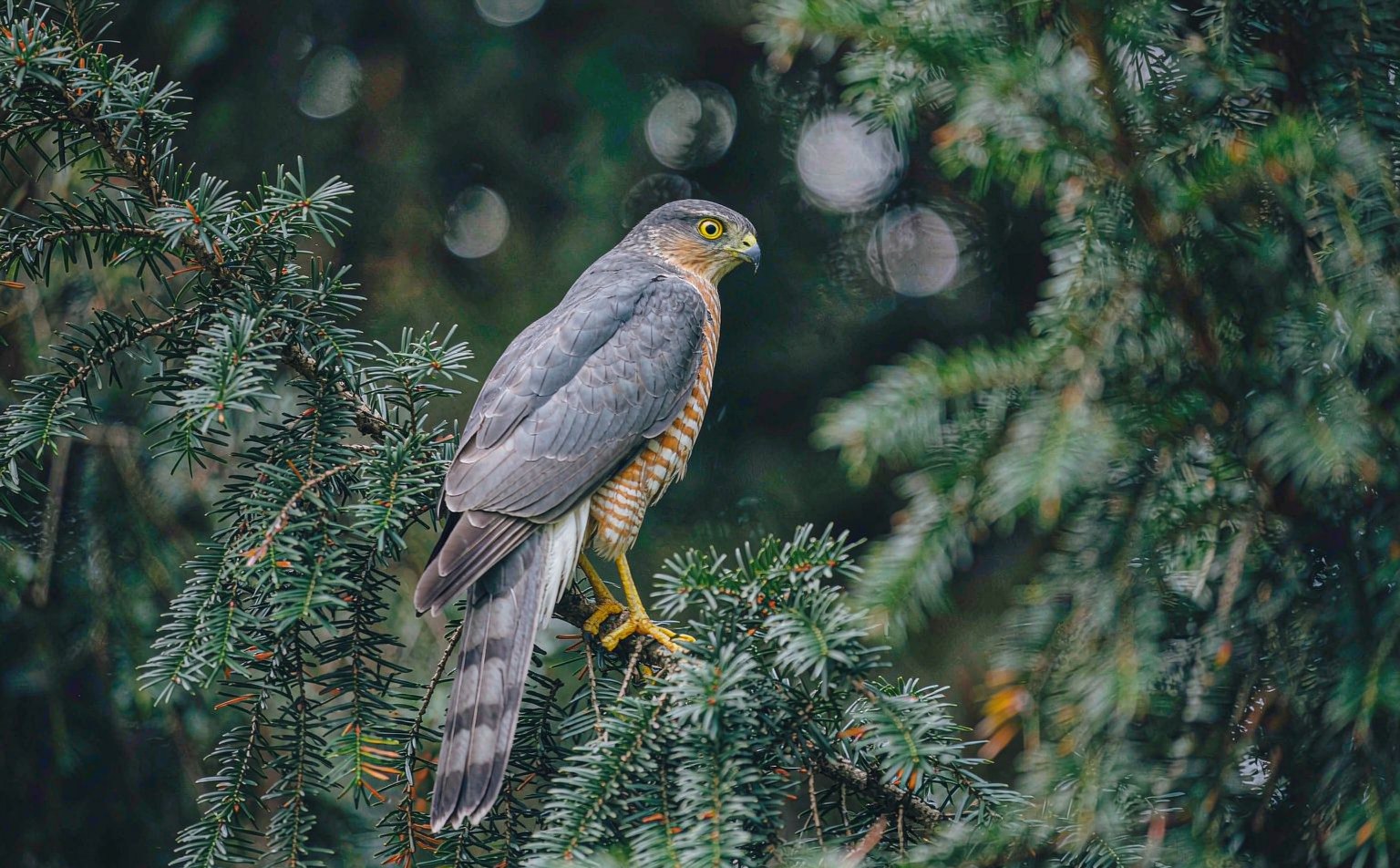
Accipiter nisus | Eurasian Sparrowhawk
Introduction
The Eurasian sparrowhawk, Accipiter nisus, is a small, agile forest raptor that hunts birds in woodland, farmland, and suburban gardens across the temperate Old World. With short, rounded wings and a long barred tail built for weaving through branches, it is one of the most widespread accipiters and a familiar, if often unseen, predator of small birds. Its explosive dash from cover has made it both admired and, historically, persecuted by pigeon and poultry keepers.
Adaptable and numerous, the sparrowhawk has recolonised many areas where it was once eliminated, and it now hunts routinely over parks and gardens in major cities.
Taxonomy
Accipiter nisus was described by Carl Linnaeus in 1758. It belongs to the family Accipitridae and the genus Accipiter, the true hawks, characterised by short wings and long tails for ambush hunting in cover. As a bird-hunting specialist it overlaps ecologically with the Common Blackbird, one of its many garden prey species.
Physical Characteristics
The sparrowhawk measures 28–38 cm in length with a wingspan of 55–70 cm and weighs 110–260 g, females being substantially larger than males — a size difference that lets the pair exploit different prey sizes. Adults are slate-grey above with finely barred orange-red underparts in the male and browner, streaked underparts in the female. The long tail is barred with a broad dark terminal band.
The eyes are yellow in males and orange to red in females, and the legs are long and slender with large talons for gripping struggling birds. The flight is a characteristic sequence of rapid wingbeats followed by a glide, and the silhouette is compact with a square-cut or slightly notched tail.
Habitat
Sparrowhawks occupy a broad range of wooded and partially wooded habitats: coniferous, deciduous, and mixed forest, plantations, copses, orchards, and well-treed urban and suburban areas. They require perches and dense cover from which to launch surprise attacks, and a surrounding mosaic of open hunting ground where songbirds congregate.
They are absent from treeless steppe and Arctic tundra but have thrived in human landscapes provided trees and bird-rich feeding areas remain. Nests are placed in the forks of tall trees, often conifers, and are reused and enlarged across years.
Diet
The sparrowhawk is an almost exclusively avian predator, taking birds ranging from finches and sparrows to thrushes, starlings, and occasionally pigeons and gamebirds. Males, being smaller, focus on smaller prey such as tits and sparrows, while females tackle larger quarry. A successful strike ends with the victim carried to a plucking post and consumed.
Hunting is by short, concealed approach and a final explosive acceleration, using vegetation as cover. The species’ impact on prey populations is generally modest and selective, and healthy songbird communities easily absorb the take.
Reproduction
Breeding begins in spring. The male performs a soaring and undulating display flight to advertise the territory, then provides most of the food while the female incubates. The nest is a platform of sticks built in a tree fork, lined with bark flakes and greenery, and the female lays four to six bluish-white eggs.
Incubation lasts about a month, performed by the female, while the male delivers prey. The chicks hatch asynchronously and are fed by the female with food the male supplies; they fledge after roughly a month and remain dependent for several weeks as they learn to hunt.
Conservation
The Eurasian sparrowhawk is listed as Least Concern and has recovered strongly across Europe since the 1980s following the ban on organochlorine pesticides such as DDT, which had thinned eggshells and crashed populations. Illegal persecution and collisions with windows and vehicles remain local threats.
Its return to city parks demonstrates how urban green spaces, when sufficiently wooded, can support top predators. Monitoring of breeding success and prey availability continues to be important, particularly as climate and land-use change reshape bird communities.
Fun Facts
- Females are up to twice as heavy as males, letting a pair hunt both small and medium birds.
- A sparrowhawk can accelerate from stillness to a strike in a fraction of a second.
- Its scientific name nisus comes from a Greek myth about a king transformed into a hawk.
- It often plucks prey on a favourite post, leaving characteristic piles of feathers.
- Once devastated by DDT, it is a celebrated recovery story of modern conservation.