 By st20113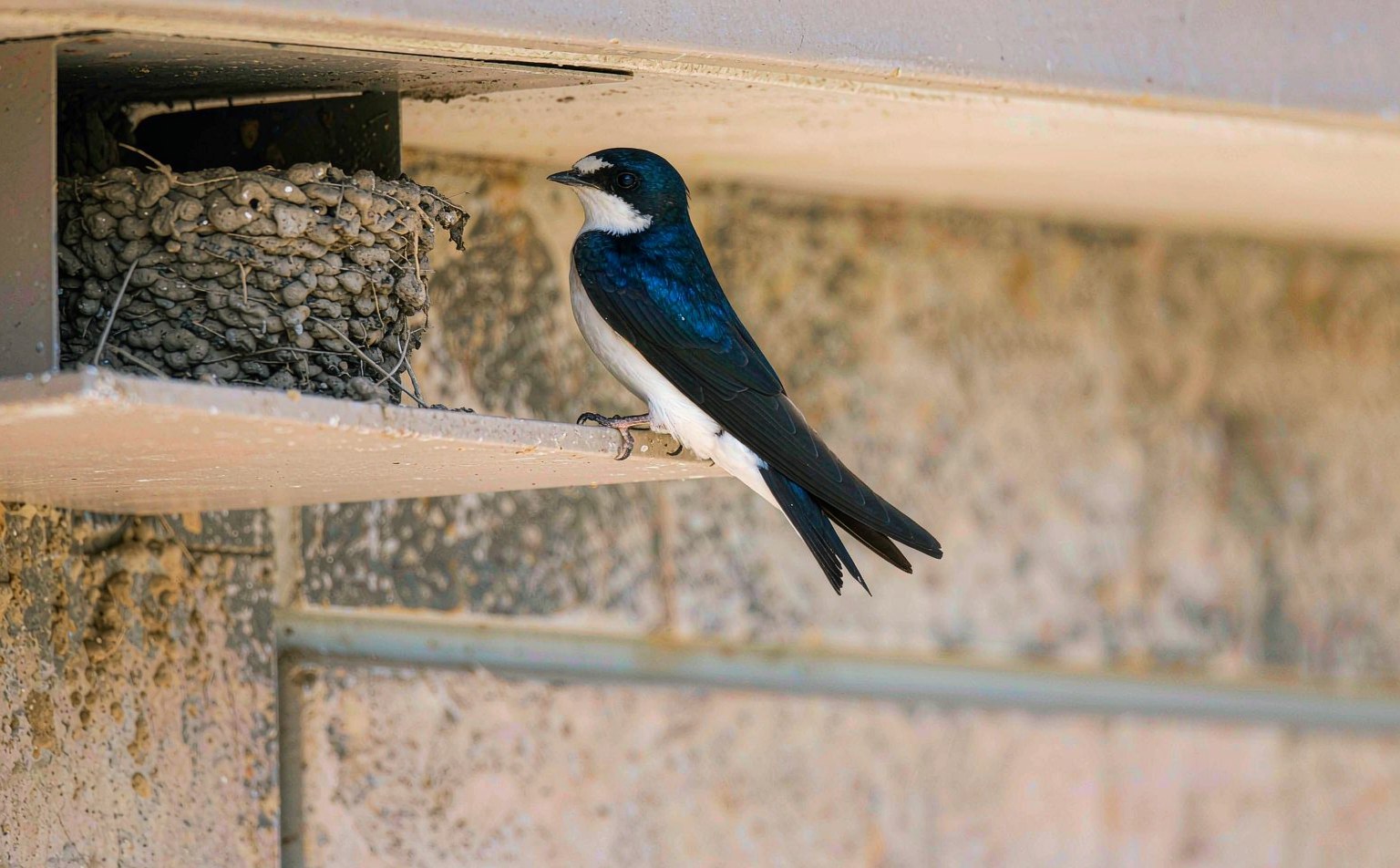
Delichon urbicum | Common House Martin
Introduction
The common house martin, Delichon urbicum, is a small migratory swallow-like bird that nests in colonies on the exterior walls of buildings across Europe and temperate Asia. Glossy blue-black above and pure white below, with a distinctive white rump, it is a familiar summer visitor that gathers mud to build enclosed nests under eaves. Each spring its return is a traditional sign of the changing season throughout its range.
Highly aerial, the house martin spends most of its waking life on the wing, capturing insects in flight and drinking and bathing by skimming the water surface. Its close association with human settlements sets it apart from many of its more forest-bound relatives.
Taxonomy
Delichon urbicum was formally described by Carl Linnaeus in 1758. It belongs to the family Hirundinidae, the swallows and martins, and is the type species of the genus Delichon. Its nearest relative among familiar birds is the Barn Swallow, which shares the same aerial lifestyle but differs in its deeply forked tail and open-cup nest.
Physical Characteristics
The house martin is a compact bird of 12–15 cm in length with a wingspan of 26–29 cm and a weight of 16–25 g. The upperparts, including the crown and the short, forked tail, are an iridescent blue-black, while the underparts and the rump are white — the white rump being the key marker separating it from the darker Common Blackbird and from swifts. The legs and feet are feathered white, an unusual trait among passerines.
The bill is short and broad at the base, an adaptation to gape-feeding on airborne insects. The wings are long and pointed for sustained flight, and the tail is moderately forked. Males and females are similar, though the male’s tail fork is marginally deeper.
Habitat
House martins are closely tied to open countryside interspersed with water and human settlement. They breed in villages, towns, farms, and increasingly cities, attaching their mud nests to vertical walls beneath overhanging eaves. Foraging occurs over meadows, lakes, rivers, and pasture, where flying insects are abundant.
They avoid dense forest and treeless desert, needing both mud sources for nest-building and open airspace for feeding. In winter they migrate to sub-Saharan Africa, where they gather in large roosting flocks in a variety of open and wooded habitats.
Diet
The diet consists almost entirely of small flying insects caught on the wing: aphids, flies, midges, small beetles, and winged ants dominate. House martins often feed in mixed flocks with swallows and swifts, working profitable insect swarms at various heights. They drink and bathe in flight by dipping to the water surface.
Foraging range expands during the breeding season as adults provision hungry chicks, and birds will travel several kilometres from the colony to rich feeding areas. The species is highly sensitive to cold, wet weather, which suppresses insect flight and can cause widespread starvation of nestlings.
Reproduction
House martins are colonial and monogamous, often reusing and renovating the same mud nest across years. The nest is a closed sphere of mud pellets mixed with saliva, with a small entrance hole at the top, fixed to a vertical wall under an eave. The female lays three to five white eggs, incubated by both parents for about two weeks.
Both adults feed the chicks, which fledge after roughly three weeks. Where conditions allow, pairs may raise two broods in a season. Failed or abandoned nests are sometimes taken over by other martins or by sparrows, and the species shows strong fidelity to successful colony sites.
Conservation
The house martin is globally listed as Least Concern and remains widespread, but several European countries have reported local declines attributed to reduced insect abundance, fewer suitable nesting surfaces on modern buildings, and poor weather during migration and breeding. The loss of accessible mud after land drainage can also limit nest construction.
Leaving eaves accessible, preserving wet marginal habitat that supports insects, and reducing pesticide use all help maintain breeding populations. Because the species is so visible in human settlements, it serves as an accessible indicator of broader insect-health trends in the countryside.
Fun Facts
- The house martin’s feet are covered in white feathers, a rare trait among perching birds.
- It builds its nest entirely from thousands of tiny mud pellets glued with saliva.
- Its white rump is a reliable way to tell it from the darker swifts it flies alongside.
- House martins migrate all the way to southern Africa for the winter.
- They often return to and repair the exact same nest year after year.