 By st20113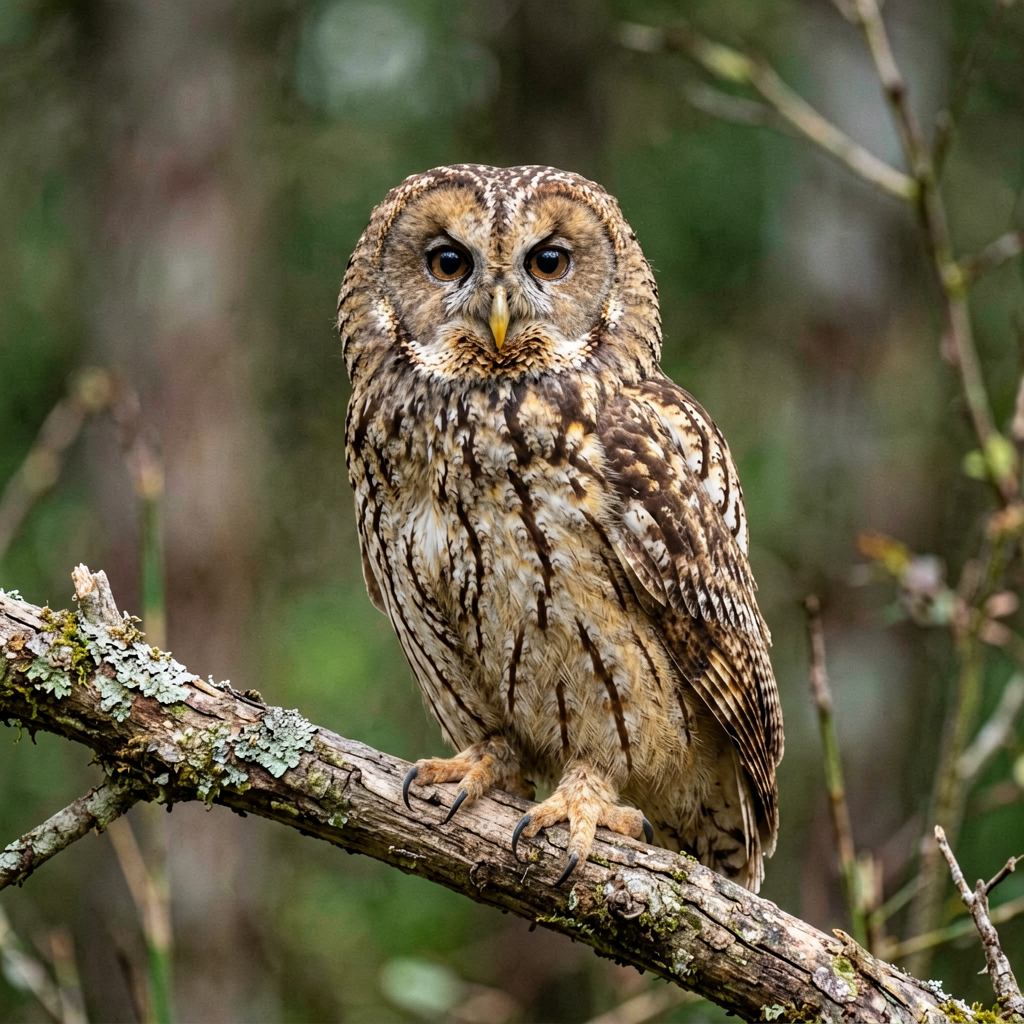
Strix aluco | Tawny Owl
Introduction
The Tawny Owl (Strix aluco) is a small to medium-sized owl belonging to the family Strigidae, commonly known as the true owls. Native to much of Europe and western Asia, this species is one of the most widespread and well-known owls across the continent. It has been a familiar presence in woodlands, gardens, and urban areas for centuries, often recognized by its distinctive hooting call that echoes through nocturnal landscapes.
This owl is predominantly nocturnal, spending its days concealed in dense foliage or tree hollows and emerging at dusk to hunt. Its round head, large dark eyes, and lack of ear tufts give it a characteristically owl-like appearance that has made it a subject of folklore and literature throughout European history. The Tawny Owl is a solitary and territorial bird, maintaining year-round home ranges that it defends aggressively against rivals.
Despite its reputation as a creature of dark forests, the Tawny Owl has adapted remarkably well to human-modified environments. It thrives in suburban gardens, parklands, and even city centers where suitable nesting cavities and prey are available. This adaptability has contributed to its stable population across much of its range, though local declines have been noted in areas where ancient woodlands have been replaced by intensive agriculture.
Taxonomy
The Tawny Owl was first described by Carl Linnaeus in his seminal 1758 work Systema Naturae, where he classified it under the binomial name Strix aluco. The genus Strix derives from the ancient Greek word for owl, while the specific epithet aluco is thought to reference a type of owl mentioned by classical authors. The species is placed within the family Strigidae, which encompasses the majority of owl species worldwide.
Genetic studies have confirmed that the Tawny Owl is closely related to other members of the genus Strix, including the common-raven-corvus-corax is not closely related but shares some ecological niches, while the Spotted Eagle-Owl and the Brown Wood-Owl represent more distant relatives within the broader strigiform lineage. Several subspecies are recognized across its extensive range, with subtle variations in plumage coloration and size corresponding to geographic clines.
Molecular phylogenetic research has helped clarify the evolutionary relationships within the genus Strix, revealing that the Tawny Owl diverged from its closest relatives during the Pliocene epoch. Fossil evidence suggests that the species has maintained a relatively consistent morphology over hundreds of thousands of years, indicating strong adaptive stability in its woodland hunting strategy.
Physical Description
The Tawny Owl measures approximately 34 to 39 centimeters in length, with a wingspan ranging from 85 to 95 centimeters. It exhibits a robust, stocky build with a broad head and short tail, proportions that facilitate agile flight through dense woodland. The plumage displays considerable color variation, ranging from pale grey-brown to rich reddish-brown, a trait that has led to the informal distinction between “grey” and “brown” morphs within populations.
Its facial disc is prominently rounded and pale, framing large, forward-facing dark brown eyes that provide excellent binocular vision for low-light hunting. Unlike many owl species, the Tawny Owl lacks ear tufts, giving its head a smooth, rounded silhouette. The bill is short, curved, and concealed beneath facial feathers, while the feet are powerful and equipped with sharp, black talons adapted for grasping and killing prey.
The underparts are typically pale with irregular dark brown streaks, providing effective camouflage against mottled bark when perched. Flight feathers are softly fringed along the leading edges, producing remarkably silent flight that allows the owl to approach prey undetected. Juveniles resemble adults but tend to have slightly browner plumage with more pronounced streaking on the breast.
Habitat
The Tawny Owl prefers mature deciduous or mixed woodlands where tree cavities are available for nesting and dense cover provides daytime roosting sites. It is equally at home in ancient forests and newly planted woodland, provided that a sufficient canopy cover and prey base exist. The species is also commonly found in parklands, hedgerow networks, and suburban gardens with mature trees, demonstrating remarkable ecological flexibility.
Throughout its range, the Tawny Owl occupies habitats from sea level up to approximately 1,800 meters in mountainous regions. In southern Europe, it tends to favor oak and beech forests, while in northern areas it adapts to birch and pine woodlands. The presence of suitable nesting cavities is often the limiting factor, as the species does not construct its own nests and relies on holes in living trees, abandoned woodpecker cavities, or occasionally cliff faces.
The species is largely sedentary, with most individuals remaining within a few kilometers of their natal territory throughout their lives. Young birds dispersing from the nest typically travel no more than ten kilometers before establishing their own home ranges, a pattern that helps maintain genetic diversity within local populations while limiting long-distance dispersal.
Diet
The Tawny Owl is a carnivorous predator whose diet consists primarily of small mammals, particularly field voles, bank voles, and common common-toad-bufo-bufo are occasionally taken but represent a minor component. In urban and suburban areas, brown rats and house mice form a significant portion of the prey spectrum, making these owls valuable agents of natural pest control in human settlements.
Hunting is conducted primarily from a perch, where the owl waits patiently for prey to move within range before launching a swift, silent attack. It also employs a quartering flight pattern over open ground, listening intently for the rustling sounds of small mammals beneath vegetation. The owl’s exceptional auditory localization allows it to pinpoint prey hidden under snow or leaf litter with remarkable accuracy.
A typical Tawny Owl consumes approximately 50 to 100 grams of food per night, equivalent to roughly one to two small mammals. Indigestible portions of prey, including bones, fur, and feathers, are compacted into pellets that the owl regurgitates through the beak, usually within twelve hours of feeding. These pellets are an important tool for researchers studying the species’ dietary habits and the ecology of small mammal communities.
Reproduction
The Tawny Owl is monogamous, with pair bonds often lasting several years or even a lifetime. Breeding season begins in late winter, typically between January and March, and is accompanied by elaborate vocal duetting between mates. The female lays a clutch of two to five creamy-white eggs, which are incubated solely by the female for approximately thirty days. The male provides food for the incubating female during this period.
Chicks are altricial and blind at hatching, covered in downy white plumage that is later replaced by juvenile feathers. Both parents participate in feeding the young, with the male delivering prey that the female tears into manageable pieces. The chicks fledge at around thirty-five to forty-two days old but remain dependent on their parents for several additional weeks before becoming fully independent.
Territoriality is established early, with young owls often remaining in their parents’ home range for the first year of life before dispersing to establish their own territories. This delayed dispersal can lead to temporary family groups, a behavior that is unusual among owls and may provide survival advantages in competitive woodland environments.
Conservation
The Tawny Owl is classified as Least Concern by the International Union for Conservation of Nature, with a stable and widespread population across its Palearctic range. Estimated global numbers exceed several million individuals, and the species shows no immediate signs of decline on a continental scale. Its adaptability to human-altered landscapes has buffered it against many of the threats that affect more specialized owl species.
Nevertheless, local population declines have been recorded in parts of northern Europe, particularly in Scandinavia and the British Isles, where harsh winters and reductions in vole populations have impacted breeding success. The loss of ancient woodland and the removal of dead trees that provide nesting cavities remain significant threats in certain regions, as is the decline of small mammal prey due to intensive farming practices.
Conservation efforts for the Tawny Owl focus primarily on habitat preservation, including the maintenance of mature woodland structures and the installation of nest boxes in areas where natural cavities are scarce. Monitoring programs across Europe continue to track population trends, providing valuable data that informs woodland management policies and wildlife conservation strategies.
Fun Facts
- The Tawny Owl’s famous hooting call, often described as “who cooks for you,” is produced by both sexes and serves to establish and defend territorial boundaries throughout the year.
- Unlike many birds, the Tawny Owl can rotate its head up to 270 degrees, compensating for its fixed eye sockets that cannot move within the skull.
- Tawny Owls have been known to kill and consume other owl species, including the smaller Little Owl, in fierce territorial disputes over nesting sites.
- The color morph of a Tawny Owl is determined genetically, with the brown morph being more common in southern parts of the range and the grey morph predominating in the north.
- A single Tawny Owl can consume up to 4,000 voles in a single year, making it one of the most effective natural controllers of rodent populations in European woodlands.
[…] of other birds rather than building its own. It shares the night skies with relatives such as the Tawny Owl, though the long-eared owl is the more strictly nocturnal and forest-dwelling of the […]