 By st20113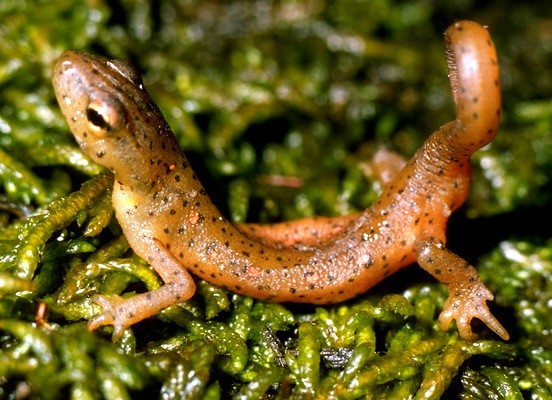
Introduction
The eastern newt (Notophthalmus viridescens) is a small salamander native to eastern North America, notable for its complex life cycle that includes a distinctive terrestrial juvenile stage known as the red eft. Found in ponds, lakes, and damp woodlands from Canada to the Gulf Coast, the eastern newt is one of the most widespread and well-studied salamanders on the continent. Its bright orange juvenile stage serves as a warning to predators of its toxic skin secretions. This species exemplifies the remarkable metamorphosis characteristic of many amphibians. salamander toad
Taxonomy
The eastern newt belongs to the family Salamandridae, the true salamanders, within the order Urodela. The species Notophthalmus viridescens was described by Rafinesque in 1820. Four subspecies are recognised across its range, differing subtly in colour and pattern. The genus Notophthalmus is restricted to North America and includes the closely related striped newt. Molecular studies place it among the advanced salamandrids, sharing a common ancestor with European newts and the iconic fire salamander of Eurasia.
Physical Characteristics
Eastern newts pass through three distinct life stages, each with different appearance. Aquatic larvae are olive-green with feathery external gills. The terrestrial juvenile, or red eft, is bright orange-red with scattered black-bordered red spots and rough, dry skin. Adults return to water, becoming olive to brown-green with a yellow underside, a flattened tail fin, and small black spots, typically 7 to 13 centimetres in total length. Adults develop a paddle-like tail and reduced gills suited to an aquatic life. Throughout all stages, the skin contains tetrodotoxin-like compounds that deter predators, a defence advertised by the eft’s warning coloration.
Habitat
Eastern newts use two complementary habitats across their life cycle. Adults inhabit quiet, vegetated ponds, lakes, and slow streams where they breed and feed. The red eft stage occupies moist deciduous and mixed forests, often far from water, hiding under logs, rocks, and leaf litter. They require clean, unpolluted water for larval development and intact woodland with adequate humidity for the terrestrial phase. Because they breathe partly through their skin, they are highly sensitive to drought and waterborne contaminants, making them valuable indicators of environmental health in both aquatic and terrestrial systems.
Diet
Eastern newts are carnivorous at every stage, with diet shifting as they grow. Aquatic larvae consume small crustaceans, insect larvae, and tadpoles. Red efts forage on land for mites, springtails, small insects, and worms among forest litter. Adults in the water take aquatic insects, worms, snails, crustaceans, and the eggs and larvae of other amphibians, including those of their own species. They are sit-and-wait predators, using a projectile tongue to capture prey. Newts may fast for extended periods during cooler months when metabolic demands are low.
Reproduction
Breeding occurs in spring when adults return to the ponds where they developed. Males perform a courtship display, depositing a sperm packet that the female takes into her cloaca. Females lay individual eggs, typically 200 to 400, which they attach to aquatic vegetation. Larvae hatch after three to eight weeks and live aquatically for two to five months before transforming into red efts. The eft stage lasts two to seven years, during which time the animal grows and disperses through the forest, before returning to water and metamorphosing into a sexually mature adult that may live a decade or more.
Conservation
The eastern newt is listed as Least Concern, remaining common across much of its extensive range. However, local populations decline where wetlands are drained, forests fragmented, or water quality degrades. Because newts depend on both aquatic and terrestrial habitats, they are particularly vulnerable to development that severs the connection between woodland and breeding pond. Pollution, road mortality during eft dispersal, and the pet trade can affect local numbers. Protecting intact forest-pond complexes is the most effective conservation measure for sustaining healthy populations.
Fun Facts
The red eft’s brilliant colouration is a warning: its skin contains toxins that make it unpalatable to most predators. Eastern newts can regenerate lost limbs, tails, and even parts of internal organs, a capacity that has made them valuable in scientific research. Adults can remain underwater for long periods using both lungs and cutaneous respiration. Some individuals skip the terrestrial eft stage entirely, becoming sexually mature while still aquatic, a phenomenon called paedomorphosis. Red efts may travel surprisingly long distances through forests during wet weather, dispersing to new woodland territories.