 By st20113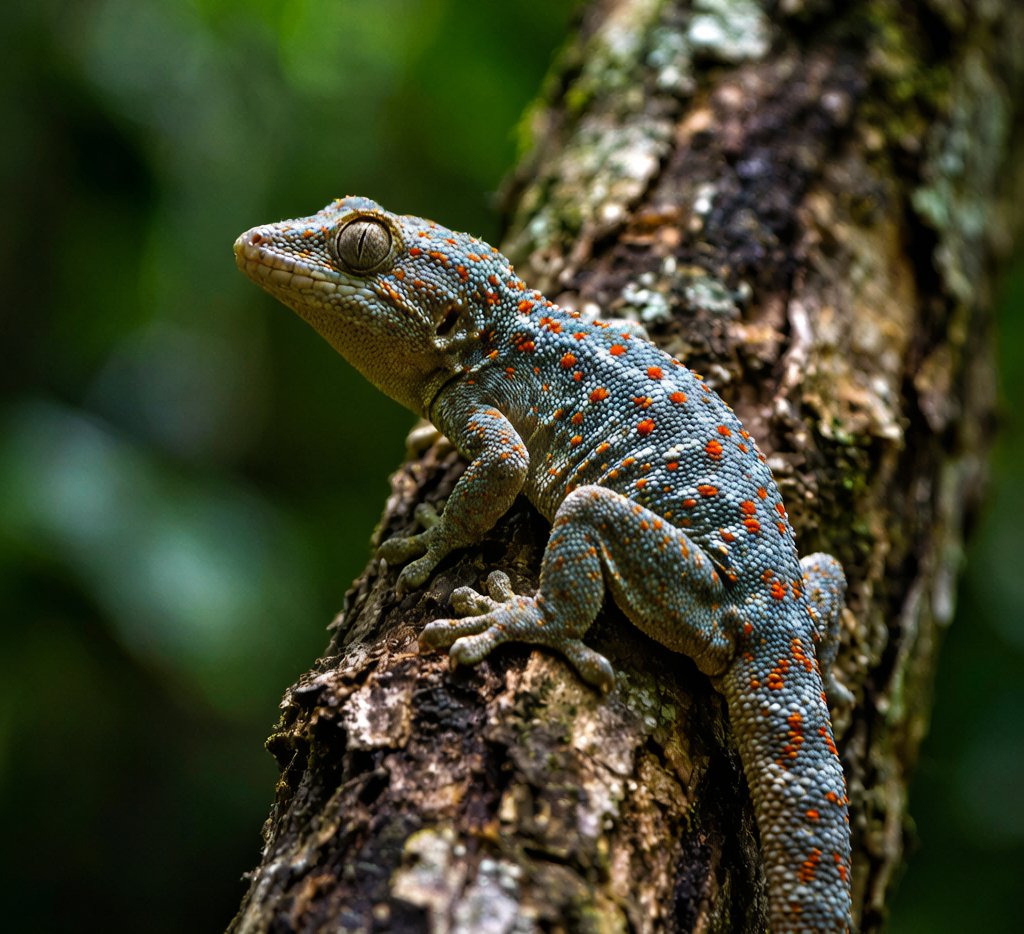
Introduction
The Tokay Gecko (Gekko gecko) is one of the most iconic gecko species in the world, celebrated for its vivid coloration, booming vocalizations, and extraordinary climbing ability. Native to Southeast Asia and South Asia, this nocturnal reptile thrives in tropical forests, rocky habitats, and human dwellings. Its loud, onomatopoeic call—rendered as “geck-geck” or “toki-toki”—resonates through rainforests and rural homes alike, making it one of the most recognisable sounds of the Asian tropics. The Tokay Gecko’s striking appearance has made it a subject of folklore, traditional medicine, and a growing presence in the global pet trade.
Taxonomy
The Tokay Gecko belongs to the family Gekkonidae, which encompasses over 1,000 gecko species worldwide. Its full scientific classification is: kingdom Animalia, phylum Chordata, class Reptilia, order Squamata, family Gekkonidae, genus Gekko, and species G. gecko. The species was formally described by Carl Linnaeus in 1758. Two subspecies are currently recognised: Gekko gecko gecko and Gekko gecko azhari. The genus Gekko contains approximately 30 recognised species, most of which share the characteristic toe pad morphology that enables superlative climbing performance.
Physical Characteristics
The Tokay Gecko is a robust lizard reaching up to 35 centimetres in total length, placing it among the largest gecko species on Earth. Its body displays vivid orange or reddish spots against a blue-grey to purple-grey base, though colour variation is considerable across its range. Its most remarkable anatomical feature is the enlarged toe pads, lined with millions of microscopic setae that generate van der Waals forces, allowing the gecko to cling to any surface including glass and polished metal. The head is broad and triangular, bearing large, lidless eyes with vertically elliptical pupils. As with all geckos, the Tokay lacks eyelids and uses its tongue to clean and moisten its eyes. Its prehensile tail can be shed as a predator distraction and regenerates over time.
Habitat
Tokay Geckos inhabit tropical and subtropical forests, rocky outcrops, and human-modified landscapes across Bangladesh, Nepal, India, Southeast Asia, southern China, and the Philippines. They are strongly arboreal, frequently found on tree trunks, rocks, and building walls. Preferred microhabitats include warm, humid environments with abundant crevices, bark fissures, and roof spaces. In rural and urban areas, they congregate near outdoor lights that attract insect prey, making human dwellings favoured night-time foraging grounds.
Diet
As a strict carnivore, the Tokay Gecko feeds primarily on insects and other small invertebrates including crickets, cockroaches, moths, beetles, and spiders. Larger individuals may consume small vertebrates such as other lizards including smaller lizard species, and even small snakes. The gecko relies on its acute night vision to detect moving prey, seizing items with its strong jaws and recurved teeth. Hunting occurs exclusively at night, with the gecko foraging from ground level to the canopy. Prey may approach half the gecko’s own body mass.
Reproduction
Tokay Geckos are oviparous, breeding during warm months. The female deposits one or two hard-shelled eggs per clutch in concealed sites such as crevices, tree hollows, or wall gaps. Both parents may guard the nesting site briefly. Eggs incubate for 60 to 90 days depending on temperature and humidity, after which fully formed hatchlings emerge and begin hunting immediately. Juveniles display brighter, more contrasting colouration than adults, which dulls with age. Sexual maturity is reached at two to three years.
Conservation
The Tokay Gecko is classified as Least Concern by the IUCN, reflecting its extensive range and large populations. However, mounting pressures from habitat loss, collection for the international pet trade, and demand for traditional medicine are growing concerns. Several range states have enacted protective legislation, though enforcement varies. Captive breeding programmes in some countries have reduced pressure on wild populations, but wild-harvested individuals still dominate some markets.
Fun Facts
The Tokay Gecko produces sounds exceeding 100 decibels, making its call among the loudest of any lizard species. Its common name is directly onomatopoeic, derived from its distinctive threat call. Tokay Geckos can live for more than a decade in captivity, with some individuals documented exceeding 15 years. Their adhesive toe pads have inspired extensive scientific research into synthetic gecko-inspired adhesives. Despite their popularity, they are notably aggressive and will deliver a powerful bite if handled roughly.