 By st20113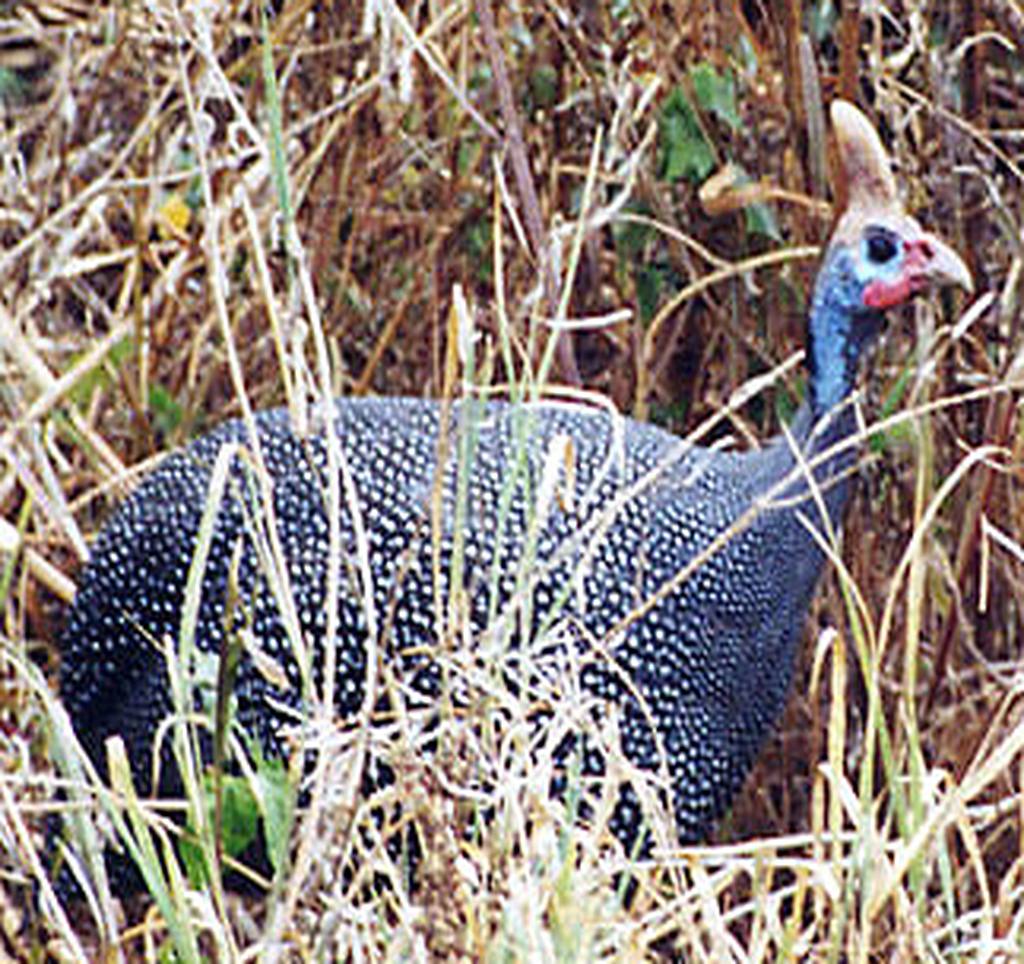
Introduction
The Helmeted Guineafowl, Numida meleagris, is one of Africa’s most distinctive birds, immediately recognisable by its slate-grey body covered in hundreds of small white pearl-like spots and its peculiar bare head crowned with a bony helmet-like casque. Native to sub-Saharan Africa, this large, chicken-like bird inhabits open savannas, grasslands, scrubland, and agricultural areas where it forages in noisy, tightly coordinated flocks of over 50 individuals outside the breeding season. Its loud, harsh alarm calls make it an effective sentinel, alerting wildlife and humans to predators, which has made it popular among farmers as a natural alarm system.
Taxonomy
The Helmeted Guineafowl belongs to the family Numididae and the genus Numida, which contains a single living species, making it the sole member of its genus. Numida meleagris was formally described by Linnaeus in 1758. Genetic studies confirm its position within the Galliformes order as a sister group to the Odontophoridae (New World quails). The species has several subspecies based on geographical variation in size and facial ornamentation, with N. m. galeata as the western subspecies and N. m. mitrata as the eastern form. The lineage diverged from other gamebirds approximately 30 to 40 million years ago.
Physical Characteristics
The Helmeted Guineafowl measures 53 to 63 centimetres in length, weighs 1.0 to 1.5 kilograms, and has predominantly slate grey and black plumage covered in numerous small white spots. The head is bare with blue facial skin, a red caruncle at the base of the beak, and a prominent bony helmet-like casque on top of the crown. A distinctive white strip of skin runs above the eye, bordered by a dark band. The legs are grey and unfeathered, equipped with sharp claws adapted for scratching the ground in search of food.
Habitat
Helmeted Guineafowl inhabit diverse African landscapes, from semi-desert scrubland and dry savannas to moist grasslands, riverine woodland, and forest edges. They prefer open country with scattered trees and tall grass providing cover for roosting and nesting while allowing clear sightlines for predator detection. Agricultural landscapes including cultivated fields and pastures are increasingly important habitat. At night, Helmeted Guineafowl roost in trees to avoid nocturnal predators, returning to the same communal roost sites night after night. Introduced populations in the West Indies and southern France thrive in similar environments.
Diet
The diet of Numida meleagris is omnivorous, primarily seeds, leaves, flowers, and fallen fruits, supplemented by beetles, caterpillars, grasshoppers, ticks, spiders, and snails. A single bird can consume several thousand ticks per day, making the species a valuable natural agent in the control of livestock ticks and tick-borne diseases. Seeds of grasses, herbs, and crops are consumed throughout the year. Food is located by scratching the ground with the feet, and the birds drink by sucking water rather than tilting the head back, a method shared with other galliformes.
Reproduction
Helmeted Guineafowl are monogamous breeders, typically forming pairs during the breeding season. The nest is a scrape on the ground lined with grasses, usually placed in dense vegetation. The female lays 6 to 20 small, dark brown speckled eggs, with an incubation period of 26 to 28 days. Chicks, called keets, are precocial at hatching. Both parents lead the brood, and because multiple females sometimes lay in the same nest, a single brood can include over 20 chicks. Keets fledge at approximately four weeks old.
Conservation
The Helmeted Guineafowl is classified as Least Concern globally, with population estimates ranging from several hundred thousand to several million individuals. The species has benefited from agricultural expansion creating new savanna and farmland habitat. However, wild populations face pressure from hunting for bushmeat in West and Central Africa. Egg collection and nest predation by small carnivores cause reproductive failure in areas with high human disturbance. In introduced regions such as the West Indies, it has integrated into local ecosystems with mixed effects on native wildlife.
Fun Facts
The Helmeted Guineafowl is famous for its loud, harsh alarm call, earning it the nickname “the original smoke detector.” A single flock can produce a cacophony audible over a kilometre away, benefiting not only other wildlife sharing the habitat but also alerting farmers to intruders. Domestication began in ancient Egypt over 4,000 years ago, and the species was subsequently introduced to Greece, Rome, and eventually most of the world as a prized game bird. The lean, dark meat is considered a delicacy in French and West African cuisine.