 By st20113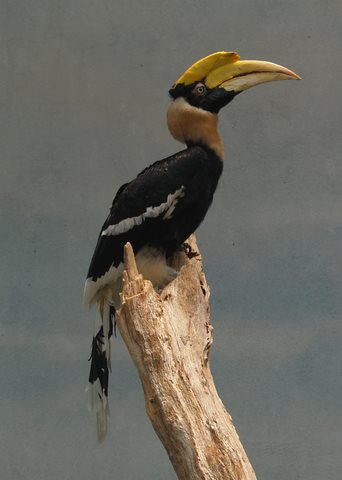
Introduction
The great hornbill (Buceros bicornis), also known as the great Indian hornbill, is one of the most spectacular birds in Asia and among the largest hornbill species in the world. Found in old-growth evergreen forests of southern Asia, this enormous bird is instantly recognizable by its massive double-crested casque atop its oversized bill, its striking black and white plumage, and its deep, far-carrying call. The great hornbill plays a crucial ecological role as a seed disperser for large-fruited trees, making it a keystone species in the forests it inhabits. Its unique breeding biology, in which the female seals herself inside a tree cavity during incubation, has fascinated naturalists for generations. Classified as Vulnerable on the IUCN Red List, it faces serious threats from habitat loss and poaching.
Taxonomy
The great hornbill belongs to the family Bucerotidae within the order Bucerotiformes, characterised by their oversized bills and casques. Carl Linnaeus described the species in 1758. The genus name Buceros, meaning horned ox, refers to the helmet-like structure on the upper mandible. The family contains around 60 species distributed across Africa and Asia, with the great hornbill being among the largest. Within the genus Buceros, two species are recognised: the great hornbill and the rhinoceros hornbill (Buceros rhinoceros). The great hornbill is the state bird of Kerala and Tamil Nadu in India.
Physical Characteristics
The great hornbill stands approximately 95 to 120 centimetres tall and weighs between 2 and 4 kilograms, with males slightly larger. Its most striking feature is the large double-crested casque atop the upper mandible, measuring up to 27 centimetres in length. Plumage is predominantly black on the body and wings, with a white belly, undertail coverts, and neck. The eye is surrounded by bare skin that is red in males and pinkish in females. The wingspan can reach 150 centimetres, and in flight the white primary feathers and black wingtips create a distinctive checkerboard pattern. The wings produce a distinctive whooshing sound audible at some distance.
Habitat
Great hornbills inhabit old-growth evergreen and semi-evergreen forests from the Himalayan foothills of India and Nepal through mainland Southeast Asia, the Malay Peninsula, and Sumatra. They prefer areas with large, mature trees capable of providing suitable nesting cavities. The species is found at elevations between 600 and 2,000 metres, though in some areas it occurs at sea level. Great hornbills require large areas of intact forest, making them highly sensitive to habitat fragmentation and selective logging. They are largely sedentary, with individuals maintaining home ranges of 20 square kilometres or more depending on food availability. The loss of large nesting trees is a significant conservation concern.
Diet
Great hornbills are primarily frugivores, with fruit making up the vast majority of their diet. Figs are a particularly important food source year-round. They also eat a wide variety of tropical fruits including mangoes and berries. Their role as seed dispersers is critically important for forest regeneration, especially for large-fruited trees whose seeds germinate only after passing through a hornbill’s digestive tract. Great hornbills also supplement their diet with small mammals, birds, reptiles, and large insects. They catch prey by swooping from a perch or by plucking it from foliage. Individuals may travel considerable distances each day following seasonal fruit availability.
Reproduction
Great hornbills breed during the dry season from February to May. They are monogamous and both sexes participate in selecting a nesting cavity in a large, old tree. Remarkably, the female seals herself inside the cavity during incubation, using mud, fruit pulp, and droppings to plaster up the entrance, leaving only a narrow slit for the male to pass food. She lays one or two eggs and incubates them for 38 to 45 days. The male feeds both the female and, after hatching, the chick. Once the chick is older, the female breaks out and both parents feed the growing young. The juvenile leaves the nest after roughly 72 to 96 days.
Conservation
The great hornbill is classified as Vulnerable, with populations declining across much of its range. Primary threats are habitat loss through deforestation for agriculture and logging, and hunting for meat, feathers, and especially the ornamental casque. In India and several range countries, the great hornbill is protected under wildlife laws. Community-based conservation initiatives and nest protection programs have shown promising results. Protected areas preserving large tracts of old-growth forest are essential for long-term survival. Ecotourism focused on hornbill watching provides economic incentives for local communities to protect both species and habitat.
Fun Facts
The great hornbill’s large casque is hollow, reinforced internally by fine bone struts that give remarkable strength while remaining lightweight. During courtship, pairs engage in duetting, alternating calls to produce a resonant duet. Hornbills disperse the seeds of more than 50 tree species in Asian rainforests, making them among the most important gardeners of the forest ecosystem.