 By Iris
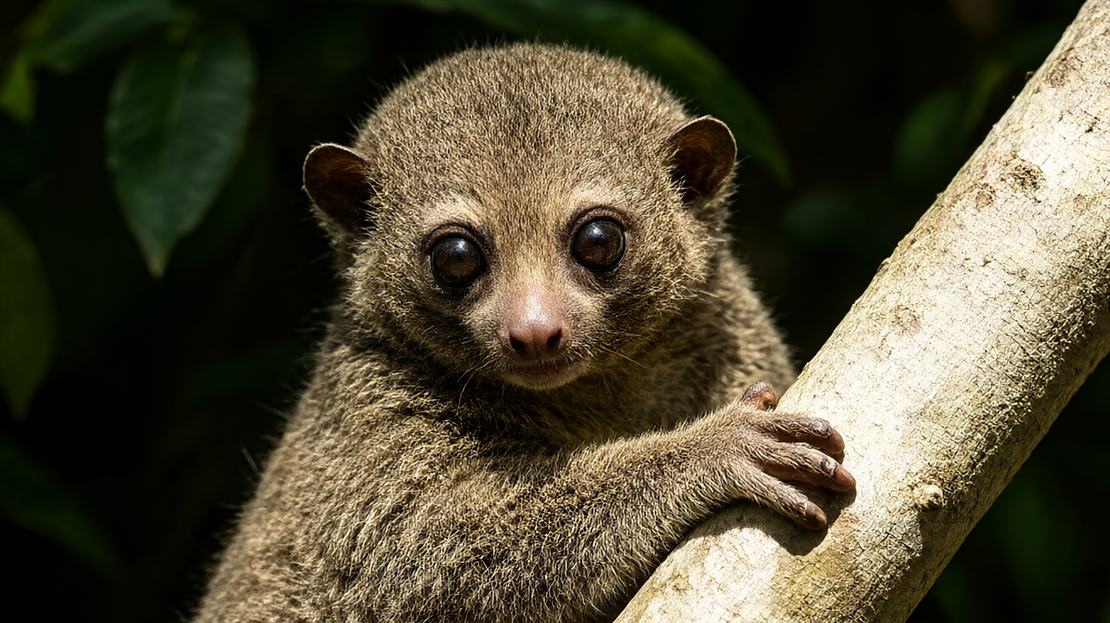
Perodicticus potto | Potto
Species Profile · Lorisidae
Potto
A slow animal climbs a branch and stops mid step.
Least Concern
Weight
Body
Fingers
Wrist
Litter
Rating
The Potto
Slow enough to grow moss
A slow potto climbs a branch and stops mid step. Its grip holds without effort, and the hand closes like a clamp. Nothing about the movement suggests a hunt, yet it catches prey.
Most people never see one, since it works at night. A potto moves so slowly that moss grows on its back. The potto belongs to a group that split from lemurs long ago, and it has kept the same slow habits ever since.
Family tree
Lorisidae, the lorises
Perodicticus potto sits in the loris family, Lorisidae. Its closest relatives live in Asia, and the two groups separated millions of years ago. Workers once lumped every potto into one species, though skull work split them apart. One close cousin, the angwantibo, shares the same slow habits.
Potto comes from an African name, since the animal has carried it for centuries. No close cousin lives in Madagascar, because the island’s lemurs followed another path. One relative abroad, the Slow Loris, carries the same toxin in its saliva.
Wrist knob, spiny neck
How to tell one
Adults weigh 1 to 1.2 kg. Body length runs 30 to 40 cm, and the tail adds almost nothing. A reduced index finger leaves a stump, and the hand still grips well. Its wrist carries a knob, and the ridge works like a second thumb.
Spiny vertebrae sit in the neck, and those bones show through the skin. Fur stays dense and grey brown, which hides it against bark. The eyes run large, since almost all activity happens in darkness.

1
2
3
Closed canopy
Where it lives
Rainforest holds the species across West and Central Africa. It stays in the trees, and it rarely comes down. Its range covers a wide belt, and the species survives in fragments that once joined across the continent.
Because it needs tall trees, logging removes habitat fast. Swamp forest suits it, since the trees stay closed there. Farmland holds few pottos, though hedgerows carry them between patches.
Gum, fruit, insects
What it eats
Gum forms much of the diet. Fruit and insects fill the rest. It scrapes bark to reach sap, and the wound then seeps for weeks.
Because it moves slowly, it cannot chase prey and must ambush instead, waiting at a flower until prey lands. A strike comes fast once the prey arrives, and the hand closes before the insect lifts off. Nothing gets wasted, since it returns to the same trees each night.
One young, carried
The breeding cycle
Birth comes after months of pregnancy. The mother carries the baby on her belly, and the two stay close. Because the infant cannot grip at first, the mother supports it with a hand, and the baby clings within a week.
Weaning takes months, and the young stays near the mother for a year. Females reach breeding age near two years, though males take longer. Breeding happens year round, since the forest supplies food in every month.
Bushmeat
Conservation
The Red List calls the species Least Concern. Its range stays wide, and the population holds up across much of it. Bushmeat hunting removes pottos, because the slow pace makes them easy to catch, and a single snare takes several a year.
Forest clearing poses the larger threat, though the species takes some disturbance. Because it hides in trees, surveys miss how many remain. Reserves protect part of the range, yet enforcement varies between countries.
Side by side
How It Compares
| Trait | Potto | Slow Loris |
|---|---|---|
| Family | Lorisidae | Lorisidae |
| Weight | 1-1.2 kg | 0.4-0.8 kg |
| Wrist | bony knob | no knob |
| Toes | reduced index finger | reduced second finger |
| Range | West and Central Africa | South and Southeast Asia |
| Rating | Least Concern | Vulnerable |
Common misreadings
What People Get Wrong
- Not a lemur. The two lines split long ago. Pottos sit with the lorises, while lemurs evolved on Madagascar after a separate crossing, and the two groups now look alike only in their habits.
- Not a fast hunter. The animal waits for prey to arrive. A strike comes fast once something lands, and the hand closes before the insect can lift off again.
- Not a primate with a good grip by luck. A bony knob does the work. The ridge on the wrist braces against a branch, so the hand holds without effort and the animal can hang by one limb.
Going further
Sources and Further Reading
Quick hits
Five things to remember
- Its wrist knob works like a thumb, and the grip never slips.
- Urine washing marks a trail, and the smell tells other pottos who passed.
- A potto can hang by one limb for minutes without effort.
- It produces a toxin in its saliva, and a bite swells fast.
- Its neck bones carry spines, and a predator that bites the neck meets them.
[…] It sits in the family Spheniscidae, the penguin family. That family also holds the much larger Emperor Penguin. The two birds share the same basic plan. Both have flippers instead of wings and dense feathers […]