 By st20113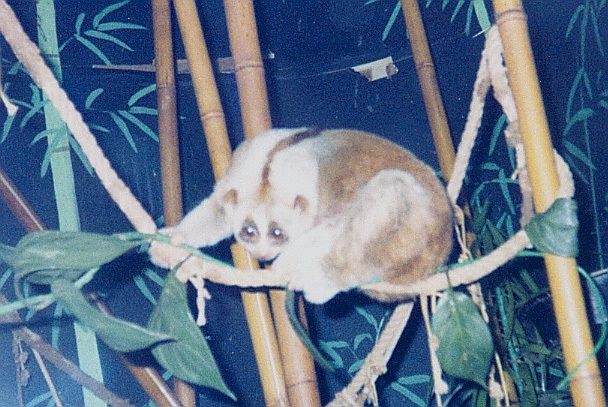
Introduction
The slow loris (Nycticebus coucang) is a small, nocturnal primate native to Southeast Asia, recognized by its large, round eyes ringed with dark fur, soft dense coat, and deliberate movements through the forest canopy. Despite its cute appearance, the slow loris is one of the few venomous mammals, using this ability to deter predators and compete with rivals. Found in the tropical rainforests of the Malay Peninsula, Sumatra, Borneo, and Java, it spends nights foraging for nectar, fruit, and insects in the forest canopy. The species is classified as Vulnerable by the IUCN, having been driven toward Near Threatened status primarily by the illegal pet trade, one of the most intensive wildlife trafficking operations in Southeast Asia.
Taxonomy
Nycticebus coucang belongs to the family Loridae and the order Primates, first formally described by Coenraad Jacob Temminck in 1821. Three subspecies are recognized from the Malay Peninsula and Sumatra, Borneo, and Java, with some authorities elevating these to full species based on genetic evidence. Within the strepsirrhine group, slow lorises are most closely related to angwantibos, pottos, and the ring-tailed lemur of Madagascar, sharing the characteristic wet nose and reflective eye layer. Slow lorises are haplorrhine-like primates that split from the common ancestor of orangutans and humans more than 70 million years ago.
Physical Characteristics
The slow loris is a compact primate 24 to 38 centimeters in body length and weighing 0.7 to 2 kilograms. Its most striking feature is a pair of enormous, forward-facing eyes providing exceptional depth perception for locating prey in low light. Dark, mask-like fur patches around the eyes break up the facial outline for camouflage. The dense, woolly underfur sheds water efficiently in tropical rainforest conditions. Highly opposable thumbs enable powerful gripping on branches, and the spine is unusually flexible, allowing unusual contortions while foraging or resting. The species possesses a venomous bite, produced by brachial glands in the inner elbow. Mixed with saliva, the secretion causes painful reactions, and the animal applies it to its fur by licking the gland and grooming its body for chemical defense against predators.
Habitat
The slow loris inhabits tropical and subtropical rainforests across the Malay Peninsula, Sumatra, Borneo, and Java, from sea level to approximately 1,600 meters elevation. It is primarily arboreal, spending nearly all its time in the forest canopy and rarely descending to the ground. The species prefers dense, primary rainforest with abundant lianas and vines, though it can survive in secondary forest and plantation edges. Within the canopy, it inhabits the middle to upper strata, moving deliberately along horizontal branches and avoiding open spaces exposed to aerial predators. Slow lorises maintain stable home ranges through scent-marking with urine and glandular secretions on branch surfaces.
Diet
The slow loris is a nocturnal omnivore with a diet dominated by nectar, fruit, and insects. Nectar and pollen from flowers such as the kapok tree constitute an important seasonal food source. Ripe fruits including figs, mangoes, and lychees supplement the diet when available. Animal prey, crickets and beetles, spiders, bird eggs, and small vertebrates including tree frogs and lizards provide essential protein. Slow lorises hunt by sight rather than smell, capturing insects with both hands in a precise strike before prey can escape.
Reproduction
Slow lorises are polygynous, breeding throughout the year with births in all months but regional peaks. After a 186-day gestation, a single infant is born in a nest of leaves and branches. Newborns are relatively well developed, fully furred, with eyes open, immediately clinging to the mother’s belly. The mother parks her infant on concealed branches between foraging bouts, returning to nurse every one to two hours, minimizing predation risk. Weaning occurs between 5 and 6 months, with independence shortly after. Sexual maturity is reached between 18 and 24 months.
Conservation
The slow loris is classified as Vulnerable by the IUCN, with populations declining across its range due to habitat loss and the illegal wildlife trade. Southeast Asia has one of the world’s highest deforestation rates, and rainforest destruction for palm oil, agriculture, and logging has severely reduced habitat. The most immediate threat is the international pet trade; slow lorises are widely sold online and in markets despite legal protection in all four primary range countries. Slow lorises destined for the pet trade are almost always declawed or have their teeth ripped out, making them extremely poor candidates for rehabilitation. Listed in CITES Appendix I, enforcement remains inadequate.
Fun Facts
The slow loris is one of the few venomous mammals; its bite can cause severe pain, swelling, and in rare cases anaphylactic reactions in humans. When threatened, the slow loris raises its arms overhead in a posture called toxic necking, bringing the venomous elbow gland to the mouth for a potentially lethal bite. Despite their name, slow lorises can move at surprising speed when capturing prey or fleeing danger. Their large eyes provide excellent night vision, among the best of any primate.