 By st20113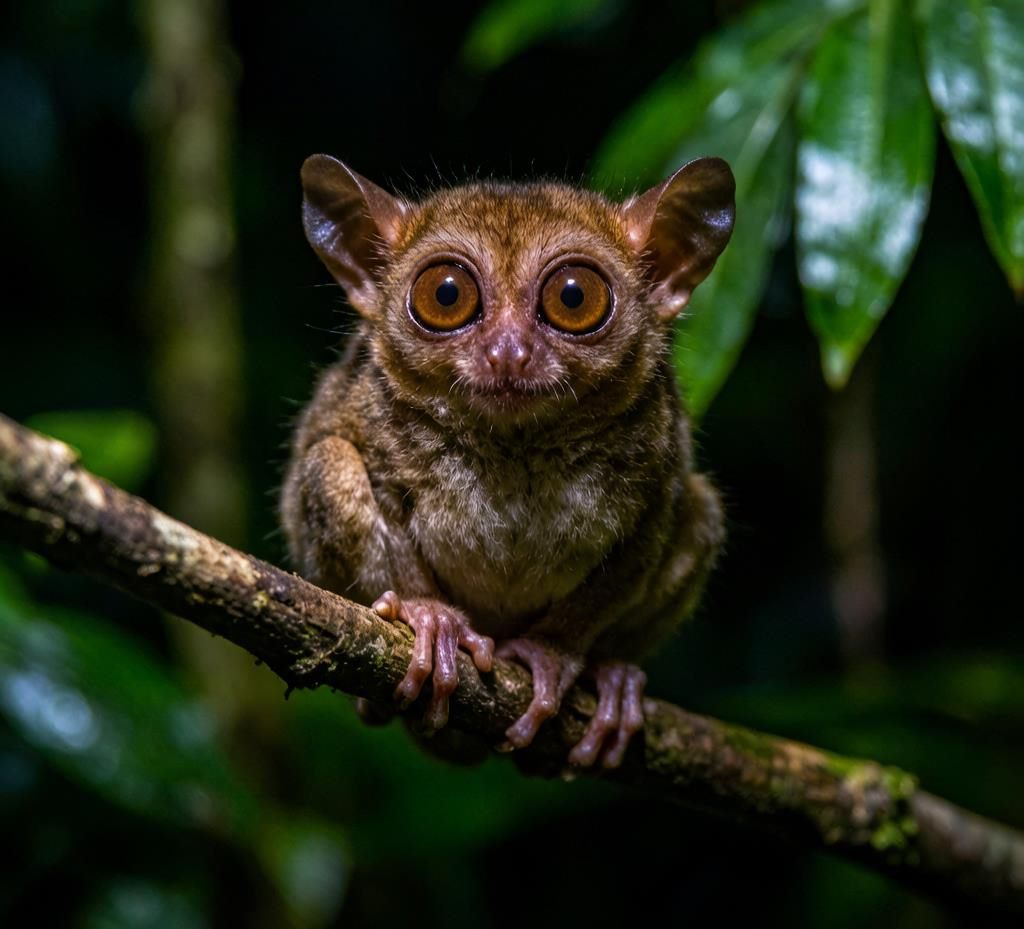
Introduction
The Philippine tarsier (Carlito syrichta) is one of the smallest and most extraordinary primates on Earth, a tiny inhabitant of the dense tropical forests on the Philippine islands of Samar, Leyte, Bohol, and Mindanao. Weighing no more than 130 grams and standing roughly 15 centimeters tall, this nocturnal mammal possesses the largest eyes relative to body size of any known animal, an adaptation for hunting insects in total darkness. Once thought to be related to lemurs, genetic research has confirmed the tarsier belongs to the haplorrhine branch of primates, closer to monkeys and apes than to lemurs. Despite its diminutive size, the Philippine tarsier is a fierce predator capable of leaping more than three meters between trees to capture prey. Listed as Near Threatened by the IUCN, populations are declining due to habitat destruction and capture for the illegal pet trade.
Taxonomy
Carlito syrichta was formerly classified under Tarsius, but genetic and morphological studies led to its reclassification into the new genus Carlito in 2015 to distinguish it from other tarsier species in Southeast Asia. First described by Carl Linnaeus in 1758, it is one of approximately 13 recognized tarsier species and the only one found in the Philippines. Philippine tarsiers are haplorrhine primates sharing a more recent common ancestor with orangutans and humans than with strepsirrhine lemurs and lorises. The species occupies a unique position in primate evolution, representing a lineage that diverged from the common ancestor of all monkeys and apes more than 60 million years ago.
Physical Characteristics
The Philippine tarsier measures approximately 15 centimeters in body length and weighs 110 to 130 grams, small enough to fit in a human hand. Its enormous eyes each measure approximately 16 millimeters in diameter, larger than the species’ entire brain case. These eyes provide exceptional low-light vision and are fixed in their sockets, requiring the animal to rotate its entire head to look around, a trait shared with owls. Elongated tarsal ankle bones, the source of the species’ name, provide powerful leverage for leaping, with hindlimbs more than twice the length of forelimbs. Fingers are long and fleshy with adhesive gripping pads, and the tail is slender and nearly hairless with a terminal tuft.
Habitat
The Philippine tarsier is endemic to the Philippines, found exclusively on Samar, Leyte, Bohol, and Mindanao, with each island population genetically distinct. It inhabits dense tropical and secondary forests, preferring areas with thick vegetation including tall grasses, shrubs, and small trees that provide cover and hunting perches. Tarsiers are almost entirely arboreal, rarely descending to the ground and requiring interconnected vegetation to move between trees. They are commonly found near limestone outcrops, where crevices provide shelter and daytime sleeping sites. The species requires dense canopy cover and is highly sensitive to deforestation and forest fragmentation.
Diet
The Philippine tarsier is an obligate carnivore, one of the few primates with an almost exclusively animal-based diet. The diet is dominated by insects including crickets, grasshoppers, katydids, beetles, moths, cicadas, ants, and spiders. Prey is located using the enormous eyes and captured in a rapid aerial pounce from a branch. The hunting strategy relies on stillness and patience; the tarsier sits motionless, scanning for movement before launching at prey. Its powerful hindlimbs enable leaps exceeding three meters to capture flying or fleeing insects.
Reproduction
Philippine tarsiers breed throughout the year, with births in all months but regional peaks associated with rainfall patterns. The gestation period is approximately six months, yielding a single offspring. Newborn tarsiers are born well developed, fully furred, with eyes open, immediately gripping their mother’s fur. Unlike most primates, the mother parks her offspring on a concealed branch between feeding bouts, returning to nurse every one to two hours, minimizing predation risk. The young is weaned at around two months and becomes independent shortly after.
Conservation
The Philippine tarsier is classified as Near Threatened by the IUCN, with populations declining across its limited island range. Primary threats include habitat loss from deforestation for agriculture, logging, mining, and human settlement. The remaining forest is highly fragmented, with most populations isolated in patches too small for long-term viability. The illegal pet trade is a significant secondary threat; the species’ small size makes it desirable to collectors, and tarsiers typically die within months of capture. Conservation programs operate on all four range islands, and the species is protected under Philippine national law.
Fun Facts
The Philippine tarsier’s eyes are so large they cannot rotate within their sockets, forcing the animal to rotate its head nearly 180 degrees in each direction, a trait shared with owls. Each eyeball is larger than its entire brain, giving the species the largest eye-to-body-mass ratio of any mammal. The tarsier is an athletic jumper, capable of leaps exceeding three meters, equivalent to a human clearing a building more than 20 meters tall.