 By st20113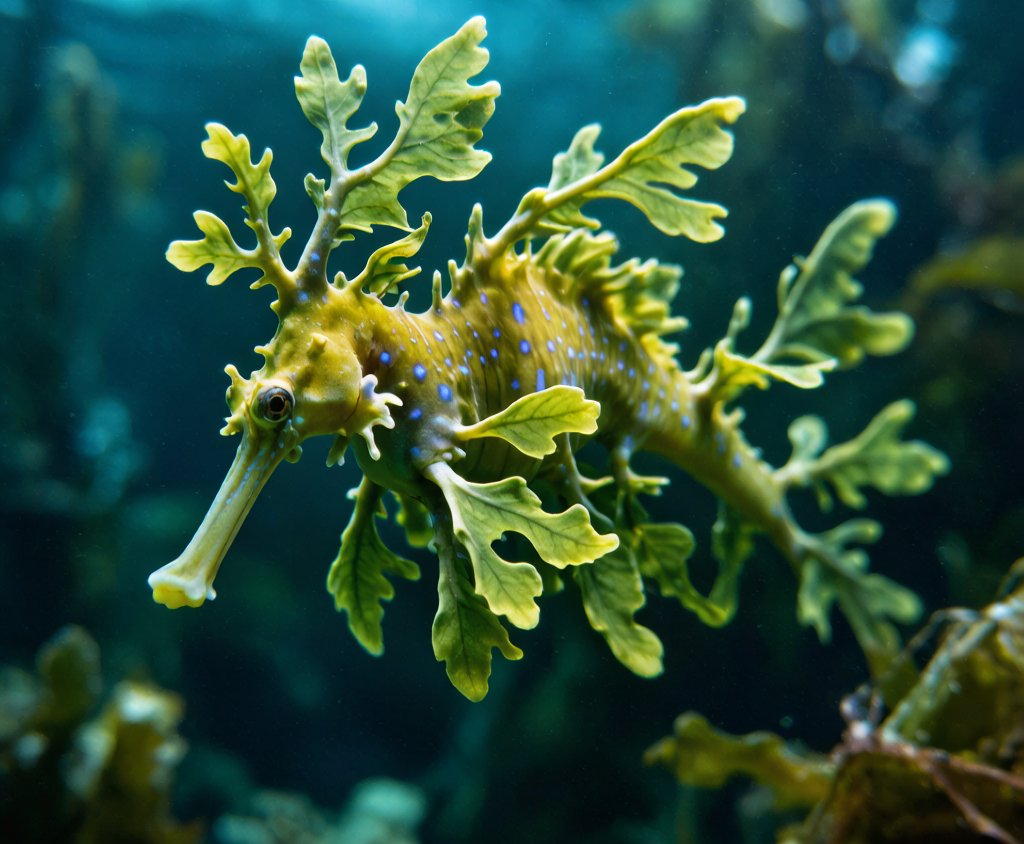
Introduction
The leafy seadragon is a marine fish renowned for its extraordinary camouflage, bearing leaf-like appendages that make it resemble floating seaweed. Found only along the southern and western coasts of Australia, it is a close relative of seahorses and pipefish. The jellyfish and other drifting organisms share its slow, gentle world, but the seadragon is unique in its plant-like disguise. It moves with delicate, almost waving fins that are nearly invisible in motion, allowing it to hover among kelp and seagrass without alerting predators or prey. Its common name captures this uncanny resemblance, which baffles both predators and divers who struggle to spot it against a backdrop of drifting algae.
Taxonomy
Leafy seadragons belong to the family Syngnathidae, the same group that includes seahorses and pipefish, within the order Syngnathiformes. The species is placed in the genus Murrayia as Murrayia pseudo-pilosa, distinguished from the closely related weedy seadragon by its more elaborate foliage-like fins. Like all syngnathids, it has a fused jaw, a tubelike snout, and a bony-plated body rather than scales. Its evolutionary lineage is tied to shallow temperate reefs of the southern hemisphere.
Physical Characteristics
An adult leafy seadragon reaches about 20 to 35 centimetres in length. Its body is covered with bony plates and adorned with elaborate, leaf-shaped dermal appendages that extend from the head, body, and tail. These fins are not used for propulsion but for camouflage. Coloration ranges from yellow-green to brown, often with purple or maroon accents, matching the algae among which it lives. The small pectoral fins near the neck and a dorsal fin along the back provide the only means of movement, creating a gentle, swaying drift.
Habitat
Leafy seadragons inhabit shallow, temperate waters along the Australian coast, typically at depths of 3 to 50 metres. They favour rocky reefs, seagrass meadows, and beds of kelp and seaweed where their disguise is most effective. They are poor swimmers and rely on their camouflage rather than flight to avoid danger. Sightings are most common where dense algal growth provides both food for prey and cover for the dragons themselves.
Diet
These fish are ambush predators that feed almost exclusively on tiny crustaceans, especially mysid shrimp, along with amphipods and other small invertebrates. Using their pipe-like snout, they suck prey in with a rapid, powerful intake of water. Because they lack a stomach, they must eat frequently and in small amounts throughout the day. They remain nearly motionless, waiting for prey to drift within striking range before snapping it up with surprising speed. This specialist diet means the seadragon must stay among productive algal beds where shrimp are abundant, rarely straying into open water.
Reproduction
Like seahorses, leafy seadragons practise male brooding, though the eggs are attached to a spongy patch on the underside of the male’s tail rather than carried in a pouch. During courtship, a pair dances together, intertwining tails before the female transfers up to 250 bright pink eggs to the male. He carries and protects them for about six to eight weeks until they hatch as fully formed miniature seadragons. The young are independent from birth and receive no further parental care.
Conservation
The leafy seadragon is protected by Australian law and is listed as near threatened, with populations pressured by pollution, habitat degradation, and illegal collection for the aquarium trade. Climate change and warming seas also threaten the kelp forests they depend on. Conservation measures include marine protected areas and restrictions on capture. Compared with wide-ranging species such as the shark, the seadragon’s limited range makes it especially vulnerable to local environmental change.
Fun Facts
The leafy seadragon is the official marine emblem of the state of South Australia. Despite its fearsome name, it is completely harmless and has no teeth or sting. It cannot curl its tail like a seahorse and instead trails it behind like a leafy ribbon. Each individual’s pattern of leafy appendages is unique, much like a fingerprint. The “leaves” are not used for swimming at all—they exist purely to fool the eye.