 By st20113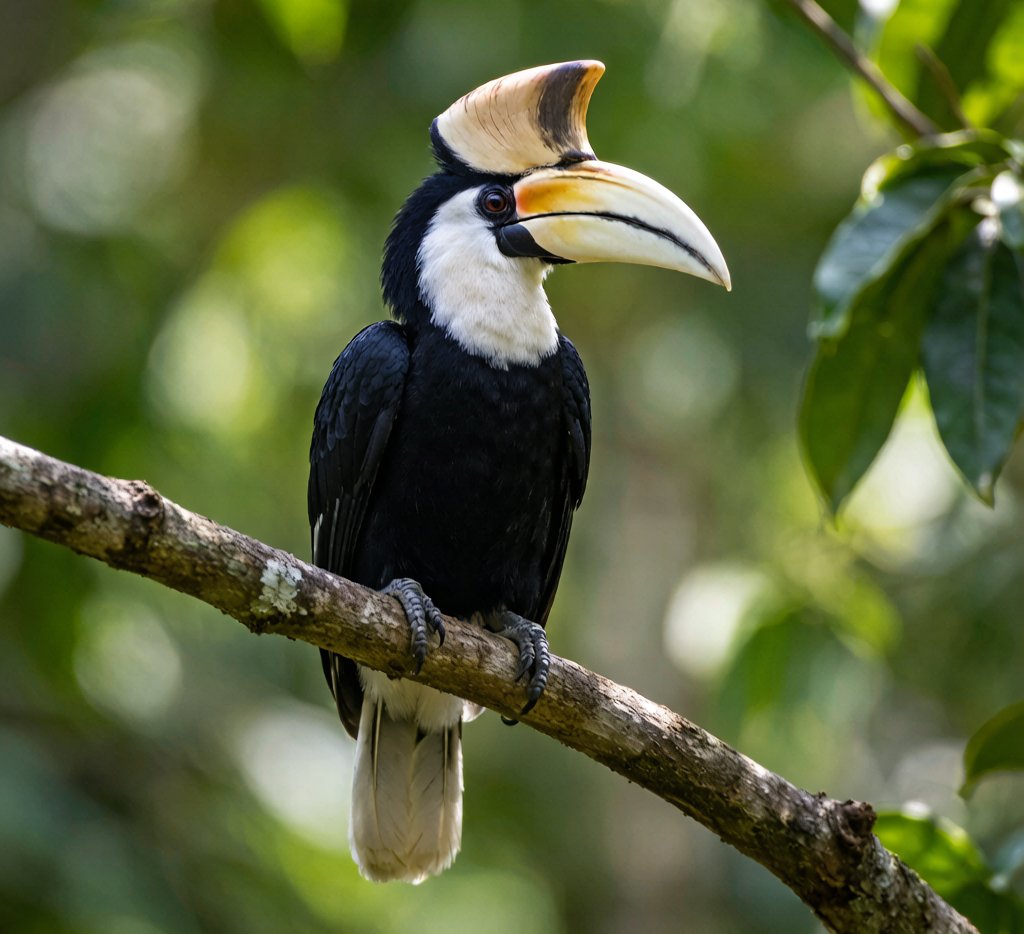
Introduction
The rhinoceros hornbill is one of the largest and most spectacular birds of Southeast Asia, named for the prominent casque that rises from its bill like a horn. This striking black-and-white bird is a symbol of the rainforests of Borneo and Sumatra, where its loud, echoing calls ring through the canopy. It is also deeply woven into the culture of indigenous Dayak peoples, who revere it as a messenger of the gods.
Taxonomy
The rhinoceros hornbill belongs to the family Bucerotidae, the hornbill family, which contains more than fifty species across Africa and Asia. Its scientific name is Buceros rhinoceros. The genus Buceros includes several large Asian hornbills with massive bills and prominent casques. Three subspecies are recognized, distributed across Borneo, Sumatra, Java, and the Malay Peninsula. Hornbills are unique among birds because of their fused neck vertebrae, which help support their heavy heads and large bills.
Physical Characteristics
The rhinoceros hornbill is a large bird, measuring 80 to 90 centimeters in length, not including its long central tail feathers. Males are slightly larger than females and have red eyes, while females have white eyes. The plumage is mostly black with white underparts, a white tail with a black band, and a white rump. The most remarkable feature is the casque, a hollow structure on top of the bill that is bright red and orange at the base, fading to yellow toward the tip. The casque is made of keratin and is believed to amplify the bird’s calls. In flight, the wings produce a loud whooshing sound that can be heard from a distance.
Habitat
The rhinoceros hornbill lives in primary lowland rainforests and occasionally in hill forests up to 1,400 meters above sea level. It occurs on the islands of Borneo, Sumatra, and Java, and on the Malay Peninsula. The species depends on large, mature trees for both food and nesting, and it rarely ventures far from dense forest. Hornbills are highly mobile and travel long distances in search of fruiting trees. These forests are also home to large predators such as tigers and clouded leopards, though hornbills are rarely threatened by them.
Diet
The rhinoceros hornbill is primarily frugivorous, feeding on figs and many other rainforest fruits. It plays a vital role as a seed disperser, carrying seeds far from the parent tree and helping to maintain the diversity of the forest. The bird also eats insects, small reptiles, and the nestlings of other birds, which provide essential protein. Hornbills feed in the canopy and sometimes gather in large numbers at fruiting fig trees. They pluck fruit with the tips of their bills, toss it into the air, and catch it in their throats. Because fruit supplies fluctuate, hornbills roam over vast home ranges in search of food.
Reproduction
Rhinoceros hornbills have one of the most unusual nesting strategies of any bird. The female seals herself inside a tree cavity with a wall of mud, fruit pulp, and droppings, leaving only a narrow slit through which the male passes food. She remains sealed inside for the entire incubation and early chick-rearing period, molting and regrowing her flight feathers while protected from predators. The male works tirelessly, making dozens of feeding visits each day to deliver fruit to his mate and chicks. After several months, the female breaks out of the nest, and the young chicks reseal the opening and continue to be fed by both parents until they are ready to fledge.
Conservation
The rhinoceros hornbill is listed as Vulnerable by the International Union for Conservation of Nature. Its population is declining because of rapid deforestation across Southeast Asia, driven by logging and the expansion of oil palm plantations. The loss of large trees eliminates both nesting sites and food sources, and hornbills disappear quickly from fragmented forests. Hunting and capture for the pet trade add further pressure. Conservation measures include protecting large forest reserves, restoring degraded habitat, and enforcing wildlife trade laws. Because hornbills require extensive home ranges, their survival depends on preserving connected tracts of rainforest.
Fun Facts
The rhinoceros hornbill’s casque is so important to Dayak culture that it features prominently in carvings, dances, and ceremonies, and the bird is considered a symbol of strength and loyalty. The casque is hollow and extremely light, adding little weight to the head. When a hornbill takes flight, its wings make a loud, rhythmic whooshing noise that sounds like a steam train. The male’s devoted feeding of the sealed female has made the species a symbol of faithful partnership. Hornbills also have long eyelashes, unusual among birds, which protect their eyes from branches and dust. These magnificent birds can live for more than thirty years in captivity.