 By st20113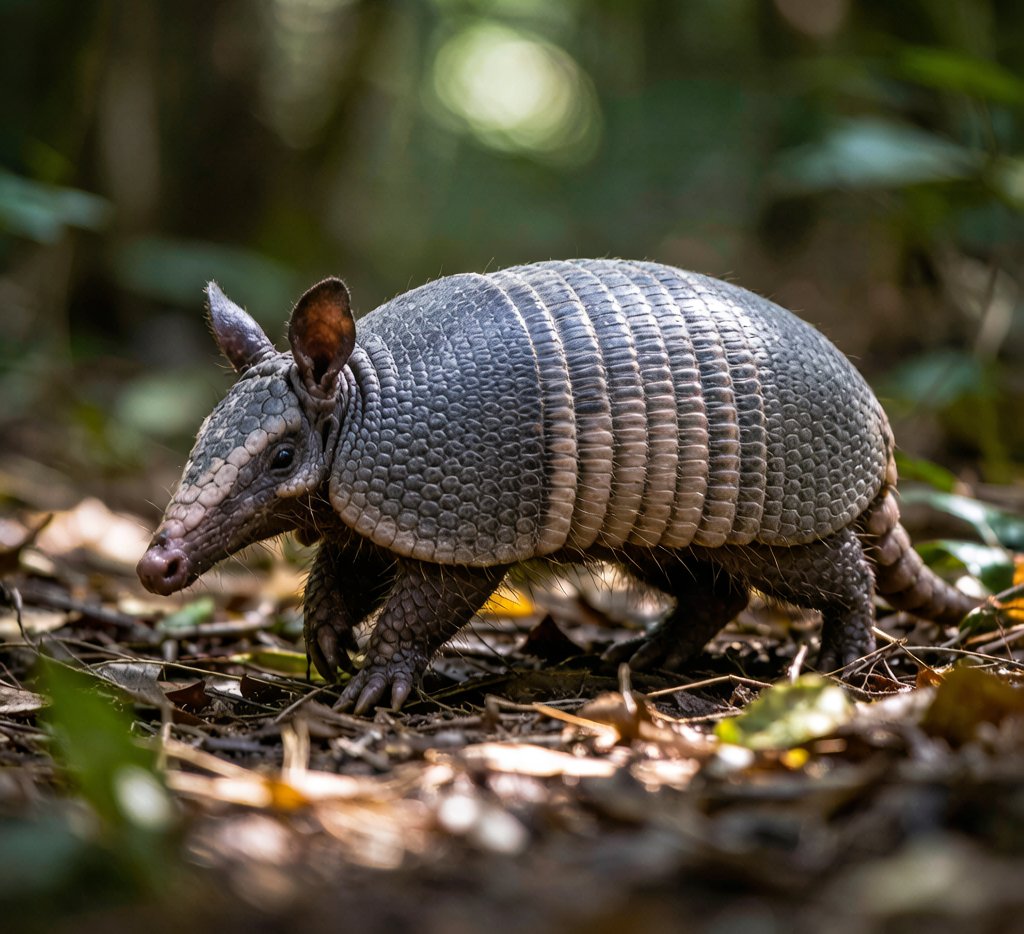
Introduction
The nine-banded armadillo, Dasypus novemcinctus, is a small mammal recognizable by its bony armored shell and long, pointed snout. Native to the Americas, it ranges from the southern United States through Central America and much of South America. Despite its awkward gait, it is a capable digger and swimmer that has expanded its range northward in recent decades. Armadillos are the only living mammals with a true shell of dermal bone. The nine-banded species is the most widespread armadillo and is often seen along roadsides at dusk. Its unusual biology has made it a subject of both scientific study and folklore.
Taxonomy
Dasypus novemcinctus belongs to the genus Dasypus within the family Dasypodidae, part of the order Cingulata. The species was first described by Carl Linnaeus in 1758. The genus Dasypus includes several similar long-nosed armadillos found across the Neotropics. Nine-banded armadillos are distinguished from relatives by the number of movable bands across the midsection, though the count varies from seven to eleven. Genetic research supports their close relationship with other Dasypus species and clarifies how they colonized different habitats. Fossil relatives show that armadillos once included giant forms such as the extinct glyptodonts. Modern classification relies on both anatomy and molecular evidence to place the species among New World xenarthrans.
Physical Characteristics
An adult nine-banded armadillo weighs between 2.5 and 6.5 kilograms and measures about 60 to 75 centimeters including the tail. Its body is covered by a leathery carapace made of dermal bone plates separated by flexible bands. The shell is tan to brown and protects the back, head, and tail, while the underside remains soft. Long claws on the front feet are adapted for digging burrows and unearthing food. The animal has small eyes and poor vision but an excellent sense of smell. It can hold its breath and inflate its stomach with air, allowing it to float across water or walk along the bottom when crossing streams.
Habitat
This species occupies a broad variety of habitats, from forests and grasslands to scrub and agricultural land. It prefers areas with loose, sandy soil that is easy to dig. Across its range it uses burrows for shelter during the day and emerges at night to forage. The nine-banded armadillo has adapted well to human-modified landscapes, including suburbs and farmland, as long as cover and insects are present. It is less common in dense rainforest and high mountains. Expanding northward, it now occurs in parts of the central and southeastern United States. Mild winters and abundant roadside habitat have aided its spread into new territories.
Diet
The nine-banded armadillo is primarily an insectivore, feeding on ants, termites, beetles, and larvae. It uses its keen nose to detect prey underground, then digs with rapid forelimb strokes to expose meals. Grubs and worms supplement its diet, and it occasionally eats small reptiles, eggs, or fallen fruit. A single animal may consume thousands of insects in one night, providing natural pest control. Because it relies so heavily on smell, it often ignores food it cannot scent. The long, sticky tongue helps lap up ants and termites from narrow chambers. Seasonal changes shift the balance of its diet toward whatever invertebrates are most available at the time.
Reproduction
A remarkable trait of this species is that nearly all offspring are genetically identical quadruplets. After a long delayed implantation, a single fertilized egg splits into four embryos, so a litter always contains four same-sex young. Gestation including the delay lasts around eight to nine months. The young are born with soft, leathery skin that hardens within weeks. They nurse for about two months and then begin foraging with the mother. Independence comes after several more weeks. Sexual maturity is reached at roughly one year. This unusual reproductive strategy produces predictable litter sizes and has intrigued biologists studying mammalian development and genetics.
Conservation
The nine-banded armadillo is listed as Least Concern by the IUCN, reflecting its wide distribution and rising numbers. It is hunted for food and sport in parts of its range, and road traffic kills many individuals, yet populations remain stable. The species benefits from forest clearing and agricultural expansion that create open foraging ground. In the United States it is generally viewed as a minor nuisance because of digging, but it faces no major threat. Research on the armadillo has contributed to medicine, since it is susceptible to leprosy and used in related studies. Continued habitat tolerance should keep the species secure, though local declines can follow severe cold snaps.
Fun Facts
A nine-banded armadillo can jump straight up when startled, a reflex that surprises predators. Its shell is made of bone, not horn or cartilage. The species always gives birth to four identical babies. It can walk underwater across creek beds by holding its breath. Armadillos have been around for millions of years alongside other New World mammals. Their name comes from Spanish words meaning “little armored one..
[…] local pain and swelling in humans, though it is rarely life-threatening to healthy adults. Like the nine-banded armadillo, the Asian forest scorpion relies on its armored exoskeleton as its primary defense against […]