 By st20113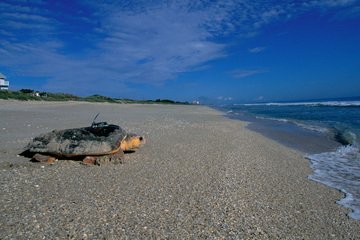
Introduction
The loggerhead sea turtle (Caretta caretta) is the most abundant sea turtle in U.S. waters and one of the most widely distributed marine reptiles on Earth. Named for its exceptionally large head housing powerful jaw muscles, the loggerhead is built to handle one of the most armored diets of any sea turtle. Found in all warm and temperate ocean basins, the loggerhead occupies a critical niche as a predator of hard-shelled invertebrates on rocky and sandy seafloors. Classified as Vulnerable globally by the IUCN, with some populations Endangered, the loggerhead faces serious threats from fisheries bycatch, coastal development, and climate change.
Taxonomy
The loggerhead sea turtle is the only living species in the genus Caretta, within the family Cheloniidae. The genus name Caretta comes from the French word caret, meaning turtle. Originally placed in various genera, the loggerhead was eventually assigned its own monotypic genus reflecting its distinctiveness. Phylogenetic studies confirm that the loggerhead forms a clade with the Kemp’s ridley and olive ridley turtles, sharing a common ancestor that diverged from the green sea turtle and hawksbill lineage approximately 40 million years ago. Four major regional populations are recognized: North Atlantic, South Atlantic, Mediterranean, and North Pacific.
Physical Characteristics
The loggerhead is a large sea turtle, with adults typically ranging from 70 to 110 centimeters in carapace length and weighing 80 to 200 kilograms, with exceptional individuals exceeding 300 kilograms. Its carapace is broadly oval to heart-shaped, with a reddish-brown to yellowish-brown coloration. The head is distinctly large and broad, supporting robust jaw musculature capable of tremendous bite force. Hatchlings are dark brown to nearly black and measure approximately 4 centimeters. The loggerhead is distinguished from the leatherback sea turtle by its hard, bony carapace covered with scutes, versus the leatherback’s flexible leathery skin. Adults display strong site fidelity, returning to the same foraging grounds year after year.
Habitat
Loggerhead sea turtles are found in all warm and temperate ocean waters worldwide, with particularly dense populations in the southeastern United States, the Mediterranean, Japan, and Australia. They are considered the most oceanic of the sea turtle species, encountered far from coastlines during long migrations. Adults concentrate in productive coastal waters during the foraging season, particularly around rocky reefs and shipwrecks. Loggerheads are highly migratory, traveling thousands of kilometers between nesting beaches and distant foraging grounds. Major nesting aggregations occur in the southeastern U.S., Oman, Greece, and Japan.
Diet
The loggerhead sea turtle is a formidable predator of hard-shelled prey, with a diet dominated by mollusks, crustaceans, and sea urchins. Its powerful jaws are adapted to crush the thick shells of horseshoe crabs, whelks, conchs, and other large marine mollusks. Crabs of more than 40 species have been documented in loggerhead diets across their range. In addition to hard-shelled prey, loggerheads eat sea urchins, sea stars, fish, jellyfish, and floating seaweed. By preying on sea urchins, loggerheads indirectly support the growth of coral reef and kelp forest ecosystems, extending their ecological influence beyond direct predatory impact.
Reproduction
Loggerhead sea turtles reach sexual maturity between 17 and 33 years of age. Like all sea turtles, they exhibit natal homing, returning to the beach where they hatched to lay their own eggs. The nesting season varies by region but typically occurs during the warmest months. A single female mates with multiple males and stores sperm for multiple clutches. She comes ashore at night, excavates a body pit and nest chamber, and deposits an average of 100 to 126 spherical leathery eggs. Incubation lasts 45 to 80 days. Hatchlings emerge together at night and rush toward the ocean. Despite producing large numbers of eggs, the survival rate from egg to adulthood is less than one in a thousand.
Conservation
The loggerhead sea turtle is classified as Vulnerable globally, with North Pacific and South Pacific populations listed as Endangered. The primary ongoing threat is fisheries bycatch, in which hundreds of thousands of individuals are estimated to be captured each year in gillnets, shrimp trawls, and longlines. Coastal development destroys nesting beaches, while beach armoring and artificial lighting disorient both nesting females and hatchlings. Conservation measures include CITES regulation, beach protection programs, and hatchery projects. The loggerhead benefits from integrated multi-species marine turtle programs that also protect the sea otter and other coastal marine species.
Fun Facts
The loggerhead sea turtle holds the record for the deepest recorded dive among sea turtles, with one individual documented descending to 1,176 meters in the western North Atlantic. Loggerheads are considered the noisiest sea turtles, producing clicking, grunting, and hissing sounds underwater during mating and social interactions. Hatchlings are natural-born navigators, using magnetic field detection, wave direction, and visual cues to orient toward the sea. Like clownfish, loggerheads have been the subject of extensive conservation breeding programs that have released thousands of head-started juveniles into the wild.