 By st20113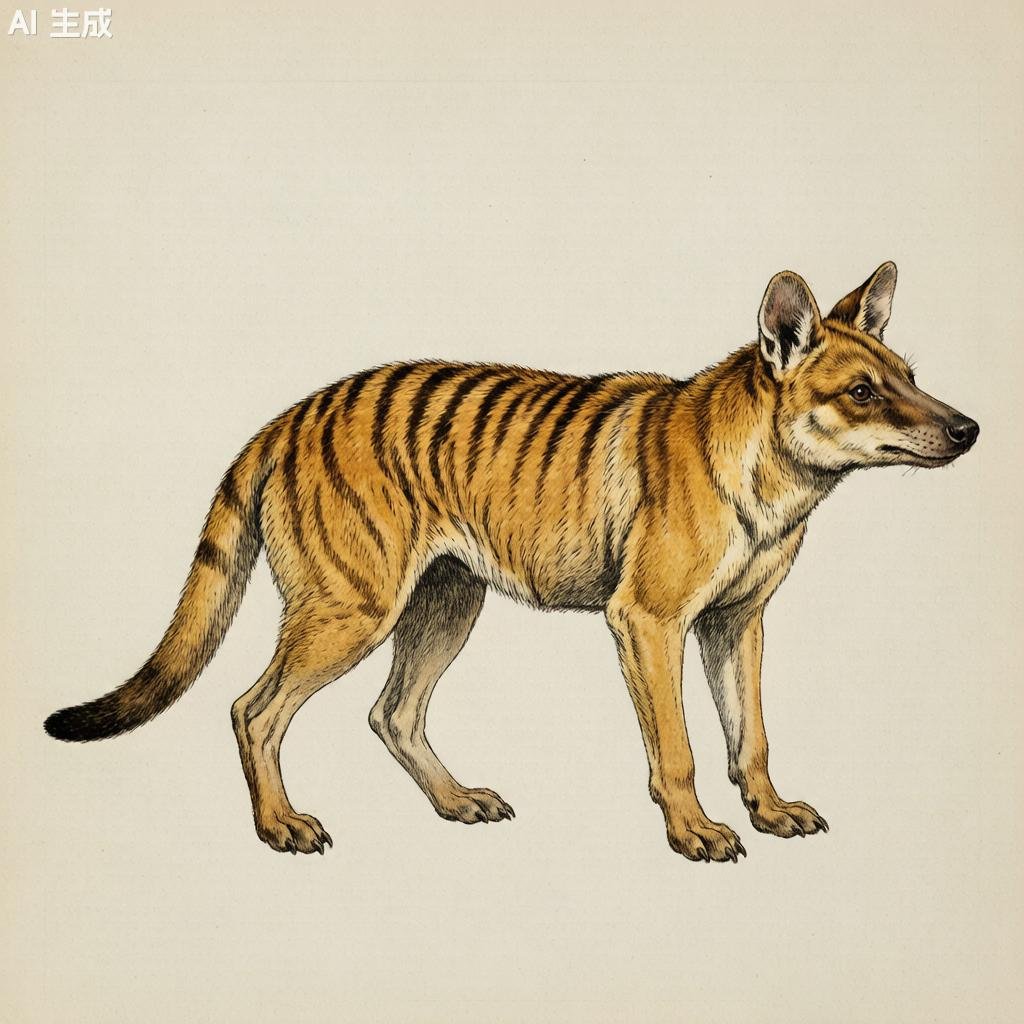
Introduction
The thylacine, commonly known as the Tasmanian tiger or Tasmanian wolf, was the world’s largest marsupial predator and one of the most remarkable examples of convergent evolution in the animal kingdom. Native to Australia, New Guinea, and Tasmania, it died out on the Australian mainland roughly 3,000 years ago, surviving only in Tasmania until the arrival of European settlers. The last known thylacine died in captivity at Hobart’s Beaumaris Zoo on September 7, 1936, one of the most recent and well-documented extinctions of a large mammal species. No confirmed wild sighting has definitively proven the species survived.
Taxonomy
The thylacine belongs to the order Dasyuromorphia, family Thylacinidae, and genus Thylacinus. The species Thylacinus cynocephalus was first formally described by Pieter Boddaert in 1808, its scientific name translating to “dog-headed pouched jaw” in reference to its dog-like head and the marsupial pouch. Thylacinids diverged from other marsupials around 25–30 million years ago, and the family Thylacinidae once contained multiple species. The sole surviving member, T. cynocephalus, was among the last of its kind before human pressures drove the entire family to extinction.
Physical Characteristics
The thylacine resembled a large, short-haired dog with a stiff tail and an unusually stilted gait when running. Its coat was a sandy yellow to deep brown with 13–21 dark stripes across the lower back and rump, inspiring the common name “Tasmanian tiger.” The abdominal pouch was unusual: in both sexes it opened rearward, with the female’s pouch protecting suckling young and the male’s protecting the genitalia during running. Adults measured 100–130 cm in body length with an additional 50–65 cm for the tail, and weighed 15–30 kg.
Habitat
The thylacine ranged across Tasmania, New Guinea, and mainland Australia, inhabiting open grasslands, temperate forests, and arid interior regions. In Tasmania it favored drier open woodlands and grassy plains where prey was abundant, though it also inhabited coastal heath and rocky mountainous terrain. Like the related Tasmanian devil, it used rocky dens and caves for shelter during daylight hours, emerging at dusk and dawn to hunt. The species was primarily nocturnal and crepuscular, avoiding the midday heat while maximizing hunting opportunities during low-light hours.
Diet
The thylacine’s diet centered on medium-sized marsupials including wallabies, possums, and rat kangaroos, supplemented with small mammals, birds, and occasionally insects. It hunted alone or in small family groups, chasing prey until exhaustion rather than relying on a sprint. Unlike the echidna and koala, which shared its range but were not primary prey, the thylacine was an active pursuit predator. Early settler accounts noted its stiff, stilted running style during hunts, a technique that proved less effective against introduced dogs that outpaced it in a straight sprint.
Reproduction
Reproductive biology of the thylacine is poorly documented because the species was already vanishing before detailed study was possible. Based on limited observations, females possessed a rear-opening pouch and carried four to six mammae inside. The gestation period appears to have been approximately 35 days, with females giving birth to one to four young per litter. Young spent several months developing inside the pouch before emerging, and both parents cared for offspring, an unusual trait among marsupial predators. The thylacine’s low reproductive rate made it particularly vulnerable to population decline.
Conservation
The thylacine is listed as Extinct by the IUCN, with its decline driven primarily by direct human persecution. A government bounty system was established in 1830, paying hunters for each thylacine killed and remaining in place until 1909. Additional factors included habitat clearing for agriculture, competition with introduced dogs, and disease outbreaks including canine distemper that devastated populations in the late 1800s. By the time full legal protection arrived in 1936, the species had already been reduced to a tiny, fragmented wild population. The final known individual died in Beaumaris Zoo in September 1936, just two months after protection was granted, in one of history’s most avoidable and tragic extinctions.
Fun Facts
The thylacine was a striking example of convergent evolution: despite being a marsupial, its skull and body shape were nearly identical to those of wolves and dogs, the result of similar selective pressures producing analogous designs across unrelated mammalian lineages. It had the widest gape of any marsupial, capable of opening its jaws to an extraordinary 120 degrees, though evidence suggests it relied more on endurance than bite force to capture prey. Unconfirmed sightings of thylacines in Tasmania and the Australian outback continue to be reported, fueling ongoing searches and occasional expeditions. The species is considered one of the most compelling cases for de-extinction research, with efforts underway to potentially resurrect it using preserved genetic material and advanced cloning technologies.