 By st20113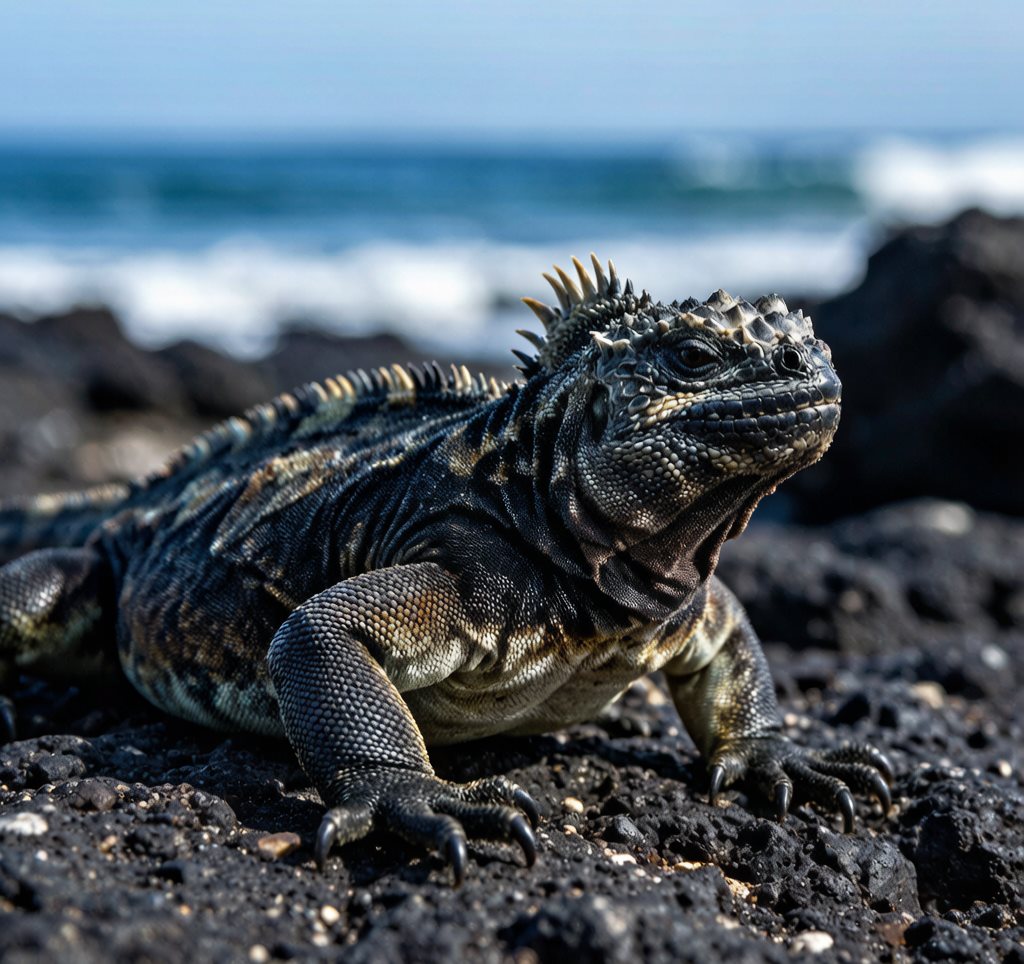
Introduction
The Marine Iguana (Amblyrhynchus cristatus) is the world’s only fully marine lizard, found exclusively on the Galapagos Islands off Ecuador. It forages in the cold Pacific waters surrounding the archipelago, a remarkable adaptation that has fascinated scientists since Charles Darwin first documented it in 1835. Today it stands as a symbol of the Galapagos extraordinary biodiversity and the power of natural selection. The species evolved from a land-dwelling ancestor that arrived on the islands millions of years ago, developing specialized traits to survive an environment no typical lizard could tolerate.
Marine Iguanas are classified into subspecies across different islands, each showing subtle variations in size and coloration reflecting localized adaptation. Conservation efforts are ongoing, as introduced predators such as cats and rats continue to threaten nesting sites on several islands.
Taxonomy
The Marine Iguana was formally described in 1869 by zoologist Albert Gunther, who assigned it the scientific name Amblyrhynchus cristatus. The genus name Amblyrhynchus, derived from Greek, means “blunt snout,” a reference to the animal’s short, blunt-ended muzzle. The species name cristatus means “crested” in Latin, referring to the row of spiny scales along its back and tail. Genetic studies have confirmed that its closest living relative is the Green Iguana (Iguana iguana), from which it diverged approximately 4.5 to 8 million years ago.
The Marine Iguana is the sole member of its genus, making it a taxonomically unique lineage. It illustrates a classic example of adaptive radiation, where a single ancestral species colonized a new environment and diversified to fill a wide range of ecological niches. Within the species, researchers have identified at least seven distinct subspecies, each endemic to a specific island or island group within the Galapagos archipelago.
Physical Characteristics
Adult Marine Iguanas range in length from about 20 centimeters on the smallest islands to over 100 centimeters on Isabela Island, with males growing considerably larger than females. Their coloration is predominantly black or dark gray, a trait that aids thermoregulation by absorbing heat efficiently after emerging from cold ocean waters. During the breeding season, adult males often develop patches of reddish and turquoise coloring along their sides and backs for sexual display. The skin is rough and textured, covered in small, rounded scales that provide protection against abrasion from volcanic rock and ocean currents.
The most distinctive anatomical feature is the flattened tail, which functions as a powerful lateral swimming organ. The claws are notably sharp and recurved, an adaptation for gripping rocky surfaces in strong wave action. The Marine Iguana possesses specialized nasal salt glands capable of excreting highly concentrated salt solution, allowing it to process large amounts of seawater ingested while feeding on marine algae. The teeth are flattened and leaf-shaped, ideal for scraping algae off rock surfaces rather than tearing prey.
Habitat
Marine Iguanas inhabit the rocky coastlines and intertidal zones of the Galapagos Islands, an archipelago of volcanic origin situated approximately 1,000 kilometers off the coast of Ecuador. They are found on virtually every major island, from arid lowlands to higher volcanic slopes, though they are most abundant along rocky shores where platforms extend into the ocean. The islands’ location at the confluence of several ocean currents, including the cold Humboldt Current, creates water temperatures ranging from about 17 to 25 degrees Celsius. To cope with these conditions, Marine Iguanas bask extensively on dark volcanic rock during the day, using solar radiation to raise their body temperature before entering the water to feed.
The terrestrial habitat consists primarily of black volcanic lava fields, coastal cliffs, and rocky beaches. During non-breeding seasons, these lizards form loose aggregations in sun-exposed resting areas, sometimes dozens of individuals piled together to reduce individual heat loss. The Green Sea Turtle shares these coastal waters, and both species bask on the same rocky shorelines after foraging in the cold Pacific.
Diet
The Marine Iguana is primarily an herbivore, feeding almost exclusively on marine algae and seaweed that grow on the rocky ocean floor at depths of up to 10 meters. Individuals typically feed for 10 to 15 minutes per dive before returning to the surface to breathe and bask. Juvenile Marine Iguanas, which are smaller and have less body mass to insulate against heat loss, tend to feed in shallower waters and tidal pools rather than risk deep dives. Competition for the richest foraging sites is significant, with larger males typically claiming access to the most productive feeding territories along the shore.
Climate change and ocean warming pose increasing threats to the Marine Iguana food supply, as rising sea temperatures disrupt the growth patterns of the cold-water algae species on which the species depends. El Nino events have been linked to dramatic population crashes in which adult survival rates drop sharply. The species has developed a metabolic adaptation called “eking,” in which individuals literally shrink their bodies during periods of food scarcity to reduce energy requirements.
Reproduction
Mating season occurs once per year, typically between December and March, coinciding with the onset of the warm season when food is most plentiful. During this period, males become more aggressive and territorial, engaging in head-bobbing displays and outright combat to establish dominance and win mating rights with females. After mating, females travel inland to suitable sandy or volcanic soil substrates, where they excavate burrows in which to lay their eggs. A single clutch typically contains between one and six eggs, buried about 30 to 80 centimeters deep.
The eggs incubate for approximately three to four months, with hatching typically occurring between April and June. Hatchlings are miniature versions of adults, fully independent from the moment they emerge and immediately capable of climbing, feeding, and avoiding predators. Juvenile Marine Iguanas face extremely high mortality rates during their first year of life, with predation by introduced mammals and native birds accounting for the majority of losses. Those that survive can live for many decades, with some individuals known to be over 50 years old.
Conservation
The Marine Iguana is classified as Endangered on the IUCN Red List. The introduction of invasive species to the Galapagos Islands, including cats, dogs, pigs, and rats, has had a devastating impact on Marine Iguana populations. These predators raid nesting sites and consume eggs and hatchlings in large numbers, causing nesting success rates to plummet in areas where they are present. Feral pigs are particularly destructive, rooting up nesting beaches and destroying burrows en masse.
Climate change presents an increasingly serious long-term threat. Rising ocean temperatures disrupt the growth and distribution of the cold-water algae that constitute the Marine Iguana primary food source. Conservation programs on several islands have focused on invasive species eradication and the protection of key nesting habitats. The Galapagos National Park provides a legal framework for the protection of Marine Iguana populations, though enforcement remains challenging given the remote and vast nature of the islands.
Fun Facts
The Marine Iguana holds the unique distinction of being the world only fully marine lizard, a remarkable evolutionary achievement. Its ability to swim in the open ocean and forage on the seafloor is unparalleled among lizards globally. Like the Komodo Dragon, the world largest living lizard, the Marine Iguana demonstrates how island isolation and natural selection can produce extraordinary reptilian adaptations. Marine Iguanas have also developed a mutualistic relationship with certain species of Darwin finches, which perch on the backs of basking iguanas and pick off ectoparasites.
Despite its fearsome reputation and somewhat prehistoric appearance, the Marine Iguana is completely harmless to humans. Charles Darwin famously described it as “hideous-looking,” but modern observers recognize the species unique ecological role and unexpected elegance. Its presence on the Galapagos Islands serves as a powerful reminder of how isolation and natural selection can produce results of extraordinary biodiversity.
on islands such as Fernandina and Isabela. They favor areas with cold, productive waters where the marine iguana also forages along the rocky shoreline. Unlike polar penguins, they seek shade and can pant or