 By st20113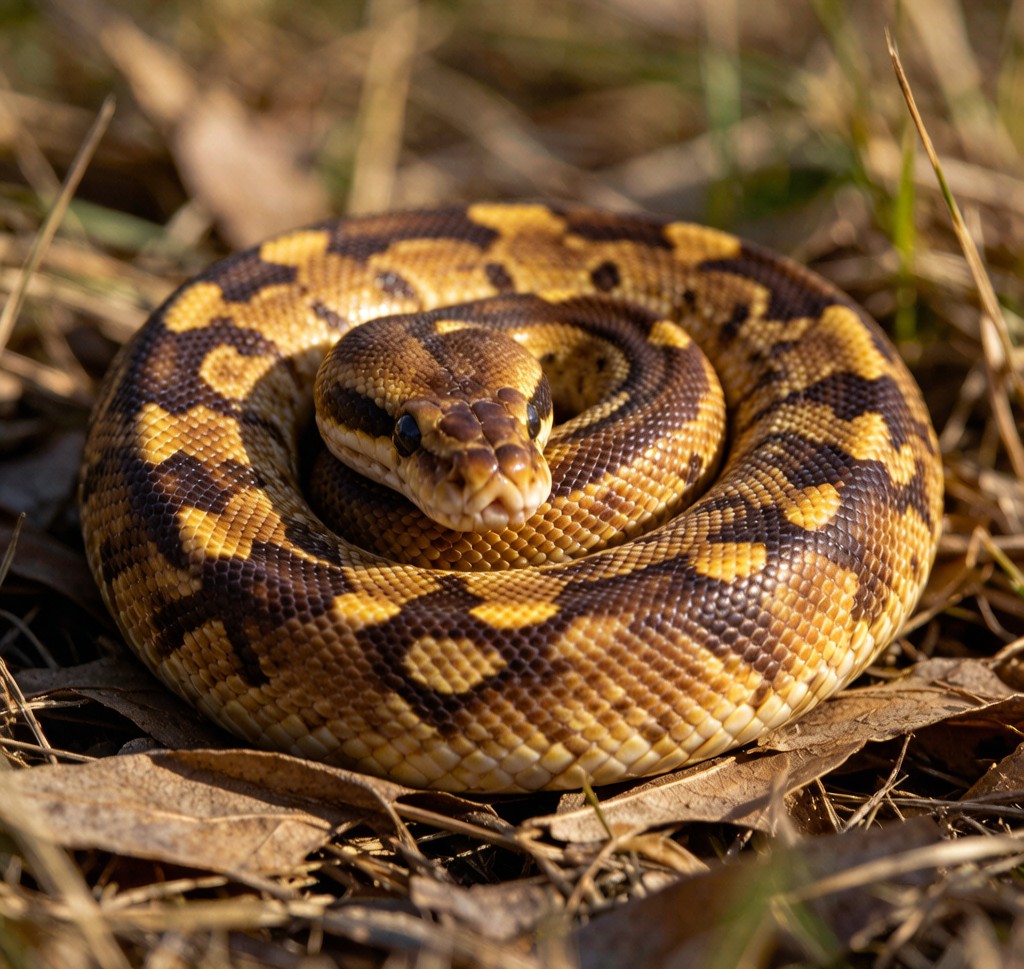
Introduction
The Ball Python (Python regius), also known as the royal python, is a small, docile constrictor native to sub-Saharan Africa and one of the most popular pet snakes in the world. Named for its habit of curling into a tight ball when threatened, it is celebrated for its calm temperament, manageable size, and striking pattern of dark blotches on a tan or brown background.
Reaching only 1 to 1.5 meters in length, the ball python is far smaller than many other constrictors. In the wild it shares African savannas and grasslands with large predators, and its defensive ball posture contrasts with the alert, venomous strike of the rattlesnake found in the Americas, a snake it never actually meets but resembles in its role as a ground-dwelling hunter.
Taxonomy and Classification
The Ball Python belongs to the family Pythonidae, the true pythons, and the genus Python, which includes some of the world’s largest snakes. Its scientific name, Python regius, means royal python, a title possibly earned because African rulers reportedly wore the snakes as living jewelry.
Pythons are non-venomous constrictors, more closely related to boas than to venomous snakes such as vipers. Genetic studies place them among the most ancient lineages of snakes, distinct from the American rattlesnakes and the giant South American constrictors like the green anaconda.
Physical Characteristics
Adult ball pythons typically measure 90 to 150 centimeters and weigh 1 to 2.5 kilograms, with females slightly larger than males. Their heads are small and rounded, marked with a dark line through the eye, and their bodies are stout with smooth scales.
Color varies widely in captivity due to selective breeding, but wild individuals are light brown to golden with dark brown or black blotches and a lighter belly. Heat-sensing pits line the upper lip, helping them locate warm-blooded prey in darkness.
Habitat and Distribution
Ball pythons inhabit grasslands, savannas, and open forests across western and central Africa, from Senegal to Uganda. They are secretive, spending daylight hours in burrows, termite mounds, or rodent holes and emerging at night to hunt.
They tolerate dry conditions better than many pythons but rely on burrows to escape heat. Their range overlaps with agricultural land, where they help control rodent populations that damage crops.
Diet and Behavior
Ball pythons are carnivorous, feeding mainly on small mammals such as African soft-furred rats and gerbils, and occasionally on birds. They are ambush predators, lying in wait near rodent trails and striking with a quick bite before coiling around prey and constricting.
Unlike active foragers, they may fast for long periods, sometimes months, especially during the dry season or in captivity. Their famous defensive behavior is to roll into a ball with the head tucked inside, protecting vulnerable parts rather than biting.
Reproduction and Life Cycle
Ball pythons are oviparous, laying eggs rather than giving live birth. Females lay 4 to 10 leathery eggs in a sheltered burrow and coil around them, twitching their muscles to generate heat and incubate them for about 55 to 60 days.
Hatchlings are 25 to 45 centimeters long and independent immediately. They reach sexual maturity at three to five years and may live 20 to 30 years in captivity, with some individuals exceeding 40 years.
Conservation Status
The Ball Python is listed as Least Concern but faces pressures from the pet trade, which collects hundreds of thousands annually, and from habitat conversion. Sustainable captive breeding has reduced wild collection in recent years.
Conservation efforts focus on regulating trade and protecting savanna habitat. Because it controls rodents, the species provides natural pest management valuable to local farmers.
Fun Facts
The ball python’s royal name may come from its use as adornment by African royalty, who draped the calm snakes around their necks. It is one of the longest-lived snakes kept by humans.
Captive breeding has produced hundreds of color morphs, from albino to piebald, making it a favorite among enthusiasts. In the Americas, its ecological niche as a constricting ground snake is filled by species such as the green anaconda of South American swamps, a far larger relative that also subdues prey by constriction.