 By Iris
Galidia elegans | Ring-tailed Vontsira
Species Profile · Eupleridae
Ring-tailed Vontsira
A Malagasy hunter with a ringed tail, found nowhere else on earth.
Least Concern
Body
Tail
Weight
Young
Active
Rating
An island family of hunters
A tail of dark rings
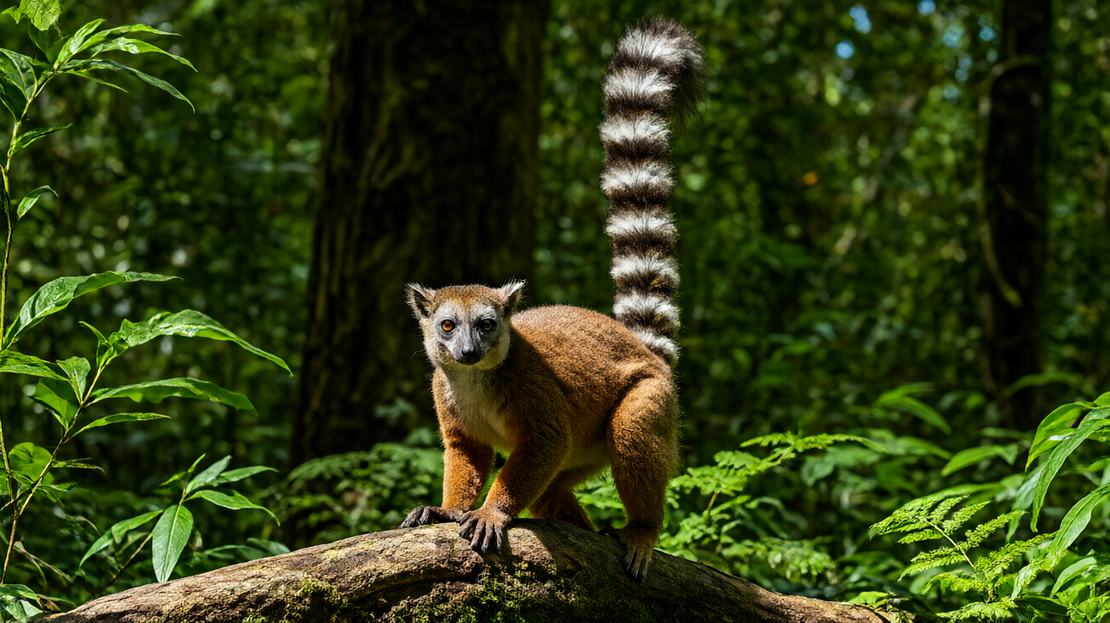
A reddish animal trots along a fallen log with its ringed tail held straight up. It stops, listens, and turns over a heap of wet leaves. Ring-tailed vontsiras live only in the forests of eastern Madagascar. Adults run 32 to 38 cm in the body, and the tail adds another 28 cm.
Weight stays between 700 and 900 g. Short reddish brown fur covers the body, and pale rings band the tail. Those rings give the animal its common name. Feet carry long claws, and the animal uses them to tear open rotten wood.
Most hunting happens in the early morning and again before dusk. The animal lives alone or in pairs, and it keeps to a small home range. Nobody sees one easily, although it passes close to villages. Its family live nowhere else on earth.
Family tree
Eupleridae, the Malagasy carnivores
Eupleridae holds the Malagasy carnivores, and every one of them evolved on the island. A Fossa belongs to the same family, although it hunts far larger prey. Both sit close to the mongooses, and gene work puts the whole group inside a single island radiation. The ancestor arrived once, then split into eight species, and each one took a different role.
This one keeps the name elegans, given for its neat markings. Three subspecies have been named, and each lives in a different part of the island. Fur pattern separates them slightly, and so does size. Skull shape ties the species to the other vontsiras rather than to the mongooses.
That link matters, because the family shows how one arrival can fill every role. Cats and civets later arrived with people, and they now compete for the same food, so the older hunters face new rivals. Names shifted twice, since early workers placed the animal among the civets. Field work now treats the group as a single island family.
An island family of its own
How to tell one
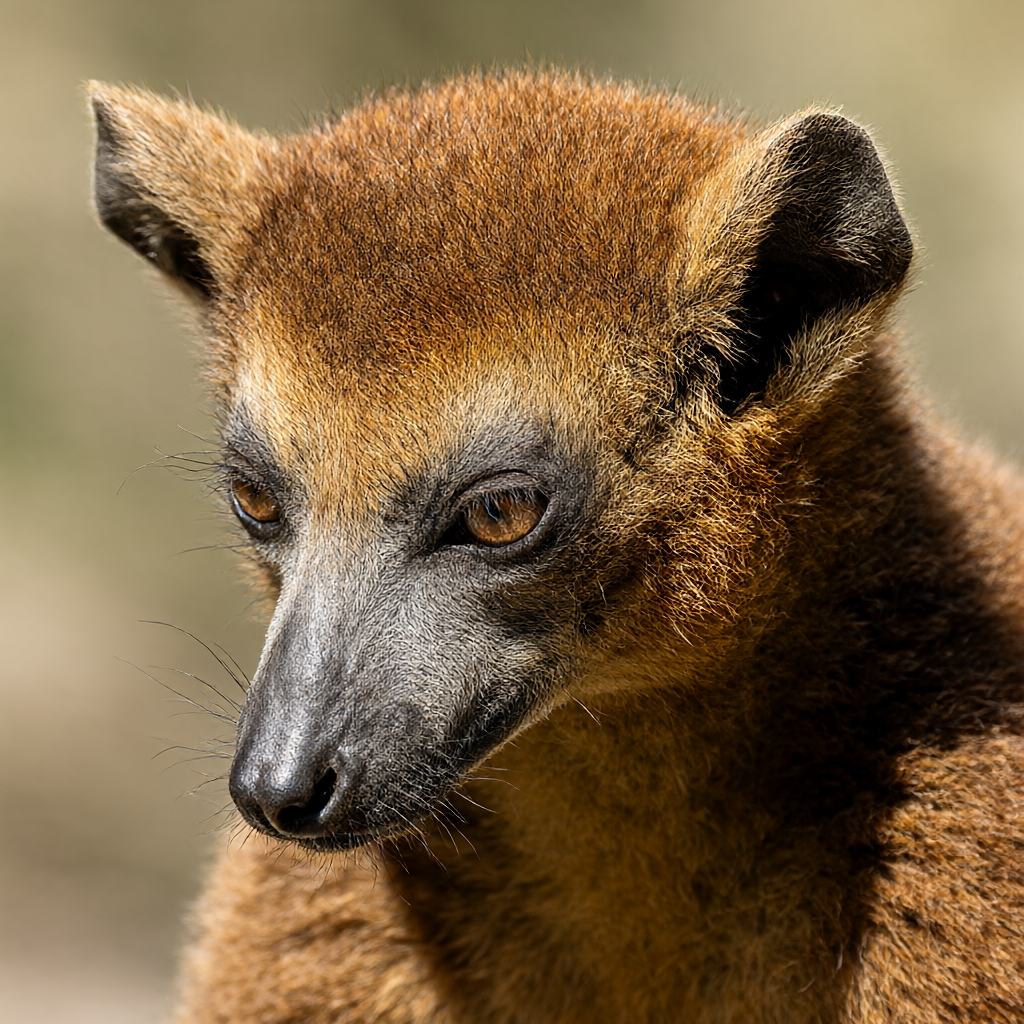
Fur looks short and dense, with a reddish brown back and a paler belly. The tail carries six to eight dark rings and ends in a dark tip. Claws stay long and only partly retract. That suits a digger. Legs stay short.
Bodies stay low to the ground. Ears sit small and rounded. They turn toward small sounds. Eyes carry a reflective layer, which lifts light in dense shade. Teeth stay sharp, and the jaw works with a strong snap.
A scent gland sits near the tail base, and the animal rubs it on logs. Females carry two teats on the belly. Males grow slightly larger than females. Anal glands produce a sharp smell, and the animal uses it to mark paths, which tells neighbours who passed. The tail works as a balance pole when the animal runs along a branch.
1
2
3
Rings, claws and a low body
Where it lives
Eastern rainforest covers a narrow strip along the island, and the animal stays inside it. Dense undergrowth gives cover, and the animal rarely crosses open ground, which keeps one group apart from the next. Streams and rivers cut the forest, and the animal hunts along the banks. Wet leaves hold crabs and frogs, which form much of the prey.
Altitudes run from the coast up to about 2,000 m. Rain falls through the year on the eastern side, although the west stays dry. Forest loss has cut the strip into pieces, and each piece holds fewer animals. Rice fields replace forest in the valleys, although the animal crosses them at night.
Secondary growth holds animals for a while, although it lacks the big trees. Paths along ridges link one patch to another, and animals use those links. A cleared valley can cut a group off for decades. Volcanic soil supports dense forest where it stays protected.
Eastern rainforest and streams
What it eats
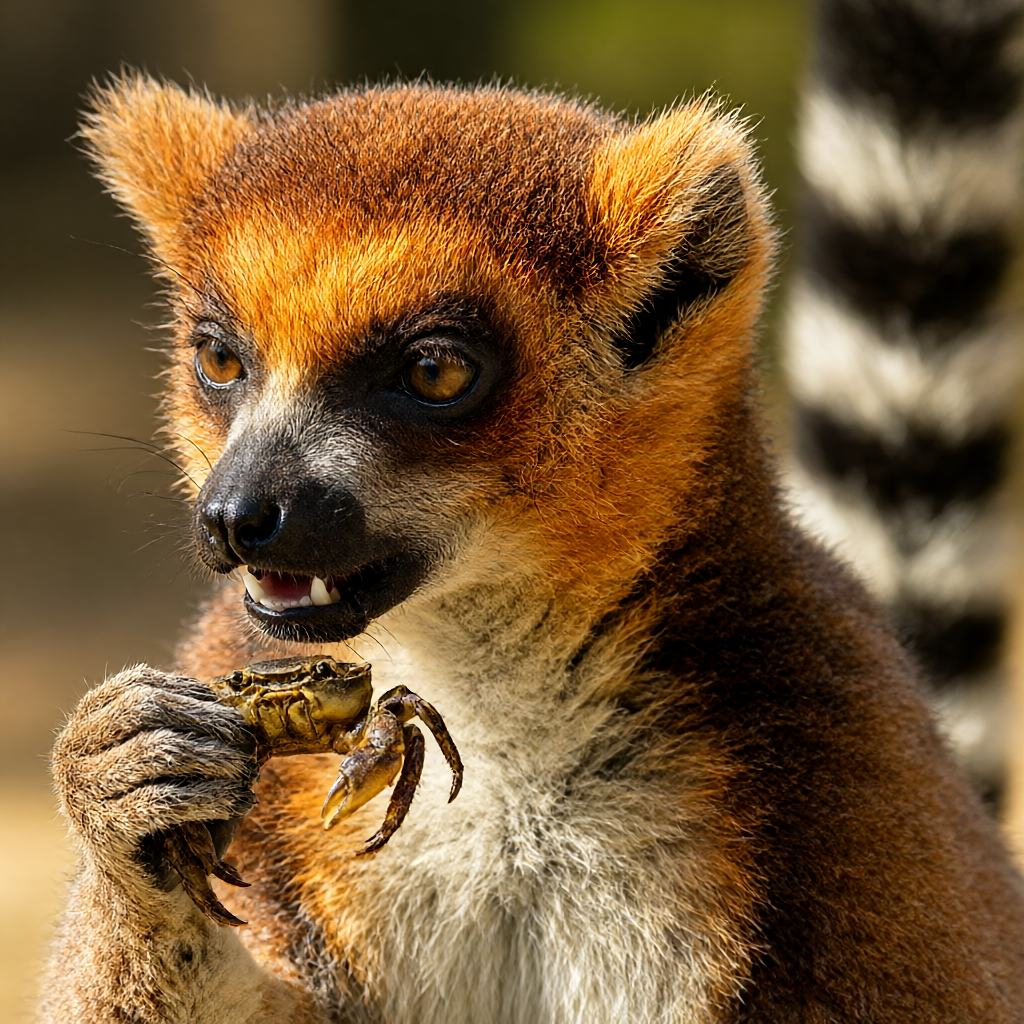
Crabs form a large share of the diet, especially along streams. Insects come next, and beetles and larvae rank high. Small vertebrates also get taken, although frogs and mice make up most of them. Eggs and nestlings fill the rest. Feeding happens in short bursts through the morning and the evening.
The animal turns over leaves and tears open rotten wood with its claws. Prey gets held down with a front paw, then bitten. Water comes from streams. Wet prey carries little. Hunting stops in the heat of the day, so the animal then rests.
A pair may hunt together, although each animal takes its own prey. Food runs short in the dry season, and the animal then widens its search. Young animals learn by following adults, since watching a catch teaches more than trying alone.
Crabs, insects and small prey
The breeding cycle
Pairs stay together through the year, which is unusual for the family. A female gives birth after a pregnancy of about three months. One young is usual, and twins stay rare. The newborn stays in a den of leaves and roots for the first weeks.
Both parents bring food to the den. Young animals start hunting at about three months. Independence comes at around six months, when the young animal leaves. Males may help raise the young, although the evidence stays thin.
Females breed once a year at most, since many lose the whole litter. Captive animals have lived past twenty years, so the animal can take its time. Nobody knows how long a wild one survives. One young a year cannot replace heavy losses.
Least Concern, and still hunted
Conservation
IUCN lists the species as Least Concern. Numbers fall across the eastern forests, since the habitat keeps shrinking. Slash and burn farming removes forest every year, since the soil loses its strength within a few seasons. Hunting takes animals for meat, and free running dogs kill them on the trails, which no patrol can guard.
Alien cats and civets compete for the same prey, although nobody has measured the loss. Protected areas cover part of the range, yet many animals live outside them. Forest corridors matter most, since cut off groups lose variety fast. Local taboos protect the animal in a few districts.
Ecotourism now pays guides who keep visitors on the trails. Research has grown, and camera traps confirm animals in logged forest. Long term survival depends on the eastern strip staying connected, since the animal cannot cross open ground. A single road can split a group in two for good, since the animal will not cross bare ground.
Side by side
How It Compares
| Trait | Ring-tailed Vontsira | Fossa |
|---|---|---|
| Length | 32 to 38 cm body, 28 cm tail | 70 to 80 cm body |
| Weight | 700 to 900 g | 5.5 to 8.6 kg |
| Home | forest and marsh up to 2,000 m | forest across Madagascar |
| Diet | rodents, frogs, fish and eggs | lemurs and small mammals |
| Habit | hunts along streams and in trees | hunts alone on the ground and in trees |
| Rating | Least Concern | Vulnerable |
Common misreadings
What People Get Wrong
- Most people mistake it for a small fossa, although the banded tail gives it away.
- Popular accounts place it with civets, yet the animal belongs to a Madagascar family.
- Some guides say it stays on the ground, though it climbs trees to raid nests.
Going further
Sources and Further Reading
Quick hits
Five things to remember
- The tail carries six to eight dark rings.
- Crabs form a large share of the diet.
- Every Malagasy carnivore came from one ancestor.
- The animal is active in the morning and the evening.
- A pair often stays together through the year.